THE MICHIGAN SELLER’S CLOSING STATEMENT — BEFORE THE CLOSING STATEMENT
We’ll start with a hypothetical sale price.
Then we’ll work backward.
$400,000 sale price
↓
Mortgage payoff, if any
↓
Brokerage/listing costs
↓
Buyer-broker compensation, if agreed
↓
Seller concessions, if negotiated
↓
Michigan transfer taxes, unless exempt
↓
Title/closing and transaction-specific costs
↓
Repairs and preparation
↓
Moving and seller-selected expenses
↓
ESTIMATED NET PROCEEDS
By the end, you’ll understand why asking:
“What does it cost to sell a house in Michigan?”
is really asking several different questions.
START WITH THE NUMBER EVERYONE SEES: THE SALE PRICE
Let’s imagine three hypothetical Michigan homes.
| Property | Sale Price |
|---|
| Home A | $250,000 |
| Home B | $400,000 |
| Home C | $700,000 |
It is tempting to think of those numbers as what the seller “gets.”
But the sale price is better understood as the top line.
Net proceeds are farther down.
Think about selling a home almost like reading a business income statement:
SALE PRICE
− SELLING COSTS
− DEBT/PAYOFFS
± TRANSACTION ADJUSTMENTS
= NET PROCEEDS
And the largest subtraction for one seller may not be the largest for another.
COST #1: YOUR MORTGAGE PAYOFF IS NOT REALLY A “SELLING FEE”
Suppose our $400,000 homeowner still owes $180,000 on the mortgage.
That amount may need to be satisfied as part of the sale.
So:
$400,000 sale price
minus
$180,000 hypothetical mortgage payoff
leaves:
$220,000 before the other transaction costs
But here’s an important distinction.
The $180,000 isn’t the cost of selling the home in the same sense as a brokerage fee or transfer tax.
It’s debt secured by the property.
That’s why two neighbors can sell nearly identical houses for $400,000 and walk away with dramatically different amounts.
Seller A may owe:
$50,000
Seller B may owe:
$300,000
Same selling price.
Very different net proceeds.
Don’t use your mortgage app balance as the final payoff number
A mortgage payoff can differ from the balance shown on a monthly statement because payoff calculations may include accrued interest and other applicable amounts through the payoff date.
Your lender or servicer can provide the actual payoff information needed for closing.
For planning purposes, however, your approximate mortgage balance gives you a useful starting point.
COST #2: HOW YOU CHOOSE TO SELL THE HOME
Now we reach one of the biggest variables.
There is no single legally mandated real estate commission.
Broker compensation is negotiable. Current NAR policy specifically states that broker fees and compensation are not set by law and are fully negotiable.
That means an article claiming:
“It costs exactly X% to sell a Michigan home”
would be oversimplifying the transaction.
Different sellers may choose different service models.
For example:
MODEL A — Traditional full-service brokerage
The seller negotiates services and compensation with the listing brokerage.
MODEL B — Flat-fee brokerage / Flat Fee MLS
The seller pays an agreed flat listing fee and generally takes on more responsibility depending on the particular service.
MODEL C — Other negotiated service arrangements
Brokerages may offer different structures depending on the company and agreement.
The important point is:
The listing model is a variable—not a fixed tax on the transaction.
If you’re unfamiliar with what happens behind a flat-fee listing, start with our new guide:
What Does a Flat Fee Broker Actually Do in Michigan?
It follows a Michigan seller from listing preparation through MLS exposure, showings, offers and closing.
THE COMMISSION MATH PEOPLE OFTEN GET WRONG
Suppose someone tells a homeowner:
“It’s only a 1% difference.”
One percent doesn’t sound particularly large.
Until you apply it to a home.
| Sale Price | 1% |
|---|
| $250,000 | $2,500 |
| $400,000 | $4,000 |
| $700,000 | $7,000 |
Now imagine a difference of two percentage points.
| Sale Price | 2% |
|---|
| $250,000 | $5,000 |
| $400,000 | $8,000 |
| $700,000 | $14,000 |
This isn’t an argument for or against any particular brokerage model.
It’s an argument for doing the math.
A seller should understand both:
What am I paying?
and
What am I receiving for that amount?
The lowest fee isn’t automatically the best service.
The highest fee isn’t automatically the best service either.
The meaningful comparison is:
SERVICE + RESPONSIBILITY + EXPOSURE + SUPPORT + TOTAL COST
That’s also why we created our Complete Guide to Choosing a Flat Fee Broker in Michigan.
COST #3: WHAT ABOUT THE BUYER’S AGENT?
This is one of the areas where older home-selling articles can now create confusion.
Under current NAR MLS rules, offers of compensation to buyer brokers cannot be made on an MLS.
That does not mean buyer-broker compensation disappeared.
And it does not mean there is a universal amount sellers must pay.
Broker compensation remains negotiable.
Depending on the transaction and agreements involved, a buyer may request that the seller contribute toward buyer-broker compensation as part of an offer.
For our cost calculator, therefore, we shouldn’t automatically write:
Buyer agent = X%
Instead write:
Negotiated buyer-broker compensation, if applicable = $_____
That’s much more accurate.
COST #4: SELLER CONCESSIONS
Now imagine a buyer offers Sarah the full $400,000.
But the offer also asks the seller to contribute $8,000 toward allowable buyer costs.
Is the house selling for $400,000?
Yes.
Does that mean the seller’s economics are identical to a $400,000 offer without that concession?
No.
That’s why experienced sellers look beyond the headline price.
Consider:
OFFER A
$400,000
No hypothetical seller concession.
OFFER B
$405,000
$10,000 hypothetical seller concession.
Ignoring all other differences, which produces more for the seller?
Offer A:
$400,000
Offer B:
$405,000 − $10,000 = $395,000
The higher offer price does not necessarily create the higher seller proceeds.
Of course, real offers can contain many other important differences, including financing, contingencies, timing and other terms.
The lesson is simply:
Compare the economics of the complete offer—not just the number at the top.
COST #5: MICHIGAN REAL ESTATE TRANSFER TAX
Now we reach a cost that is distinctly Michigan-specific.
Michigan generally imposes both a state real estate transfer tax and a county real estate transfer tax on taxable transfers.
The commonly applicable rates are:
State: $7.50 per $1,000
County: $1.10 per $1,000
or a combined:
$8.60 per $1,000
Michigan county sources confirm these rates, and the tax is generally imposed on the seller/grantor unless an exemption applies.
Michigan Treasury also confirms that the seller or grantor is liable for the State Real Estate Transfer Tax under the SRETT Act.
So what does that look like?
| Hypothetical Sale Price | Approx. State Tax | Approx. County Tax | Approx. Combined |
|---|
| $250,000 | $1,875 | $275 | $2,150 |
| $400,000 | $3,000 | $440 | $3,440 |
| $700,000 | $5,250 | $770 | $6,020 |
These examples assume a taxable transfer at the standard rates and convenient exact-thousand sale prices. Michigan’s statutory calculation actually applies per $500 or fraction thereof, so sellers should use the applicable calculation for their transaction rather than treating this table as a closing quote.
That’s a real Michigan selling cost worth planning for.
But there’s another important part.
YOU MAY QUALIFY FOR A TRANSFER-TAX EXEMPTION
Don’t automatically assume every transaction owes the amount in the table.
Michigan law provides exemptions from State Real Estate Transfer Tax for qualifying transfers.
One exemption can apply in certain circumstances involving a property for which the seller claimed a Principal Residence Exemption and where other statutory requirements are satisfied, including requirements involving the property’s state equalized value and an arm’s-length transaction.
This is precisely the kind of issue where sellers should avoid diagnosing eligibility from a blog article.
If you believe your transaction qualifies for an exemption, verify it with the appropriate closing, legal or tax professional and current Michigan requirements.
COST #6: TITLE AND CLOSING COSTS
This is where a national “average closing cost” article becomes less useful.
Transactions differ.
Depending on the deal and local practice, seller-side costs may involve items associated with:
- title work
- title insurance
- recording/document preparation
- closing/settlement services
- lien or payoff processing
- prorations
- municipal or property-related charges
- other transaction-specific services
Who pays a particular expense can also depend on the purchase agreement and local practices.
That’s why I don’t recommend planning your Michigan home sale by saying:
“Closing costs are always X%.”
Instead, ask the title/closing provider for an estimated seller closing statement once the transaction details are known.
That turns vague percentages into actual line items.
COST #7: PROPERTY TAXES AND PRORATIONS
Property taxes deserve their own category because they’re easy to confuse with transfer taxes.
They are not the same thing.
Michigan’s property-tax system has specific rules around ownership changes. Treasury explains that a transfer of ownership can cause the property’s taxable value to “uncap” in the calendar year following the transfer, unless an exemption from transfer-of-ownership treatment applies.
The seller’s closing statement may also reflect property-tax prorations or other adjustments depending on the transaction.
The key point for our seller-cost framework is:
Transfer tax and property tax are separate concepts.
Don’t combine them into one generic “Michigan tax” estimate.
COST #8: THE MONEY YOU SPEND BEFORE THE HOUSE IS EVEN LISTED
Here’s the category that many seller-cost calculators ignore.
Suppose you spend:
$450 on cleaning.
$1,800 painting.
$700 landscaping.
$350 on minor repairs.
$500 on photography or other marketing services you independently choose.
That’s:
$3,800
The closing statement may never call that a “seller closing cost.”
Your bank account certainly will.
So when we’re asking:
How much does it really cost to sell a house in Michigan?
we need two categories:
TRANSACTION COSTS
Expenses connected directly with the transaction.
and
SELLING COSTS
Money you spend because you’ve decided to sell.
Those aren’t always identical.
THE $15,000 KITCHEN QUESTION
Suppose your kitchen is dated.
Someone tells you:
“You need to remodel before selling.”
Estimated cost:
$15,000.
Should you do it?
This article cannot answer that from a distance.
The relevant question isn’t:
Will a new kitchen make the house nicer?
Probably.
The financial question is:
Is the likely impact on sale outcome worth the $15,000, time, disruption and risk?
Sometimes preparation makes sense.
Sometimes cleaning, decluttering and targeted repairs may make more sense.
Sometimes the property should be marketed largely as it stands.
Not every pre-sale dollar automatically comes back at closing.
That’s why sellers should distinguish between:
necessary
helpful
and
optional
expenses.
COST #9: INSPECTION-RELATED NEGOTIATIONS
Now the house is under contract.
The buyer completes whatever inspections are permitted under the purchase agreement.
Issues emerge.
Maybe the buyer asks for:
$3,000 of repairs
or
a $3,000 concession
or
a price adjustment
or another negotiated resolution.
That’s not necessarily a predictable upfront selling cost.
But it can change the seller’s final economics.
So our net sheet needs another line:
Post-contract negotiated adjustments: $_____
You may enter zero.
Or you may not.
The important thing is to leave room for uncertainty.
COST #10: MOVING IS PART OF THE REAL-WORLD EQUATION
Technically, your moving truck isn’t a brokerage cost.
But if we’re asking what selling the house really costs the household, ignoring the move would be strange.
Depending on the seller, this could include:
- Movers
- Truck rental
- Packing materials
- Storage
- Temporary accommodation
- Cleaning
- Utility transitions
- Travel
- Pet arrangements
- Other relocation expenses
These don’t reduce the contract price.
They reduce the money left in your pocket after the life event is finished.
NOW LET’S BUILD THE $400,000 SELLER’S NET SHEET
Here’s our hypothetical transaction.
This is illustrative only—not an estimate of what any particular Michigan seller will pay.
SALE
Sale price: $400,000
Now imagine:
| Item | Hypothetical Amount |
|---|
| Sale price | $400,000 |
| Mortgage payoff | − $180,000 |
| Listing/brokerage cost | − $395 |
| Negotiated buyer-broker amount | − $8,000 |
| Seller concession | − $5,000 |
| Michigan state + county transfer tax | − $3,440 |
| Hypothetical title/closing-related costs | − $2,000 |
| Pre-sale preparation | − $3,500 |
| Inspection-related adjustment | − $2,500 |
| Moving costs | − $2,500 |
| Illustrative remaining amount | $192,665 |
Before anyone screenshots that number:
THIS IS NOT A PREDICTION.
We’ve deliberately invented many of the assumptions.
The $395 listing cost in this particular illustration corresponds to Reozom’s currently published Michigan flat listing fee; the other variable amounts are hypothetical. Sellers should verify current Reozom pricing and terms on the Michigan Flat Fee MLS page.
The point isn’t that a $400,000 seller receives $192,665.
The point is:
The sale price alone tells you almost nothing about the seller’s final proceeds.
Change the mortgage balance and the answer changes dramatically.
Change the negotiated compensation and it changes.
Change concessions.
Change preparation.
Change the listing model.
Change inspection negotiations.
Every line matters.
NOW REMOVE THE MORTGAGE FROM THE EQUATION
This gives us a better way to compare the cost of selling itself.
Let’s use the same hypothetical $400,000 transaction but ignore the mortgage payoff.
Our illustrative seller expenses were:
$395 listing cost
$8,000 negotiated buyer-broker amount
$5,000 seller concession
$3,440 transfer taxes
$2,000 hypothetical closing/title expenses
$3,500 preparation
$2,500 inspection-related adjustment
$2,500 moving
Total hypothetical outflow:
$27,335
Now we can ask much more useful questions.
Which expenses were mandatory?
Which were negotiated?
Which were optional?
Which depended on the selling model?
Which could not have been known in advance?
That’s how sellers should analyze costs.
WHAT CHANGES WITH A FLAT FEE BROKER?
Let’s isolate one variable.
Imagine two hypothetical sellers with otherwise identical transactions.
The only thing we’re changing is the listing-side brokerage arrangement.
SELLER A
Negotiated listing-side brokerage compensation:
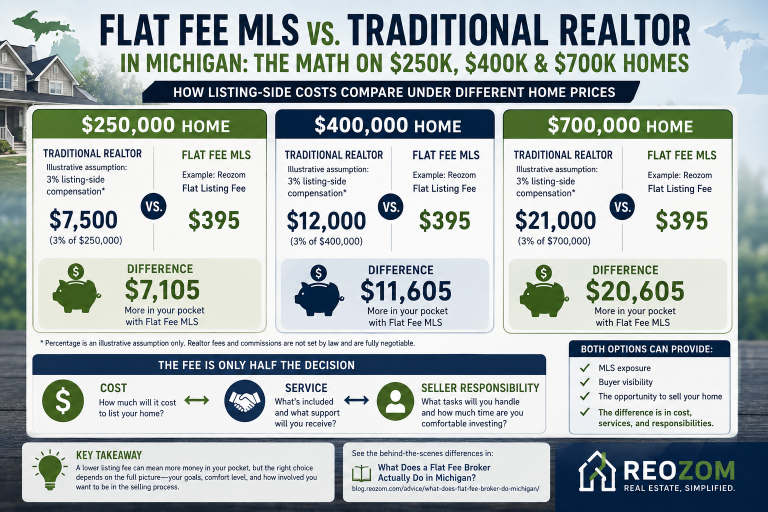
$12,000
SELLER B
Hypothetical flat listing fee:
$395
Difference:
$11,605
But stop there.
This is where a lot of Flat Fee MLS marketing becomes too simplistic.
That $11,605 is not automatically “savings.”
Why?
Because the services and seller responsibilities may be different.
Seller B may be taking responsibility for tasks Seller A’s brokerage performs.
That’s why the correct question isn’t:
Which number is smaller?
Obviously $395 is smaller.
The correct question is:
What services am I receiving, what responsibilities am I assuming, and what is that difference worth to me?
Our behind-the-scenes Flat Fee Broker guide explains exactly what sellers should understand before making that comparison.
THE $250K / $400K / $700K MICHIGAN SELLER TEST
Now let’s see how some costs behave as the home price changes.
$250,000 HOME
Michigan transfer tax at the standard combined rate:
approximately $2,150
One percentage point of sale price:
$2,500
$400,000 HOME
Transfer tax:
approximately $3,440
One percentage point:
$4,000
$700,000 HOME
Transfer tax:
approximately $6,020
One percentage point:
$7,000
Notice something?
Some expenses scale directly with price.
Others don’t.
A $395 flat listing fee remains $395 under the assumed pricing structure.
A percentage-based amount grows as the price grows.
Moving expenses don’t necessarily double because the home’s price doubles.
Painting doesn’t necessarily scale with sale price.
Mortgage balance has almost no predictable relationship with the sale price.
That’s why a simple universal:
“Selling costs X%”
can obscure what’s actually happening.
BUILD YOUR OWN MICHIGAN SELLER NET SHEET
Before listing, create this worksheet.
STEP 1 — EXPECTED SALE PRICE
$____________
STEP 2 — ESTIMATED MORTGAGE PAYOFF
− $____________
STEP 3 — LISTING/BROKERAGE COST
− $____________
STEP 4 — POSSIBLE BUYER-BROKER COMPENSATION
− $____________
STEP 5 — POSSIBLE SELLER CONCESSIONS
− $____________
STEP 6 — ESTIMATED MICHIGAN TRANSFER TAX
− $____________
STEP 7 — TITLE/CLOSING ESTIMATE
− $____________
STEP 8 — PROPERTY PREPARATION
− $____________
STEP 9 — CONTINGENCY/REPAIR RESERVE
− $____________
STEP 10 — MOVING/RELOCATION
− $____________
ESTIMATED NET
$____________
Now create three versions.
CONSERVATIVE
Assume higher expenses and a lower acceptable sale result.
EXPECTED
Use what you currently consider reasonable assumptions.
OPTIMISTIC
Use a stronger sale result and fewer unexpected expenses.
Now you’re not relying on one magical number.
You’re planning a range.
THE NUMBER SELLERS SHOULD COMPARE ISN’T COMMISSION
Here’s perhaps the most important idea in this article.
Imagine Seller A says:
“I paid less commission.”
Seller B says:
“I sold for more.”
Seller C says:
“I spent less preparing the property.”
Seller D says:
“I negotiated fewer concessions.”
Which seller did best?
We don’t know.
The meaningful number is closer to:
NET RESULT
not one isolated expense.
A low brokerage fee can be financially attractive.
So can a stronger sale outcome.
So can avoiding unnecessary renovations.
So can negotiating better terms.
The seller’s job is to understand the whole equation.
A BETTER WAY TO COMPARE SELLING OPTIONS
When comparing a traditional brokerage arrangement with a Michigan Flat Fee MLS model, create two columns.
| Question | Option A | Option B |
|---|
| Listing-side cost | $_____ | $_____ |
| MLS exposure | _____ | _____ |
| Photos | _____ | _____ |
| Listing changes | _____ | _____ |
| Showing management | _____ | _____ |
| Offer workflow | _____ | _____ |
| Transaction support | _____ | _____ |
| Seller responsibilities | _____ | _____ |
| Additional fees | $_____ | $_____ |
| Closing-related brokerage fee | $_____ | $_____ |
Now you’re comparing something meaningful.
Not:
CHEAP vs. EXPENSIVE
but:
SERVICE MODEL A vs. SERVICE MODEL B
If you’re at this stage, use our Complete Guide to Choosing a Flat Fee Broker in Michigan before making the decision.
FIVE COSTS SELLERS OFTEN FORGET
Before we finish, here are five categories worth putting on your planning sheet even if they eventually equal zero.
1. PREPARATION
Cleaning, repairs, landscaping, painting and photography.
2. CONCESSIONS
A strong headline offer can still contain seller-paid amounts.
3. TRANSFER TAX
Michigan’s state and county real estate transfer taxes can represent thousands of dollars on a typical transaction unless an exemption applies.
4. POST-INSPECTION NEGOTIATIONS
The agreement you sign on Day 1 may not necessarily represent the final economics after contractual contingencies play out.
5. MOVING
The transaction may be complete when the deed transfers.
Your household’s expenses aren’t necessarily finished.
Frequently Asked Questions
How much does it cost to sell a house in Michigan?
There is no universal percentage. Seller expenses can include negotiated brokerage compensation, Michigan transfer taxes, title/closing expenses, concessions, preparation, transaction adjustments and moving costs. Mortgage payoff also affects net proceeds but is better treated separately from the actual cost of selling.
What are Michigan’s real estate transfer tax rates?
For many taxable transfers, the state rate is $7.50 per $1,000 and the county rate is $1.10 per $1,000, for a combined standard rate of $8.60 per $1,000. The statutory calculation is applied per $500 or fraction thereof, and exemptions can apply.
Who normally pays Michigan real estate transfer tax?
Michigan law generally places State Real Estate Transfer Tax liability on the seller or grantor, subject to applicable exemptions. County sources likewise describe the seller/grantor as the taxpayer for the county transfer tax.
Is real estate commission fixed in Michigan?
No. Broker compensation is negotiable and is not set by law.
Does a Michigan seller have to pay the buyer’s agent?
There is no universal fixed buyer-agent percentage that every seller must pay. Broker compensation is negotiable, and current MLS rules prohibit offers of buyer-broker compensation from being communicated through the MLS. The particular transaction and agreements determine what applies.
Is my mortgage payoff a closing cost?
It can appear as a major deduction in the seller’s closing/net-proceeds calculation, but conceptually it is repayment of existing secured debt rather than a fee caused by selling the property.
Can I avoid Michigan transfer tax?
Certain transactions qualify for statutory exemptions. Michigan Treasury provides guidance on SRETT exemptions, including a specific exemption that can apply to some principal-residence transactions when all statutory requirements are satisfied. Sellers should verify eligibility rather than assuming an exemption applies.
Does Flat Fee MLS eliminate all selling costs?
No. A flat listing arrangement changes one part of the cost structure. Transfer taxes, negotiated buyer-side compensation, concessions, title/closing costs, preparation, repairs and other expenses may still apply depending on the transaction.
How can I estimate what I’ll actually receive at closing?
Start with expected sale proceeds, subtract your estimated mortgage payoff and transaction expenses, and then obtain an estimated seller closing statement from the appropriate professionals once you have actual transaction terms.
THE $400,000 QUESTION HAS A BETTER ANSWER NOW
Remember our homeowner?
They sold for:
$400,000
At the beginning, they asked:
“How much money do I get?”
Now we know why nobody can responsibly answer that from the sale price alone.
We need to know:
What’s the mortgage payoff?
What brokerage arrangement did you choose?
What compensation did you negotiate?
Are there concessions?
What transfer taxes apply?
What are the title and closing expenses?
What did you spend preparing the home?
Did inspection negotiations change anything?
What will moving cost?
Only then does the $400,000 begin turning into a meaningful number.
And that leads to a much better question for every Michigan homeowner considering a sale:
“After every cost and obligation—not just the obvious ones—what is my estimated net?”
Because your home’s selling price makes the headline.
Your net proceeds determine the financial outcome.
Recommended Related Reading
What Does a Flat Fee Broker Actually Do in Michigan? — Follow the Flat Fee MLS process from listing preparation through closing.
Complete Guide to Choosing a Flat Fee Broker in Michigan — Compare service models, fees, support and seller responsibilities.
Michigan Flat Fee MLS — Explore Reozom’s current Michigan listing service.
For Sale By Owner Resources — Learn more about taking an active role in the home-selling process.