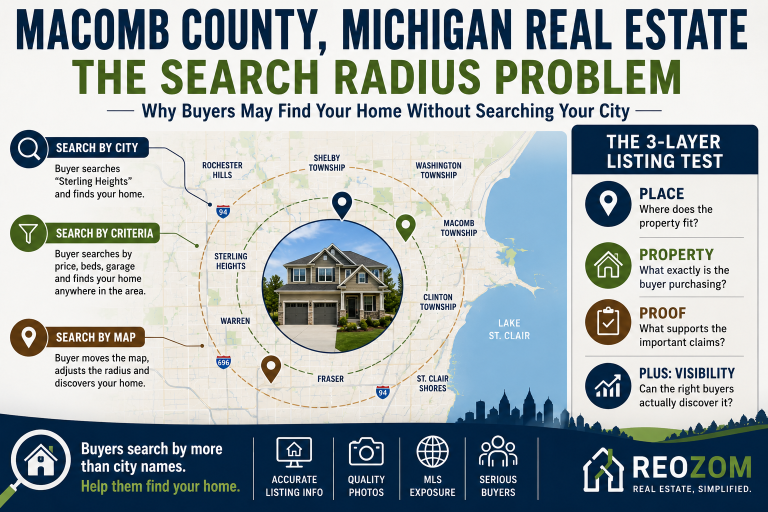
LAYER ONE: PLACE
Don’t Sell Manistee Without Explaining Where the Home Fits
Location matters in real estate.
But location context and tourism marketing are not the same thing.
Imagine this listing description:
Beautiful home in breathtaking Manistee County, close to Lake Michigan, beaches, rivers, trails, restaurants and year-round recreation.
It sounds pleasant.
But imagine you’re the buyer.
You still don’t really know:
- Where the property sits
- What is actually nearby
- Which features belong to the property
- Which attractions require driving
- Whether the home is in town, rural or closer to the waterfront
- How the property relates to everyday services
That’s the difference between destination marketing and property context.
The Manistee Destination Effect
Manistee County has legitimate destination appeal.
The City of Manistee Riverwalk follows the Manistee River through the downtown area and provides a connection between the riverfront, shopping district and the broader Lake Michigan setting.
Nearby Orchard Beach State Park sits on a bluff overlooking Lake Michigan just north of the city and provides trails and recreational opportunities.
The broader county also offers extensive river, forest and outdoor recreation.
All of that can be useful context.
But the listing should not become:
Visit Manistee County!
It should remain:
Consider this property in Manistee County.
That distinction matters.
The PLACE Test
Before publishing a listing, ask five questions:
- Could someone unfamiliar with Manistee County understand approximately where this property fits?
- Am I clearly separating the property from nearby attractions?
- Am I using factual location information rather than vague phrases such as “close to everything”?
- Have I avoided presenting estimated drive times as guarantees?
- Does the location information help buyers understand everyday living—not just vacation activities?
If the answer to all five is yes, Layer One is doing its job.
PLACE ≠ PROPERTY
This sounds obvious.
Yet property descriptions blur the two constantly.
Consider this sentence:
Enjoy Lake Michigan sunsets, boating, trails and incredible outdoor recreation from this wonderful Manistee home.
Now imagine the house is several miles from Lake Michigan.
The wording may make the relationship between the home and those amenities sound more direct than it really is.
A more precise version might be:
Located within the broader Manistee County area, where residents have access to Lake Michigan, riverfront recreation, trails and other regional amenities.
Less dramatic?
Yes.
More precise?
Also yes.
And precision builds trust.
LAYER TWO: PROPERTY
The Buyer Isn’t Purchasing Manistee County
They’re purchasing an address.
This is where the listing needs to shift from regional storytelling to property intelligence.
Let’s take a hypothetical Manistee County home.
Suppose it has:
- Three bedrooms
- Two bathrooms
- Attached garage
- Full basement
- Rear deck
- Mature trees
- Updated furnace
- Replacement roof
- Storage shed
- Larger lot
Which of these details belong in the listing?
Potentially all of them—if they are accurate and relevant.
Now compare two descriptions.
Version A
Gorgeous Manistee home in an amazing location near everything Northern Michigan has to offer. Spacious, charming and ready for its new owners!
Now Version B:
Three-bedroom, two-bath home with attached garage, full basement, rear deck and separate storage shed. Recent documented improvements include [accurate improvement and year]. Mature landscaping and outdoor space add additional functionality to the property.
Version B isn’t trying nearly as hard to sound exciting.
And yet it tells the serious buyer dramatically more.
The 5-Minute Property Inventory
Before writing the listing description, walk through the property without trying to write marketing copy.
Simply observe.
Create six categories.
STRUCTURE
- Bedrooms
- Bathrooms
- Basement
- Garage
- Outbuildings
- Layout
SYSTEMS
- Heating
- Cooling
- Electrical
- Plumbing
- Water/sewer or applicable private systems
IMPROVEMENTS
- Roof
- Windows
- Kitchen
- Bathrooms
- Flooring
- Mechanical updates
STORAGE
- Closets
- Basement
- Garage
- Shed
- Built-ins
OUTDOOR
- Lot characteristics
- Deck
- Patio
- Trees
- Landscaping
- Views
- Other factual features
FLEXIBILITY
- Additional rooms
- Bonus areas
- Workshop areas
- Multi-purpose spaces
Now you have the raw material for the listing.
Marketing comes afterward.
The “Remove Manistee” Test
Take your listing description.
Delete every mention of:
- Manistee
- Lake Michigan
- River
- Beach
- Downtown
- Trails
- Northern Michigan
Now read what remains.
Does the property still sound understandable?
Can you tell:
- What type of home it is?
- What it contains?
- What has been improved?
- What physical features distinguish it?
- How it functions?
If removing the location leaves almost nothing meaningful behind, Layer Two is too weak.
The place should amplify the property—not replace it.
LAYER THREE: PROOF
“Updated” Is a Claim. “Roof Replaced in 2022” Is Information.
Every listing contains statements.
But not every statement provides the same amount of useful information.
Consider:
Updated home
versus:
Kitchen cabinetry and countertops updated in [year].
Or:
Newer roof
versus:
Roof replacement completed in [year], according to seller records.
Or:
High-speed internet available
versus:
Seller currently uses [provider/service]; buyers should independently verify availability and service levels for the property.
The second version in each example is stronger because it moves from marketing language toward verifiable property information.
The PROOF Ladder
Think of an important property claim as sitting on one of four steps.
Step 1 — Adjective
Beautiful backyard.
Very little information.
Step 2 — Description
Large backyard with mature trees.
Better.
Step 3 — Specific Property Fact
Rear outdoor area includes mature trees, deck and detached storage structure.
Stronger.
Step 4 — Documented Information
Where appropriate:
Deck completed in [year], according to available property records.
Not every feature needs documentary evidence.
But significant improvements are easier to communicate when useful records are available.
Build a Property Evidence Folder
Before publishing the home, gather what is available and appropriate.
Potential materials include:
- Improvement receipts
- Permit records
- Survey
- Roof documentation
- Appliance information
- HVAC records
- Well/septic documentation where relevant
- Seller disclosures
- Maintenance records
- Utility information
- Other property records
This doesn’t mean every document should be uploaded publicly.
The purpose is preparation.
A serious buyer’s question shouldn’t trigger a scavenger hunt through ten years of email.
Why This Matters in Manistee County
Manistee County is much more than a tourism destination.
It also supports year-round homeowners and communities.
Current demographic and housing information is available through the U.S. Census Bureau’s Manistee County QuickFacts.
That matters because Manistee County housing shouldn’t automatically be reduced to:
Vacation.
Tourism.
Lake Michigan lifestyle.
Many buyers are also evaluating ordinary long-term housing questions:
How well does the home function?
What has been updated?
What will require maintenance?
How much storage exists?
How useful is the garage?
How does the property work throughout the year?
Destination appeal may attract attention.
Property information helps sustain it.
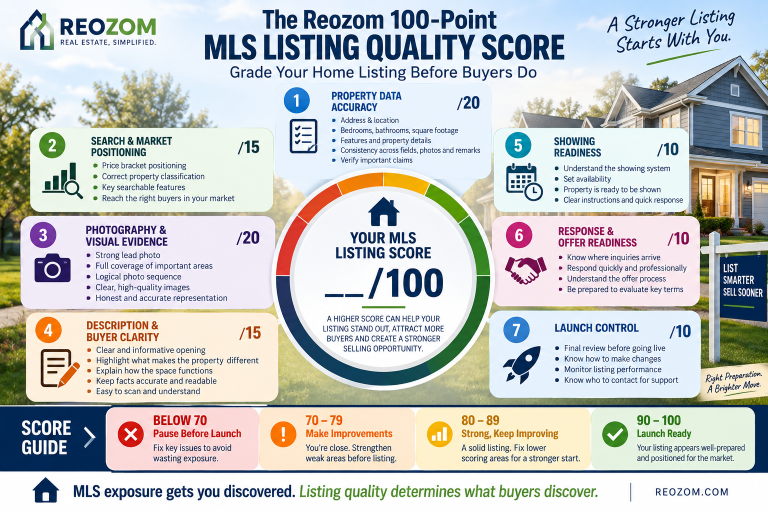
The Manistee Listing Scorecard
Now put all three layers together.
Give your listing up to 10 points per layer.
PLACE — /10
Does the listing accurately explain where the property fits?
PROPERTY — /10
Does it clearly explain what the buyer is purchasing?
PROOF — /10
Can significant property claims be supported or independently verified where appropriate?
Score Interpretation
25–30: Strong informational foundation.
18–24: Useful, but review the weakest layer.
Under 18: Don’t rush to publish. Improve the listing first.
Notice what we’re not scoring:
How many times the description says “stunning.”
That’s intentional.
Apply the Same Test to Your Photographs
Your property photographs should also support:
PLACE
PROPERTY
PROOF
PLACE Photos
Use them where genuinely useful.
Exterior context, setting or street relationship may help buyers understand the property.
PROPERTY Photos
The actual home should dominate:
- Exterior
- Kitchen
- Living spaces
- Bedrooms
- Bathrooms
- Basement when useful
- Garage
- Outdoor areas
- Important property features
PROOF Photos
Photographs can visually support statements.
If the listing emphasizes a large garage, show it.
If the listing emphasizes an outdoor entertaining area, show it.
If the listing emphasizes storage, don’t provide twenty living-room photographs and no storage context.
The photograph shouldn’t simply be attractive.
It should help explain something.
The “Manistee Tourism Photo” Warning
Suppose you’re selling a home several miles from Lake Michigan.
Should the listing include a giant photograph of Lake Michigan?
Not necessarily.
The buyer is purchasing the home—not the public lakefront photograph.
Regional images can provide useful context in broader marketing, but property listings should not create confusion about what belongs to or is directly associated with the property.
Again:
PLACE SUPPORTS PROPERTY.
PLACE DOES NOT REPLACE PROPERTY.
Now We Get to MLS Exposure
We’ve spent most of this article improving the information.
Now people need to discover it.
That’s where distribution enters the picture.
A strong listing with poor visibility has a discovery problem.
A highly visible listing with poor information has a presentation problem.
A stronger strategy combines both.
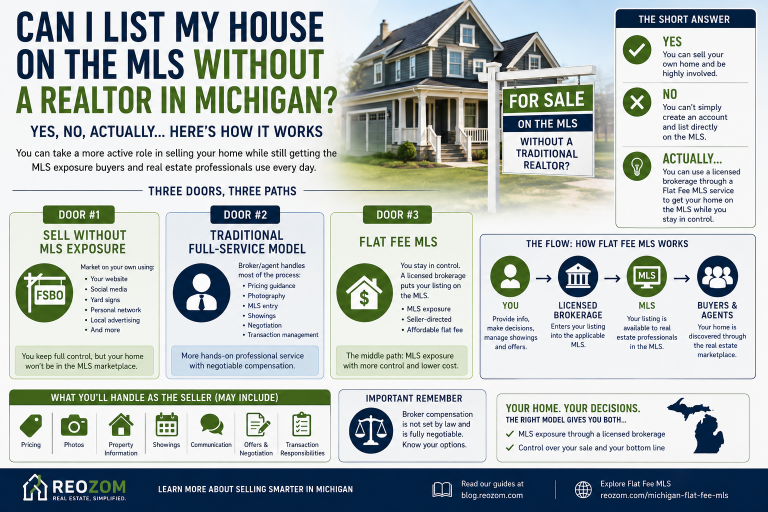
For Michigan homeowners who want broad MLS exposure while retaining greater involvement in their sale, Reozom offers Michigan Flat Fee MLS listing options.
The purpose of MLS exposure isn’t to transform a weak listing into a strong one.
It’s to give a well-prepared property presentation a broader opportunity to be discovered.
Think:
INFORMATION × VISIBILITY
Not:
VISIBILITY INSTEAD OF INFORMATION
What “Flat Fee” Doesn’t Tell You
This distinction matters when sellers begin researching listing options.
A homeowner may search:
Michigan Flat Fee MLS
Flat Fee MLS Michigan
or:
Flat Fee Broker Michigan
But the words “flat fee” alone don’t tell you:
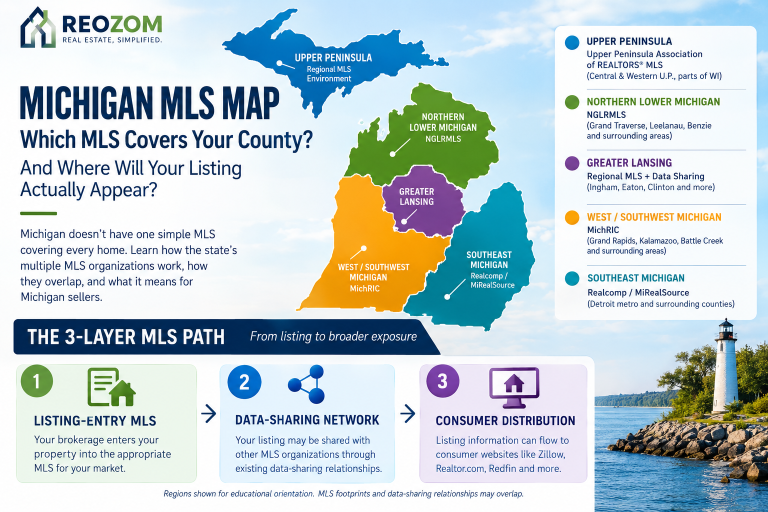
- Which MLS will contain the property
- How long the listing remains active
- How many photographs can be included
- How listing changes are handled
- How buyer inquiries are delivered
- Whether document support is available
- What happens when an offer arrives
- What costs extra
- Which responsibilities remain with the homeowner
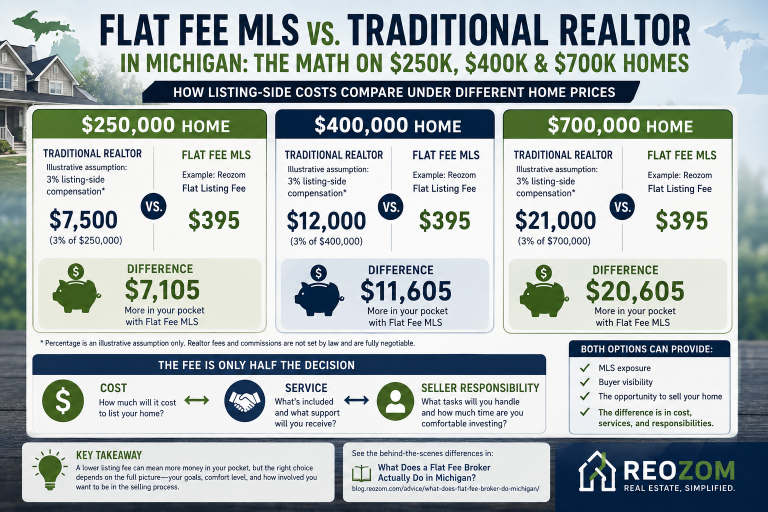
That’s why comparing only the advertised fee is incomplete.
We’ve created a detailed Complete Guide to Choosing a Flat Fee Broker in Michigan explaining the questions homeowners should ask before selecting a provider.
The best choice isn’t necessarily the lowest advertised price.
It’s the service model that provides the right combination of:
Exposure + support + technology + control + cost
for that seller and property.
The Self-Directed Seller Test
A homeowner considering greater control should evaluate themselves as carefully as they evaluate the brokerage.
Ask:
Do I know my property well?
Can I gather accurate information?
Can I respond promptly?
Can I manage the showing responsibilities assigned to me?
Can I keep documents organized?
Can I respond objectively to buyer feedback?
Do I know when professional assistance may be appropriate?
A more active selling model can create flexibility.
But flexibility works best with preparation.
Homeowners considering a more hands-on approach can also review Reozom’s For Sale By Owner resources.
Three Listings for the Same Manistee Home
Imagine the following hypothetical property:
- 3 bedrooms
- 2 bathrooms
- Attached garage
- Rear deck
- Full basement
- Updated HVAC
- Located in the broader Manistee area
Now let’s write three listings.
LISTING A — PLACE ONLY
Amazing opportunity to enjoy beautiful Manistee! Close to Lake Michigan, downtown, beaches, rivers and everything this incredible area has to offer.
Problem:
We barely know anything about the house.
LISTING B — PROPERTY ONLY
Three-bedroom, two-bath home with attached garage, full basement and rear deck.
Better.
But now we have almost no local context.
LISTING C — PLACE + PROPERTY + PROOF
Three-bedroom, two-bath Manistee-area home featuring an attached garage, full basement and rear deck. Seller records indicate the HVAC system was updated in [year]. The property is located within the broader Manistee community, with downtown, Lake Michigan and regional recreational resources available throughout the surrounding area.
Now the buyer understands:
WHERE
WHAT
SUPPORTING INFORMATION
That’s the three-layer listing.
The 15-Minute Pre-Publish Audit
Before your listing goes live, spend five minutes on each layer.
Minutes 1–5: PLACE
- Remove exaggerated location language.
- Verify place names.
- Review geographic claims.
- Make nearby amenities contextual rather than misleading.
Minutes 6–10: PROPERTY
Review:
- Bedrooms
- Bathrooms
- Square footage
- Structures
- Improvements
- Photographs
- Property description
Minutes 11–15: PROOF
Ask which important claims should be backed by records or independently verified.
Organize useful property information.
Then publish.
Fifteen extra minutes before launch can create a much more useful listing.
Manistee County’s Bigger Real Estate Lesson
The county makes this principle particularly easy to see because its surrounding story is so compelling.
Lake Michigan is compelling.
The Manistee River is compelling.
Historic downtown is compelling.
The Riverwalk is compelling.
Forests and trails are compelling.
But none of them is the house.
That’s why strong Manistee County real estate marketing needs balance.
PLACE
helps the buyer understand the context.
PROPERTY
helps the buyer understand the purchase.
PROOF
helps reduce unnecessary uncertainty.
And then:
VISIBILITY
helps buyers discover all three.
That’s the complete system.
Frequently Asked Questions
What makes Manistee County Michigan real estate distinctive?
Manistee County combines Lake Michigan communities, the Manistee River, historic Manistee, rural areas and substantial outdoor recreation. You can explore the county’s communities and general information through Manistee County’s official website.
Is Manistee County primarily a vacation-home area?
No. Tourism and recreation are important parts of the county’s identity, but Manistee County also has a substantial year-round residential population. Current housing and demographic information is available through U.S. Census Bureau QuickFacts.
What should a Manistee County seller emphasize?
Start with accurate property characteristics. Then add useful location context. Significant improvements and important claims should be supported with appropriate information where available.
Should I use Lake Michigan photographs in my home listing?
Only when they provide appropriate context and don’t create confusion about the property’s actual relationship with Lake Michigan. The property itself should remain the primary focus of the listing.
Can Manistee County homeowners use Flat Fee MLS?
Flat Fee MLS is one possible selling approach. Sellers should compare MLS coverage, included services, support, technology, fees and their responsibilities before selecting a provider. Learn more about Reozom’s Michigan Flat Fee MLS options.
How do I choose a flat fee broker in Michigan?
Compare more than the advertised price. Look at MLS access, photograph limits, listing changes, inquiry handling, available support, additional charges, listing term and seller responsibilities. Our Complete Guide to Choosing a Flat Fee Broker in Michigan provides a detailed framework.
Final Check
Before publishing a Manistee County property, ask:
PLACE — Have I accurately explained where it is?
PROPERTY — Have I clearly explained what it is?
PROOF — Can I support the important claims I’m making?
Then ask one final question:
Can the right buyers actually discover it?
That’s where strong property preparation and digital visibility meet.
Because a strong listing isn’t the one that makes Manistee County sound beautiful.
People can discover that for themselves.
A strong listing helps them understand why this particular property, in this particular place, deserves a closer look.
Recommended Related Reading
Complete Guide to Choosing a Flat Fee Broker in Michigan — Understand what to compare beyond the advertised flat fee.
Michigan Home Seller Decision Map — Explore the broader decisions involved in choosing a Michigan home-selling approach.
Michigan Flat Fee MLS — Learn about Reozom’s Michigan listing options.
About Reozom — Learn more about Reozom’s approach to Michigan real estate.