Complete Guide to Choosing a Flat Fee Broker in Michigan (2026)
Selling a home in Michigan no longer means homeowners have only one path to choose from.
Traditional full-service representation remains an option, but sellers can also consider flat fee brokerage services, limited-service arrangements, and other approaches that allow them to decide how much of the selling process they want to manage themselves.
That flexibility can be valuable—but it can also make comparison difficult.
Search for a flat fee broker in Michigan, and you may find companies offering services at dramatically different prices. One package may primarily provide MLS entry, while another includes listing support, changes, documentation assistance, showing tools, and help throughout the transaction.
The lowest advertised price therefore doesn’t necessarily represent the best value.
A better question is:
What am I actually getting for the fee—and does that service match the way I want to sell my home?
This guide explains what Michigan homeowners should understand before choosing a flat fee broker, including MLS exposure, service levels, seller responsibilities, technology, pricing, support, and local market considerations.
The goal isn’t to convince every homeowner to sell the same way. It’s to help sellers understand their choices before making one of their largest financial decisions.
Start With the Selling Experience You Want
Before comparing brokers, packages, or prices, start with yourself.
How involved do you want to be in selling your home?
Some homeowners are comfortable managing much of the process. They may want to coordinate showings, communicate with prospective buyers, monitor listing activity, and participate closely in negotiations.
Others want greater professional support with pricing, documents, offers, negotiations, and the steps leading to closing.
Neither approach is automatically better.
The right level of service depends on your experience, available time, property, market, and comfort level.
Before choosing a listing service, ask yourself:
- Am I comfortable coordinating showings?
- Can I respond promptly to buyer and agent inquiries?
- Do I understand how to evaluate competing offers?
- Will I need assistance with contracts and disclosures?
- Am I comfortable determining an asking price?
- Do I want help during negotiations?
- How much time can I realistically devote to the sale?
- Do I want professional assistance available if the transaction becomes complicated?
Your answers help determine whether you need a basic MLS-entry service, a more supported flat-fee package, or comprehensive representation.
This is why choosing a flat fee broker based solely on the advertised price can be a mistake.
The better comparison is price + services + responsibilities + support.
What Is a Flat Fee Broker in Michigan?
A flat fee broker is a licensed real estate brokerage that charges an agreed fixed fee for specified real estate services rather than structuring the listing-side fee solely as a percentage of the property’s sale price.
What is included can vary considerably.
Depending on the brokerage and package, services may include:
- MLS listing entry
- Property syndication
- Listing photographs
- Listing modifications
- Showing-management tools
- Seller disclosures
- Document support
- Offer communication
- Pricing assistance
- Contract assistance
- Negotiation support
- Transaction guidance
That variation is important.
Two companies can both describe themselves as flat fee brokers while offering substantially different levels of service.
For Michigan homeowners researching their options, the question therefore shouldn’t simply be:
“How much does your flat fee service cost?”
It should also be:
“Exactly what services are included, what will I be responsible for, and what could cost extra?”
Flat Fee Broker vs. Flat Fee MLS vs. FSBO vs. Traditional Agent
These terms frequently appear together in online searches, but they don’t mean exactly the same thing.
Understanding the distinction makes comparing services much easier.
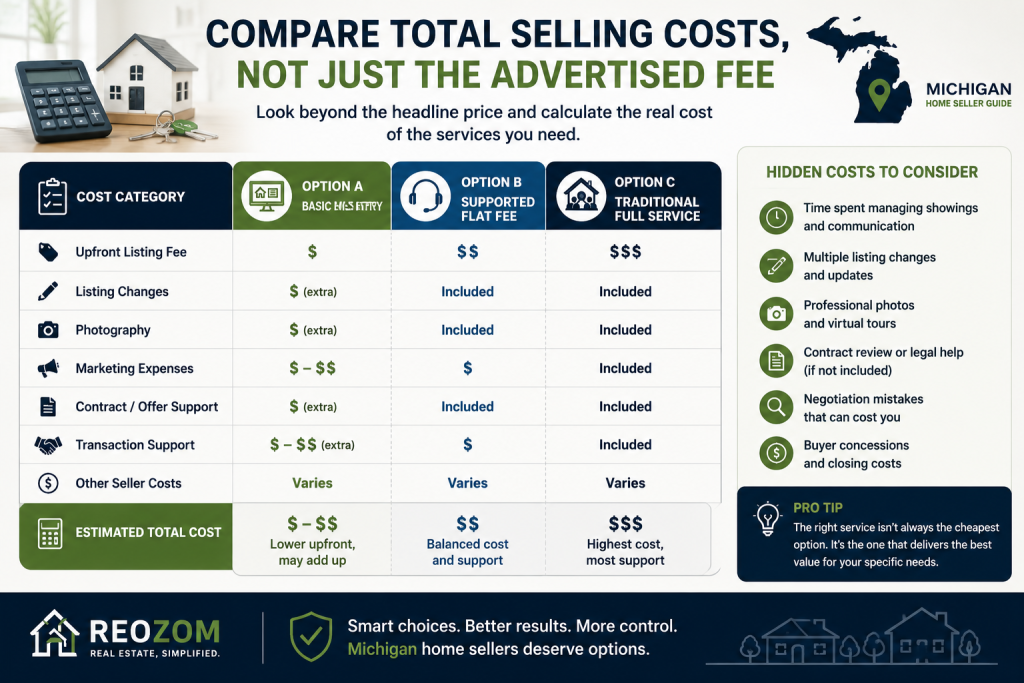
Michigan home sellers can compare basic MLS entry, supported flat fee and traditional full-service models based on the level of assistance and control they want.
Flat Fee Broker
A flat fee broker is a licensed real estate brokerage providing an agreed package of services for a predetermined fee.
The level of assistance can range from relatively limited to highly supported.
The defining characteristic is therefore not necessarily less service.
It is the way the service and compensation arrangement are structured.
Flat Fee MLS
Flat Fee MLS generally refers to a service through which a licensed real estate broker enters a seller’s property into the applicable Multiple Listing Service for a predetermined fee.
MLS exposure is important because it puts the property into the professional listing ecosystem used by real estate professionals and can support distribution to consumer-facing real estate websites.
However, sellers should investigate what happens after the property enters the MLS.
For example:
Who manages listing changes?
Who coordinates inquiries?
How are offers delivered?
Is assistance available when questions arise?
Is transaction support included?
The answers depend on the provider and package.
Michigan homeowners interested in this approach can learn more about Michigan Flat Fee MLS listing options.
For Sale By Owner (FSBO)
For Sale By Owner, commonly called FSBO, means the homeowner takes primary responsibility for selling the property rather than relying on a traditional full-service listing arrangement.
That doesn’t necessarily mean the homeowner must handle every component without professional services.
For example, a seller may manage much of the transaction while using a licensed brokerage for MLS access or purchasing additional assistance where needed.
That’s one reason FSBO and flat fee MLS are frequently discussed together—but they are not synonymous.
Homeowners considering greater control over their sale can also review Reozom’s For Sale By Owner resources.
Traditional Full-Service Representation
With traditional full-service representation, the listing agent or brokerage generally handles a broader portion of the transaction according to the listing agreement.
That may include pricing strategy, marketing, showing coordination, communication, offers, negotiations, paperwork, and transaction management.
For homeowners who want less day-to-day involvement, this can be valuable.
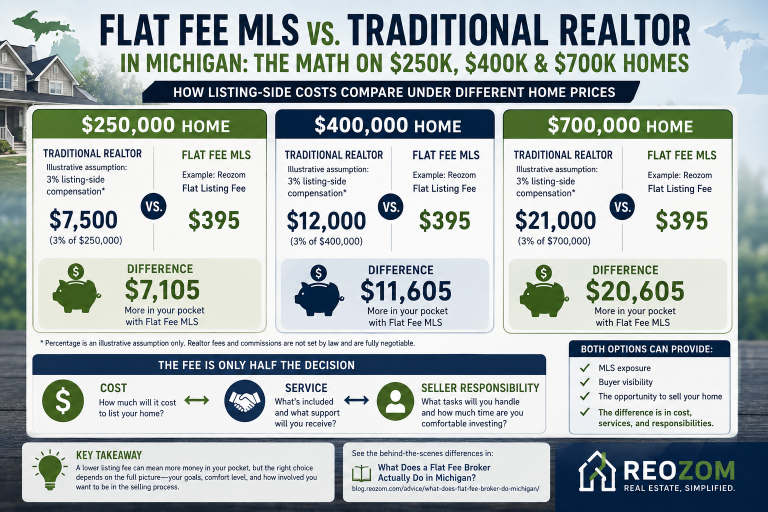
For homeowners comfortable managing portions of the transaction themselves, however, paying for a comprehensive service package may not always match their needs.
The important distinction isn’t:
Agent vs. no agent.
A more useful comparison is:
How much professional service do I want, what responsibilities am I comfortable handling, and what am I paying for?
How Does Flat Fee MLS Work in Michigan?
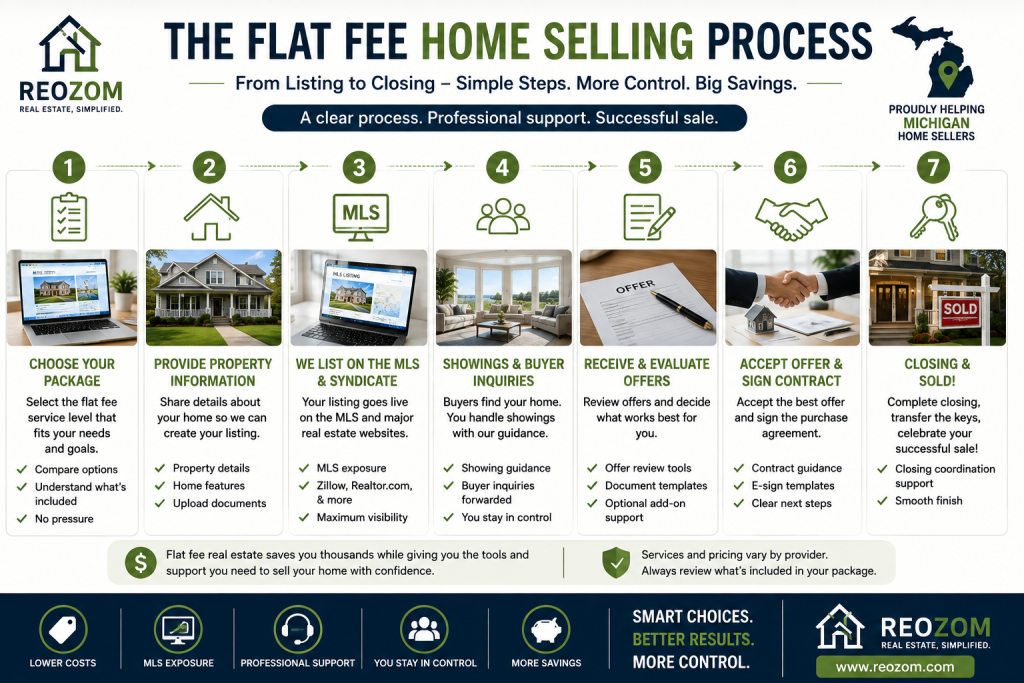
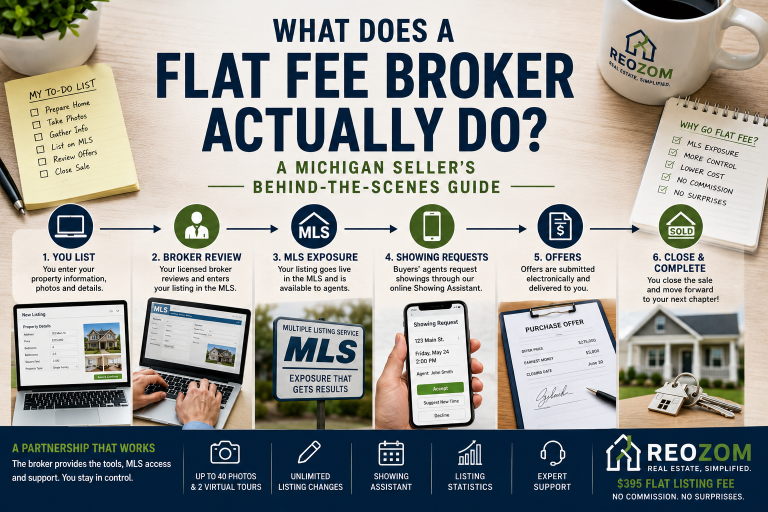
Although individual brokerages operate differently, the process generally follows several stages.
Step 1: Choose the Service Level
The homeowner selects a listing package based on the amount of assistance desired.
Before paying, review what’s included as well as potential additional charges.
Step 2: Provide Property Information
The seller typically provides details such as property characteristics, description, photographs, showing instructions, and required documentation.
Accuracy matters.
Information entered into the MLS may ultimately appear across multiple real estate platforms.
Step 3: Brokerage Review and MLS Entry
The licensed brokerage reviews the submitted information and enters the listing into the applicable MLS according to its procedures and applicable rules.
Step 4: Listing Distribution
MLS data may then be distributed to participating real estate websites and other platforms.
The exact distribution can vary, which is why sellers should ask a provider where listings may appear rather than assuming every service has identical syndication.
Step 5: Manage the Active Listing
Depending on the package, either the seller or brokerage may handle activities such as:
- showing requests
- inquiries
- listing updates
- price changes
- open-house information
This is one of the biggest differences between basic and more supported flat-fee services.
Step 6: Receive and Evaluate Offers
When an offer arrives, the seller needs to evaluate much more than the headline purchase price.
Terms can include financing, contingencies, proposed closing date, concessions, inspection provisions, and other conditions.
Some flat fee packages include support at this stage; others may offer it separately.
Step 7: Move Toward Closing
After accepting an offer, the transaction proceeds through the applicable contract, inspection, financing, title, settlement, and closing processes.
The responsibilities of the broker and seller should already be clear from the service agreement.
What MLS Exposure Can—and Cannot—Do
MLS exposure is one of the primary reasons homeowners consider a flat fee listing.
But understanding its role is important.
What MLS Exposure Can Do
A properly entered listing can help a property:
- Become visible within the professional real estate ecosystem
- Reach buyers searching online
- Be discovered by real estate professionals
- Appear on participating consumer property websites
- Reach buyers beyond the seller’s immediate network
- Present structured property information to the marketplace
That visibility can be extremely valuable.
But visibility and marketability aren’t the same thing.
What MLS Exposure Cannot Do
Simply entering a property into an MLS cannot automatically overcome:
Unrealistic pricing.
Buyers can quickly compare competing properties.
Poor photography.
Online buyers often encounter photographs before they read the full description.
Incomplete information.
Missing or inaccurate property details can create confusion.
Weak presentation.
Exposure creates an opportunity to be seen; the listing still has to capture attention.
Limited showing availability.
Interested buyers need practical opportunities to see the property.
Slow communication.
Buyer interest can disappear when inquiries aren’t handled promptly.
Property-condition problems.
Marketing doesn’t eliminate physical issues buyers may identify.
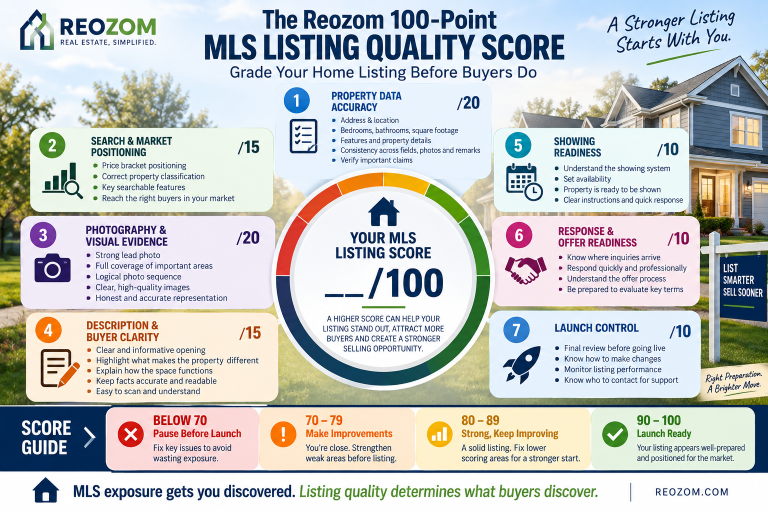
A strong selling strategy therefore combines MLS visibility with pricing, presentation, accurate information, availability, and responsiveness.
The Difference Between Exposure and Strategy
This distinction deserves special attention.
Imagine two similar Michigan homes entering the MLS on the same day.
The first property has professional-quality photographs, an accurate description, competitive positioning, clear showing instructions, and a seller who responds quickly.
The second property is technically just as “visible,” but has dark photographs, limited information, an unrealistic asking price, and complicated showing availability.
Both properties received MLS exposure.
They did not receive the same marketing opportunity.
That’s why homeowners comparing Michigan flat fee brokers should investigate what tools and assistance are available to help them create a competitive listing—not simply whether MLS entry is included.
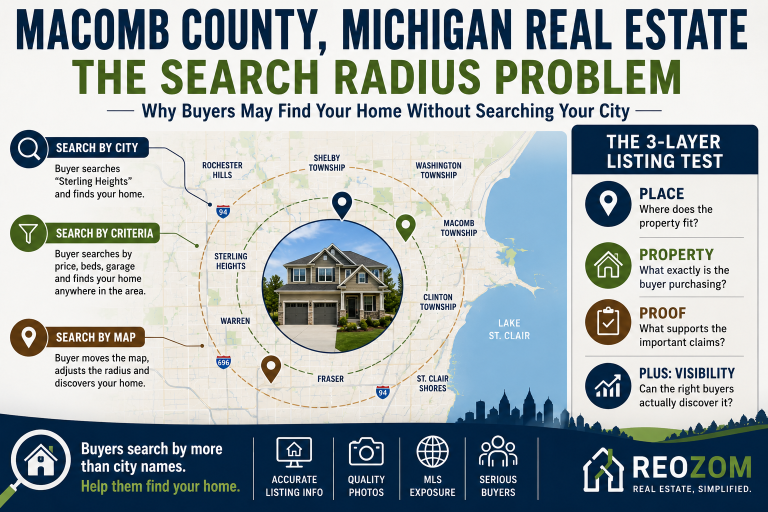
Michigan Isn't One Real Estate Market
Another mistake sellers can make is treating “Michigan real estate” as one uniform housing market.
It isn’t.
Consider the differences between a condominium in Royal Oak, a suburban home in Novi, a waterfront property near Muskegon, and a rural home in Northern Michigan.
The buyer pool, lifestyle considerations, property characteristics, competition, and marketing story can be dramatically different.
We’ve explored this concept in our analysis of Oakland County’s micro-housing markets, where communities within the same county can attract buyers for very different reasons.
We’ve also examined how Muskegon County’s community reinvention can shape how people perceive an area’s housing opportunities.
These differences matter because a successful listing doesn’t simply put a home online.
It positions that particular property within its particular market.
PART 2 — Comparing Your Options
Once homeowners understand what flat fee brokerage actually means, the next question becomes more practical:
How do I compare one service with another?
That’s where we’ll look at service levels, total selling costs, broker verification, hidden charges, and the questions every Michigan homeowner should ask before signing a listing agreement.
How to Compare Flat Fee Brokers in Michigan
Three Common Service Models
Flat-fee services don’t all operate at the same level.
A useful way to compare your options is to think of them in three broad categories.
| Feature |
Basic MLS Entry |
Supported Flat Fee |
Traditional Full Service |
| MLS entry |
Usually |
Yes |
Yes |
| Listing syndication |
Typically |
Typically |
Typically |
| Seller manages showings |
Common |
Varies |
Less common |
| Listing changes |
May be limited |
Often included |
Usually included |
| Pricing assistance |
Often limited |
May be available |
Common |
| Offer/document support |
Limited/optional |
Often available |
Common |
| Negotiation assistance |
Usually seller-led |
May be available |
Common |
| Seller involvement |
High |
Moderate–high |
Lower |
| Pricing structure |
Predetermined fee |
Package/fixed fee |
Per agreement |
These are general categories, not universal rules. Always compare the actual agreement and package.
Don't Compare the Headline Price—Compare the Total Service
Imagine Service A advertises a very low entry price.
Service B costs more initially.
At first glance, Service A appears cheaper.
But suppose the seller later discovers separate charges for:
- listing modifications
- additional photographs
- open-house updates
- contract assistance
- extended listing periods
- cancellation
- transaction support
Service B may include several of those services.
The comparison has now changed.
That’s why sellers should calculate the expected total cost for the level of service they actually need.
Simple Seller Cost Worksheet
| Potential Cost |
Provider A |
Provider B |
Provider C |
| Initial listing fee |
|
|
|
| Listing changes |
|
|
|
| Photography |
|
|
|
| Showing tools |
|
|
|
| Contract/offer support |
|
|
|
| Optional upgrades |
|
|
|
| Cancellation/extension |
|
|
|
| Other transaction costs |
|
|
|
| Estimated Total |
|
|
|
This simple exercise can reveal more than comparing advertisements.
Seven Questions to Ask Every Michigan Flat Fee Broker
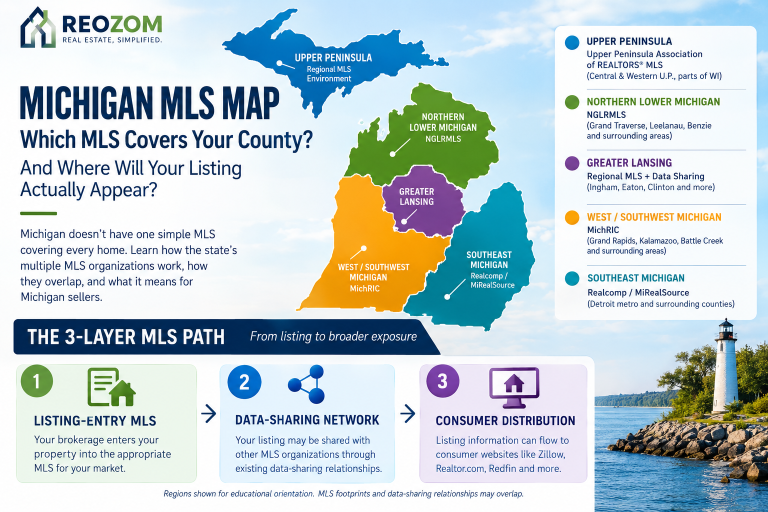
1. Which MLS Will My Property Be Listed In?
Don’t stop at “Yes, we list on the MLS.”
Ask which MLS will contain your property and whether it’s appropriate for the property’s location.
2. Where Can My Listing Be Distributed?
Ask how MLS syndication works and where the listing may become visible.
Avoid assuming every listing service provides identical distribution.
3. What Exactly Is Included in My Fee?
Request a written breakdown.
Pay particular attention to listing changes, photographs, showing management, offer support, contract assistance, extensions, and cancellation.
4. What Am I Responsible for Managing?
This question is equally important.
Will you manage:
- inquiries?
- showings?
- open houses?
- negotiations?
- documents?
- closing coordination?
Know this before listing.
5. What Happens When I Receive an Offer?
A seller who’s comfortable uploading photos may feel very differently when a purchase agreement arrives.
Ask whether someone can help explain the process and what assistance is included or available.
6. Can I Upgrade My Service Later?
Needs sometimes change during a transaction.
A seller may initially want minimal assistance and later decide that negotiation or transaction support would be valuable.
Ask whether upgrading is possible and what it costs.
7. What Happens If I Need to Cancel?
Understand the listing term, withdrawal procedures, cancellation policy, and applicable charges before signing.
Verify the Brokerage Before You Sign
This step is especially important when shopping online.
Before providing sensitive information or paying for services, confirm that you’re dealing with a legitimate brokerage and understand who is responsible for your listing.
Michigan’s licensing resources can help consumers verify professional licensing through the Michigan Department of Licensing and Regulatory Affairs.
Also verify:
- Brokerage name
- Responsible licensed professional
- Contact information
- Written terms
- Refund/cancellation policy
- Privacy and payment security
- Actual service description
A professional website is useful.
A professional website alone isn’t verification.
Red Flags Worth Investigating
Price shouldn’t be the only warning sign.
Be cautious when a provider:
- Guarantees a particular selling outcome
- Makes important fees difficult to locate
- Doesn’t clearly identify the brokerage
- Provides vague answers about MLS placement
- Doesn’t explain seller responsibilities
- Makes cancellation terms difficult to understand
- Uses unclear service descriptions
- Pressures customers into unnecessary upgrades
Transparency is particularly important with flat-fee services because the entire value proposition depends on homeowners understanding what they’re purchasing.
PART 3 — Is Flat Fee MLS Right for You?
A flat fee listing can make sense for many sellers, but not every homeowner has the same needs.
The next question isn’t whether flat fee MLS is universally “better.”
It’s:
Is it appropriate for your particular situation?
Sellers Who May Be Comfortable With Greater Control
A more self-directed listing approach may appeal to homeowners who:
- Understand their local market
- Have previous real estate experience
- Are comfortable communicating with buyers and agents
- Can coordinate showings
- Have time to manage the process
- Are comfortable reviewing documents or obtaining appropriate professional assistance
- Prefer direct control over marketing decisions
For these homeowners, paying for services individually or through a supported flat-fee package may provide useful flexibility.
Sellers Who May Want More Support
Other homeowners may prefer comprehensive assistance.
Examples include sellers who:
- Have never sold property before
- Live far from the property
- Have limited availability
- Are dealing with an estate or complicated ownership situation
- Are uncomfortable negotiating
- Need significant pricing guidance
- Prefer someone else to coordinate most of the process
Flat fee doesn’t necessarily exclude these sellers because some providers offer different service levels.
The key is matching the package to the seller.
A Seller Readiness Test
Before choosing a self-directed approach, ask whether you can confidently check these boxes:
☐ I understand my property’s competitive market.
☐ I can prepare accurate property information.
☐ I can obtain strong listing photographs.
☐ I can make the property available for showings.
☐ I can respond quickly to inquiries.
☐ I understand my responsibilities under the listing agreement.
☐ I know where I’ll seek assistance if contractual questions arise.
☐ I understand that listing exposure doesn’t guarantee a sale.
If several of these create uncertainty, consider choosing a package with additional professional support.
Common Flat Fee MLS Myths
Myth 1: Flat Fee Automatically Means Less Exposure
Not necessarily.
Exposure depends on where the property is listed, applicable syndication, and the brokerage’s process—not simply how the listing-side service is priced.
Myth 2: Flat Fee Means the Seller Is Completely Alone
Again, not necessarily.
Some services provide little beyond MLS entry.
Others provide multiple levels of support.
Compare the actual package.
Myth 3: The Cheapest Service Saves the Most Money
Not always.
A low initial fee can become less attractive if the seller later purchases multiple add-ons.
Compare total expected costs.
Myth 4: MLS Exposure Alone Sells the Home
No marketing channel can guarantee that.
Pricing, property condition, photography, market demand, showing accessibility, terms, and other factors matter.
Myth 5: Every Michigan Flat Fee Broker Is Basically the Same
This is perhaps the biggest misconception.
Service models, technology, responsiveness, MLS coverage, support, pricing, and package limitations can differ substantially.
PART 4 — The Final Michigan Seller Decision Framework
Before choosing a provider, score each company from 1–5 in these categories:
| Category |
Weight |
| Appropriate MLS exposure |
★★★★★ |
| Pricing transparency |
★★★★★ |
| Service clarity |
★★★★★ |
| Support availability |
★★★★☆ |
| Technology/ease of use |
★★★★☆ |
| Local-market understanding |
★★★★☆ |
| Ability to upgrade |
★★★☆☆ |
| Cancellation flexibility |
★★★☆☆ |
The company with the lowest advertised price may not receive the highest overall score.
That’s precisely the point.
About Reozom
Reozom provides Michigan homeowners with flexible real estate listing options designed around transparency, technology, MLS exposure, and seller choice.
Our approach recognizes that homeowners have different levels of experience and different expectations from a brokerage.
We also believe better real estate decisions begin with better information.
That’s why Reozom continues developing educational resources covering Michigan home selling, local communities, buyer behavior, and alternative listing approaches.
You can learn more about Reozom and our background.
Conclusion: The Best Flat Fee Broker Is the One That Fits Your Sale
There isn’t one correct way to sell every Michigan home.
A seller in Oakland County may face very different market conditions from a homeowner near Muskegon or someone selling a rural Northern Michigan property.
Likewise, two sellers on the same street may want completely different levels of professional involvement.
That’s why the most useful question isn’t:
“What’s the cheapest way to get on the MLS?”
It’s:
“What combination of exposure, service, support, control, and cost makes sense for my sale?”
Understanding that distinction can help Michigan homeowners make more informed decisions—and choose a listing strategy based on value rather than an advertised fee alone.
For homeowners considering a flexible approach, explore Michigan Flat Fee MLS options from Reozom.
Frequently Asked Questions About Michigan Flat Fee Brokers
1. What is a flat fee broker in Michigan?
A flat fee broker is a licensed brokerage that provides specified real estate services for a predetermined fee rather than structuring the listing-side fee solely as a percentage of the eventual sale price.
2. What is Michigan Flat Fee MLS?
It generally refers to a service through which a licensed broker places a seller’s property into an applicable MLS for a fixed fee. Additional services vary by provider and package.
3. Is Flat Fee MLS the Same as FSBO?
No. FSBO describes a seller taking primary responsibility for selling the property. Flat Fee MLS is a method a homeowner may use to obtain MLS exposure through a licensed brokerage.
4. Does a Flat Fee Listing Get MLS Exposure?
MLS entry is generally the central service offered by a Flat Fee MLS provider, but homeowners should verify the applicable MLS, listing term, and service details before purchasing.
5. Will My Listing Appear on Major Real Estate Websites?
MLS listings may be distributed to participating consumer real estate platforms, but syndication can vary. Ask the brokerage where your listing may appear.
6. Who Handles Showings?
It depends on the service package. Some flat-fee arrangements leave showing coordination largely to the seller, while others provide showing-management tools or additional assistance.
7. Can I Change My Listing Price?
Generally, listings can be modified according to the brokerage’s procedures, but providers may have different policies or fees for changes. Check before signing.
8. What Happens When I Receive an Offer?
Offers are handled according to the brokerage’s procedures and listing agreement. The level of assistance with evaluation, documentation, and negotiation depends on the package.
9. Are There Costs Beyond the Initial Flat Fee?
There can be. Sellers should review optional upgrades, transaction-related expenses, closing costs, concessions, and all other obligations associated with their particular sale.
10. How Do I Choose the Best Flat Fee Broker in Michigan?
Don’t judge on price alone.
Compare:
MLS exposure + services + transparency + support + technology + local knowledge + seller responsibilities.
The right provider is the one whose service structure best matches your needs.