WHY A LISTING QUALITY SCORE MATTERS
Home buyers increasingly encounter properties digitally before they ever schedule a showing.
The National Association of REALTORS® reported in its 2025 buyer-and-seller research that 52% of buyers found the home they ultimately purchased online. A related NAR article also reported that 81% of buyers considered listing photos the most useful feature during an online home search. View the NAR research overview
Zillow’s 2025 Consumer Housing Trends research found that prospective buyers ranked:
- floor plans
- high-resolution photographs
- 3D/virtual tours
- written descriptions
among the most important listing features when shopping for a home. See Zillow’s 2025 buyer research
That doesn’t mean every Michigan seller needs every possible marketing feature.
It means something more basic:
The quality of the information buyers encounter online matters.
So MLS entry shouldn’t be treated as the finish line.
It should be treated as the moment your listing presentation becomes visible to the market.
THE 100-POINT MICHIGAN MLS LISTING QUALITY SCORE
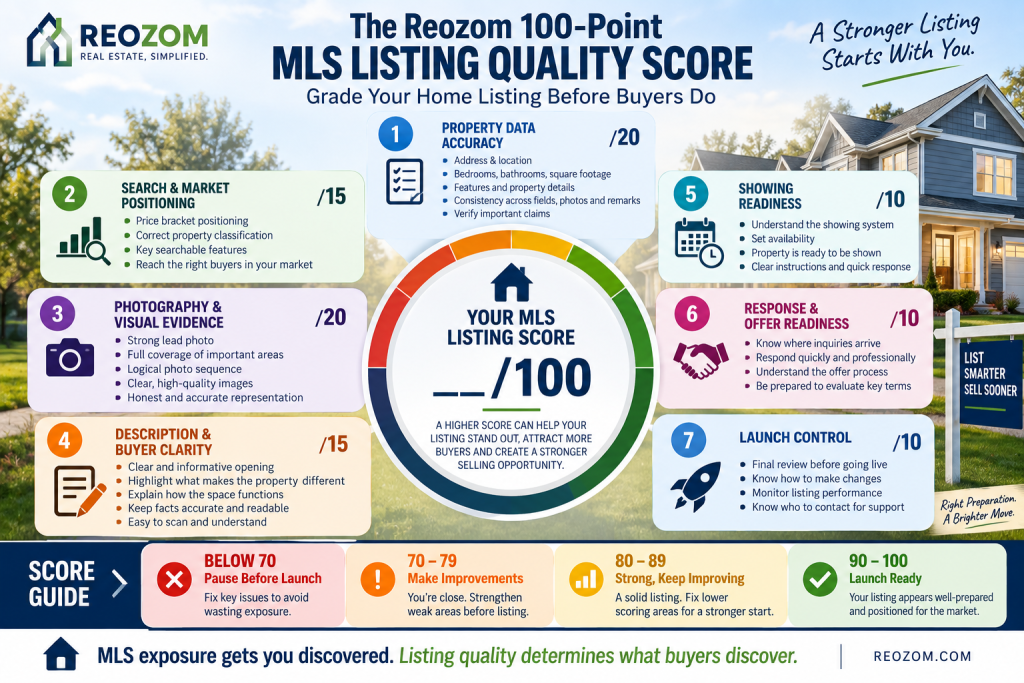
We’re going to evaluate seven areas:
| Category | Maximum Score |
|---|
| 1. Property Data Accuracy | 20 |
| 2. Search & Market Positioning | 15 |
| 3. Photography & Visual Evidence | 20 |
| 4. Description & Buyer Clarity | 15 |
| 5. Showing Readiness | 10 |
| 6. Response & Offer Readiness | 10 |
| 7. Launch Control | 10 |
| TOTAL | 100 |
You’ll score each category separately.
Don’t give yourself points because:
“It’s probably fine.”
Give yourself the points only if the listing is actually ready.
CATEGORY 1 — PROPERTY DATA ACCURACY
Maximum: 20 Points
Before worrying about clever marketing, start with something less glamorous:
Is the listing information correct?
An MLS listing is not merely an advertisement.
It is structured property information.
Depending on the property and MLS, fields can include items such as:
- address
- property type
- asking price
- bedrooms
- bathrooms
- square footage
- acreage
- lot information
- garage
- basement
- heating and cooling
- year built
- school-related fields
- tax-related information
- property features
- public remarks
- showing information
- other MLS-specific data
We’ve previously explained why accurate property information matters in Can I List My House on the MLS Without a Realtor in Michigan? Read the Michigan MLS access guide
Now let’s score it.
Give yourself 4 points for each item:
ADDRESS & LOCATION — /4
Is the address accurate?
Have you verified:
- city/township
- ZIP code
- relevant municipality
- other location fields used for the listing?
Don’t assume location information is too obvious to review.
CORE PROPERTY FACTS — /4
Are the major facts correct?
Check:
- bedrooms
- bathrooms
- square footage
- property type
- year built
- garage
- basement
- lot/acreage
If you’re uncertain about a fact, verify it rather than guessing.
FEATURES — /4
Do the listing fields accurately reflect meaningful features?
For example:
- fireplace
- finished basement
- waterfront-related attributes
- acreage
- garage configuration
- heating/cooling
- outbuildings
- accessibility features
- other property-specific characteristics
Only include a feature when the listing can accurately support it.
CONSISTENCY — /4
Do the:
MLS fields
description
and
photographs
tell the same story?
A listing creates confusion when one section says:
3 bedrooms
while another implies:
4 bedrooms
or when photographs and remarks suggest features that aren’t reflected in the structured listing information.
CLAIM VERIFICATION — /4
Can important factual claims be supported?
If you are stating something objectively verifiable—such as:
- lot size
- renovation date
- school district
- association information
- property measurements
- installed systems
make sure you’re comfortable with the source of that information.
CATEGORY 1 SCORE: ___ /20
CATEGORY 2 — SEARCH & MARKET POSITIONING
Maximum: 15 Points
Here’s something sellers sometimes miss:
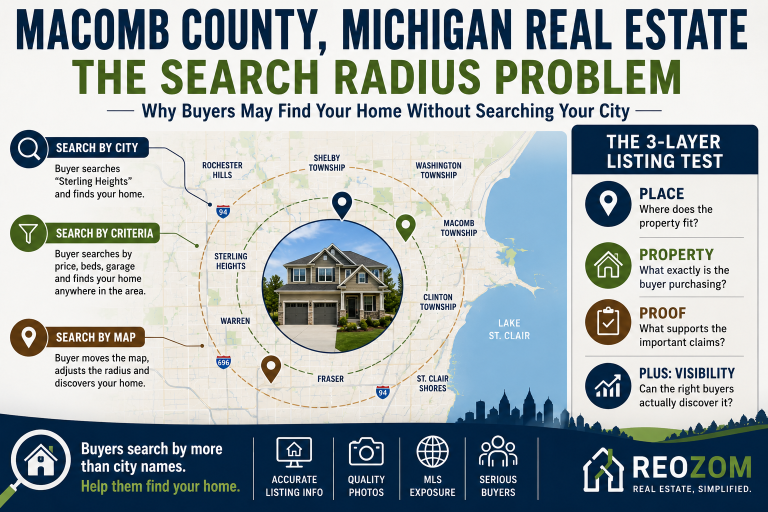
Buyers don’t begin every search by reading descriptions.
They often begin with filters.
A buyer may search:
Location
Price
Bedrooms
Bathrooms
Property type
Acreage
other available criteria.
That means some of the most important marketing decisions happen before a buyer ever reads your beautifully written paragraph.
PRICE BRACKET POSITIONING — /5
Ask:
Where does my asking price place me in buyer searches?
Imagine buyers in your area frequently search:
up to $400,000
Your property is priced at:
$404,900
The difference is only $4,900.
But depending on how buyers set their filters, those searches may behave differently.
That doesn’t mean you should automatically price below a round number.
It means pricing has a search-discovery dimension, in addition to a valuation and negotiation dimension.
Your asking price should ultimately be based on appropriate market evidence and your selling strategy—not merely search filters.
But sellers should understand where the chosen price positions the property.
Score:
5 points — pricing decision is supported and its search positioning has been considered.
3 points — price is intentional, but search positioning hasn’t really been considered.
0–2 points — price is mostly based on hope, emotion, or an unsupported number.
PROPERTY CLASSIFICATION — /5
Is the property placed in the appropriate category?
For example:
- single-family
- condominium
- vacant land
- multi-family
- other applicable property type
Classification matters because buyers may filter by property type.
The listing should accurately reflect the property—not the category you think might generate more attention.
SEARCHABLE FEATURES — /5
Have meaningful features been entered into the appropriate structured fields where available?
This is different from putting everything in the description.
Suppose the home has:
a basement
or
three-car garage
or
acreage
or another searchable characteristic.
If an applicable MLS provides structured fields for those facts, properly completing those fields can be more useful than mentioning the feature only in prose.
CATEGORY 2 SCORE: ___ /15
CATEGORY 3 — PHOTOGRAPHY & VISUAL EVIDENCE
Maximum: 20 Points
This is one of the most important sections.
Recent buyer research reinforces why.
Zillow’s 2025 Consumer Housing Trends report found that 26% of prospective buyers ranked high-resolution photographs as the single most important listing feature, second only to floor plans at 33%.
NAR’s 2025 research, as summarized in a 2026 article, reported that 81% of buyers rated listing photos as the most useful online home-search feature.
So don’t treat photographs as decoration.
Treat them as information.
LEAD PHOTO — /4
Ask yourself:
If a buyer saw only one photograph, would this be the one I want representing the property?
The first photograph often acts as the listing’s cover.
It should:
- accurately represent the property
- be visually clear
- have useful lighting
- avoid unnecessary clutter
- make the home identifiable
- set realistic expectations
It does not need to be artificially dramatic.
Accuracy matters.
COVERAGE — /4
Does the photo set show the important parts of the property?
Depending on the home, that may include:
- front exterior
- rear exterior
- kitchen
- living spaces
- bedrooms
- bathrooms
- basement
- garage
- yard
- deck/patio
- acreage
- outbuildings
- significant property features
Twenty-five photographs of the same living room don’t necessarily communicate more than a thoughtful sequence showing the whole home.
SEQUENCE — /4
Does the order make sense?
Buyers should be able to mentally move through the property.
A useful sequence might feel something like:
Exterior
→
Entry
→
Main living area
→
Kitchen
→
Bedrooms
→
Bathrooms
→
Lower level
→
Outdoor areas
→
Special features
It doesn’t have to follow this exact formula.
The test is:
Does the photo sequence help a buyer understand the home?
IMAGE QUALITY — /4
Check for:
- adequate lighting
- straight horizons/verticals
- useful composition
- resolution
- clutter
- reflections
- accidental people or personal information
- excessive distortion
- duplicate photographs
Professional photography can be valuable, but even when a seller provides the photographs, quality control matters.
HONEST REPRESENTATION — /4
This is important.
Photography should present the home attractively without materially misrepresenting the property.
Heavy digital alterations that remove permanent conditions or create features that aren’t actually present can create unrealistic expectations.
A good photograph should make a property easier to understand—not turn it into a different property.
CATEGORY 3 SCORE: ___ /20
CATEGORY 4 — DESCRIPTION & BUYER CLARITY
Maximum: 15 Points
A property description has a different job than the photographs.
The photos show.
The structured fields categorize.
The description explains.
A weak description often does one of two things:
Mistake #1
It says almost nothing.
Beautiful home in great area. Must see!
Or:
Mistake #2
It says far too much without helping the buyer prioritize anything.
The strongest descriptions help buyers understand:
WHAT THE PROPERTY IS
WHAT MAKES IT DIFFERENT
HOW THE SPACE FUNCTIONS
WHICH IMPORTANT DETAILS AREN’T OBVIOUS FROM THE PHOTOS
OPENING CLARITY — /3
Can a buyer understand the core property quickly?
The opening shouldn’t require three paragraphs to reveal:
- type of home
- relevant location/context
- important property characteristics
DIFFERENTIATORS — /3
Does the description identify features that actually distinguish this property?
Examples might include:
- usable acreage
- renovated kitchen
- attached three-car garage
- finished lower level
- flexible office space
- waterfront setting
- workshop/outbuilding
- specific outdoor functionality
Avoid filling the description with generic adjectives that could describe hundreds of homes.
FUNCTION — /3
Does the description help the buyer understand how the home works?
For example:
Main-floor bedroom with adjacent full bath
can sometimes communicate more practical value than:
Gorgeous bedroom.
Useful information beats decorative language.
FACTUAL DISCIPLINE — /3
Have you separated:
facts
from
marketing language?
Be cautious with absolute or unsupported claims such as:
best neighborhood
guaranteed investment
completely maintenance free
perfect for everyone
Use language you can responsibly support.
READABILITY — /3
Is the description:
- easy to scan
- logically ordered
- reasonably concise
- free from obvious errors
- consistent with the listing fields and photographs?
CATEGORY 4 SCORE: ___ /15
CATEGORY 5 — SHOWING READINESS
Maximum: 10 Points
A buyer likes your listing.
Wonderful.
Now can they actually see the home?
This is where a strong digital listing can lose momentum.
Showing friction might include:
- extremely limited windows
- slow approval
- confusing instructions
- unclear access procedures
- missed requests
- last-minute communication problems
That doesn’t mean sellers need to accept every showing time.
It means the process should be intentional.
SHOWING SYSTEM — /4
Before activation, know:
- how showing requests arrive
- who receives them
- who approves them
- how quickly you’re expected to respond
- what access method is used
- what happens when a time doesn’t work
Reozom’s current platform includes a Showing Assistant as part of its seller workflow. You can review current functionality on the Reozom Features page.
AVAILABILITY — /3
Have you decided when buyers can see the home?
A seller who doesn’t think about showing availability until the first request arrives is already reacting rather than planning.
PROPERTY READINESS — /3
Is the property reasonably ready to be shown?
That can mean:
- basic cleanliness
- accessible rooms
- lights/utilities as appropriate
- pets planned for
- important areas not unintentionally blocked
This isn’t about turning every home into a model home.
It’s about making the actual property reasonably inspectable.
CATEGORY 5 SCORE: ___ /10
CATEGORY 6 — RESPONSE & OFFER READINESS
Maximum: 10 Points
Many sellers prepare extensively for the listing.
Far fewer prepare for what happens when the listing works.
Imagine:
Your home goes active Monday.
Tuesday afternoon:
A buyer’s representative sends a question.
Wednesday:
You receive a showing request.
Thursday:
An offer arrives.
Now what?
INQUIRY RESPONSE — /3
Do you know:
- where inquiries arrive
- how quickly you can respond
- which questions require factual verification
- when you may need broker/professional guidance?
OFFER DELIVERY — /3
Know how an offer reaches you.
Before you list, you should understand the workflow.
Not after the first offer arrives.
OFFER EVALUATION READINESS — /4
An offer is more than:
PRICE
Potential terms can involve:
- financing
- earnest money
- inspection
- appraisal
- closing date
- possession
- contingencies
- seller concessions
- buyer-broker compensation requests
- other transaction terms
You do not need to become a real estate attorney.
You do need to know:
What am I responsible for evaluating, what assistance does my brokerage provide, and when should I seek additional professional guidance?
We will cover this much more deeply in a future Reozom guide specifically about evaluating an offer.
CATEGORY 6 SCORE: ___ /10
CATEGORY 7 — LAUNCH CONTROL
Maximum: 10 Points
This final category is intentionally different.
It asks:
If the listing goes live and something is wrong, do you know how to fix it?
A property listing shouldn’t feel like sending a message into space.
FINAL PREVIEW — /3
Have you reviewed the listing as a buyer would?
Check:
- price
- photo order
- property facts
- remarks
- spelling
- showing information
Don’t review only the form you submitted.
Review the actual live presentation when available.
CHANGE PROCESS — /3
Do you know how to change:
- price
- photos
- remarks
- factual information
- showing instructions
and whether any applicable fees or procedures apply?
Reozom’s current Michigan service includes unlimited listing changes under its published feature set, but sellers should always verify current pricing and terms before purchasing. Review current Michigan Flat Fee MLS features
MONITORING — /2
Once live, do you have a plan to check:
- whether the information appears correctly
- whether important changes have propagated
- whether buyer activity is emerging
- whether showing feedback reveals a recurring issue?
ESCALATION — /2
If something important is incorrect or you don’t understand a listing issue, do you know who to contact?
A seller should know how to reach the brokerage or support channel responsible for the listing.
CATEGORY 7 SCORE: ___ /10
NOW CALCULATE YOUR MICHIGAN MLS LISTING SCORE
Add your seven scores:
| Category | Your Score |
|---|
| Property Data Accuracy | ___ /20 |
| Search & Market Positioning | ___ /15 |
| Photography & Visual Evidence | ___ /20 |
| Description & Buyer Clarity | ___ /15 |
| Showing Readiness | ___ /10 |
| Response & Offer Readiness | ___ /10 |
| Launch Control | ___ /10 |
| TOTAL | ___ /100 |
Now interpret the result.
90–100: GREEN — LAUNCH READY
Your listing appears to have a strong operational foundation.
That does not mean:
- the price is guaranteed to be accepted
- buyers will love the home
- showings are guaranteed
- an offer will arrive
- the property will sell
It means you’ve reduced many avoidable listing-quality problems.
Your next responsibility is monitoring the market response.
80–89: YELLOW — STRONG, BUT FIX THE WEAK CATEGORY
You probably don’t need to rebuild everything.
Find the lowest-scoring category.
If you scored:
18/20 on photos
but
7/15 on description
don’t reshoot the house.
Fix the description.
Use the score to identify the actual weakness.
70–79: ORANGE — DON’T WASTE EXPOSURE
You’re close enough that it may be tempting to say:
“Let’s just publish.”
But this is exactly where a checklist can save you.
A few preventable weaknesses can undermine a lot of otherwise good work.
Ask:
Where did I lose the 20–30 points?
If most of the lost points come from:
- missing property information
- poor images
- unclear showing workflow
- uncertain pricing rationale
fix those first.
BELOW 70: RED — PAUSE BEFORE ACTIVATION
A score below 70 doesn’t mean the home is bad.
It means the listing presentation or process isn’t ready yet.
That’s a very different problem.
Your property can be:
A GOOD PROPERTY
represented by:
A WEAK LISTING.
Those are not the same thing.
The purpose of this score is to identify that difference before the listing becomes widely visible.
THE MOST IMPORTANT PART OF THE SCORE ISN’T THE TOTAL
Suppose two sellers both score:
82/100
Seller A loses most of the points in:
photography
Seller B loses most of the points in:
showing readiness + response
Same total.
Different problem.
That’s why you shouldn’t obsess over the final number.
Look at your score profile.
Your weakest category tells you more than the total.
THE EXPOSURE × QUALITY PRINCIPLE
Here’s the framework behind this entire article:
MLS EXPOSURE × LISTING QUALITY = MARKETING OPPORTUNITY
Not mathematically, of course.
But conceptually.
Consider four situations.
| | Weak Listing Quality | Strong Listing Quality |
|---|
| Low Exposure | Difficult to discover + weak presentation | Strong presentation but limited discovery |
| High Exposure | Easy to discover but weak presentation | Strongest starting position |
The objective is the bottom-right box:
DISCOVERABLE + UNDERSTANDABLE + ACTIONABLE
That’s what sellers should be working toward.
MLS provides a discovery pathway.
The listing itself still has to do its job.
WHY THIS MATTERS EVEN MORE WITH FLAT FEE MLS
A Flat Fee MLS model can give homeowners greater control over parts of the listing process.
That control can be valuable.
But control creates responsibility.
Depending on the service selected, a seller may be more involved in:
- price decisions
- property information
- photographs
- remarks
- showing availability
- buyer communication
- listing changes
- other transaction steps
That’s why comparing Flat Fee MLS providers based only on:
“Do I get MLS access?”
is incomplete.
Ask instead:
“Do I have what I need to create and manage a strong listing once I get that access?”
We’ve explained how to evaluate the broader brokerage service in our Complete Guide to Choosing a Flat Fee Broker in Michigan.
And if you’re not sure which MLS your Michigan property would actually enter, start with our new Michigan MLS Map and County Coverage Guide.
THIS IS NOT THE SAME AS “MAKE YOUR HOME PERFECT”
That’s worth emphasizing.
A 100-point listing does not require:
- luxury renovations
- expensive furniture
- a designer kitchen
- new flooring
- perfect landscaping
- a high-end property
The score measures:
HOW WELL THE LISTING REPRESENTS THE PROPERTY YOU ACTUALLY HAVE.
A modest home can have an excellent listing.
An expensive home can have a terrible listing.
Listing quality and property price are not the same thing.
THE “BUYER SHOULDN’T HAVE TO GUESS” RULE
If you want an even simpler test, use this one:
After looking at your listing, would a reasonable buyer still have to guess about something important that you could have clearly communicated?
For example:
“Where is the third bedroom?”
Maybe the photo sequence doesn’t show it.
“Is that detached building included?”
Maybe the description isn’t clear.
“Does this home have a basement?”
Maybe the structured field is missing.
“How do I schedule a showing?”
Maybe the workflow isn’t clear.
“Is the property really 2 acres?”
Maybe you haven’t verified the lot information.
Every unnecessary question introduces friction.
Good listings don’t answer every imaginable question.
They reduce avoidable uncertainty.
A 10-MINUTE PRE-LAUNCH AUDIT
If you don’t have time to complete the full 100-point exercise, do this before activation:
1. READ EVERY PROPERTY FACT
Don’t skim.
2. REVIEW THE PHOTOS IN ORDER
Not individually.
3. READ THE DESCRIPTION ON A PHONE
Most buyers won’t study it like an essay.
4. CHECK THE ASKING PRICE
Make sure it is intentional.
5. TEST THE SHOWING PROCESS
Know how a request reaches you.
6. KNOW HOW OFFERS ARRIVE
Don’t wait for one to find out.
7. KNOW HOW TO REQUEST A CHANGE
Because eventually you may need one.
Ten minutes of quality control can reveal surprisingly obvious problems.
FREQUENTLY ASKED QUESTIONS
DOES A HIGH MLS LISTING SCORE MEAN MY HOME WILL SELL?
No.
The score evaluates the quality and operational readiness of the listing.
It does not measure buyer demand and cannot predict:
- sale price
- number of showings
- number of offers
- days on market
- appraisal outcome
- closing outcome
Market conditions and property-specific factors still matter.
WHAT IS THE MOST IMPORTANT PART OF A HOME LISTING?
There isn’t one universal component.
Property facts, pricing, photos, description, showing accessibility and seller responsiveness work together.
Recent buyer research does show that visual listing features are especially important in online home shopping. Zillow’s 2025 research ranked floor plans, high-resolution photographs and 3D/virtual tours ahead of written descriptions among prospective buyers’ most important listing features.
SHOULD I USE PROFESSIONAL PHOTOGRAPHY?
That depends on your property, budget and service arrangement.
Professional photography can help produce consistent, technically strong imagery.
If you take your own photographs, apply the same quality-control standard:
clear, accurate, useful and representative.
SHOULD I PUT EVERY PROPERTY FEATURE IN THE DESCRIPTION?
Not necessarily.
When the MLS provides an appropriate structured field for a feature, complete it accurately.
Then use the description to help buyers understand what is important—not to duplicate every field.
CAN I EDIT MY MLS LISTING AFTER IT IS LIVE?
That depends on the brokerage, package and MLS process.
Before selecting a provider, ask:
- what can be changed
- how changes are submitted
- whether changes cost extra
- how long updates generally take
Reozom’s current published Michigan Flat Fee MLS package includes unlimited changes, subject to current service terms. See current Reozom Michigan service details.
DOES FLAT FEE MLS MEAN I HAVE TO DO ALL OF THIS MYSELF?
Not necessarily.
Flat Fee MLS services vary significantly.
Some primarily provide MLS entry.
Others provide technology, forms, showing tools, offer support, listing changes or broader brokerage assistance.
Always review the actual service agreement and current package details.
FINAL THOUGHT: DON’T ASK ONLY “IS MY LISTING LIVE?”
Ask:
IS MY LISTING READY?
A listing can be active in the MLS and still need improvement.
That’s why the sequence should be:
VERIFY
↓
POSITION
↓
PRESENT
↓
PREPARE
↓
LAUNCH
↓
MONITOR
The MLS can create exposure.
But exposure works best when the listing itself is accurate, understandable, visually useful and easy for the market to act on.
Before your Michigan home goes live, score it.
Not because 100/100 guarantees success.
It doesn’t.
Score it because every preventable weakness you fix before launch is one less weakness a buyer has to discover after launch.
For Michigan homeowners who want MLS exposure while remaining more actively involved in their sale, review Reozom’s current Michigan Flat Fee MLS service and verify current pricing, features and terms before listing.