THE 30-SECOND ANSWER
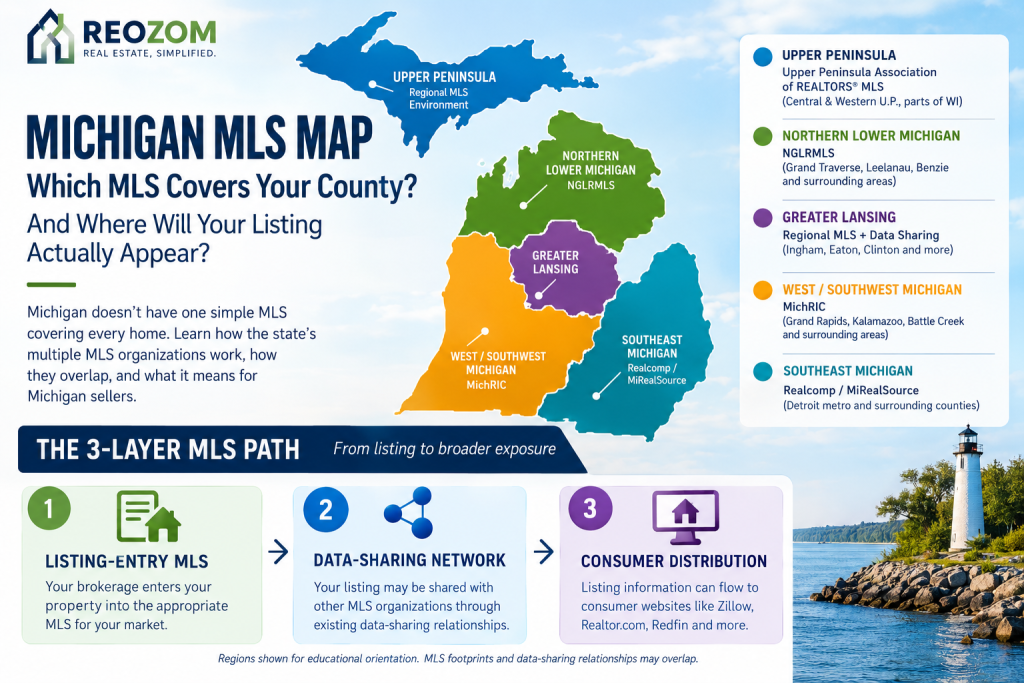
Michigan does not operate as one simple, exclusive county-by-county MLS system.
Instead, several MLS organizations serve different markets, and their geographic footprints can overlap.
Data may also be shared between MLS organizations.
That means a property can have:
1. A LISTING-ENTRY MLS
The MLS into which the listing brokerage actually enters and maintains your property.
2. A DATA-SHARING FOOTPRINT
Other participating real estate professionals may be able to see that listing through data-sharing relationships between MLS systems.
3. A CONSUMER-DISTRIBUTION FOOTPRINT
Listing information may also flow to consumer real estate websites through applicable MLS, broker and third-party data relationships.
Those three things are related.
But they are not necessarily identical.
That’s the key to understanding Michigan MLS coverage.
FIRST: WHAT IS AN MLS ACTUALLY DOING?
Before looking at the map, it helps to separate the MLS from websites consumers already know.
A Multiple Listing Service is fundamentally a professional real estate marketplace and database through which participating real estate professionals share property listing information.
An MLS can contain structured information such as:
- property characteristics
- listing status
- asking price
- photographs
- room information
- property type
- acreage
- showing-related information
- broker information
- status changes
- other standardized listing fields
The exact fields and rules depend on the MLS.
A consumer website is different.
For example, a property you see online may have originated in an MLS and then been displayed elsewhere through an applicable data feed or other distribution relationship.
That’s why:
MLS ≠ Zillow
MLS ≠ Realtor.com
MLS ≠ Redfin
and:
MLS ≠ Reozom.com
These systems can interact with one another, but they perform different functions.
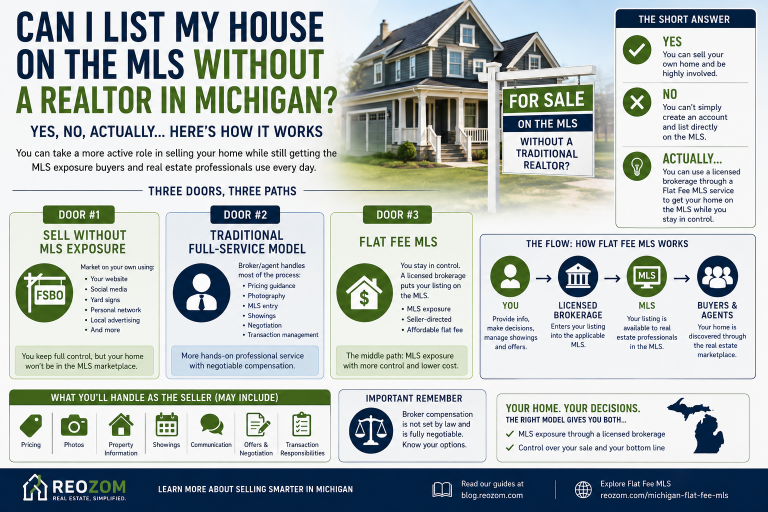
We’ve explained the homeowner-access side of this separately in Can I List My House on the MLS Without a Realtor in Michigan? Read the homeowner MLS-access guide
This article goes one level deeper:
Which MLS are we actually talking about?
THE MICHIGAN MLS MAP ISN’T A SIMPLE MAP
Imagine coloring Michigan county by county.
It would be convenient if the map looked like this:
County A → MLS A
County B → MLS B
County C → MLS C
But Michigan’s actual MLS environment is more complicated.
Why?
Because three things can overlap:
GEOGRAPHIC MARKET
MLS PARTICIPATION
DATA SHARING
Realcomp, for example, describes itself as Michigan’s largest MLS and says it exchanges data with multiple Michigan MLS organizations, including MichRIC organizations, Greater Lansing, MiRealSource and other regional groups.
MiRealSource also describes itself as Michigan’s largest broker-owned MLS and says it participates in the Great Lakes Repository data-sharing environment.
So sellers should be cautious about interpreting a coverage map as if every county belongs exclusively to one system.
A better way to understand Michigan is by MLS regions and relationships.
MICHIGAN MLS REGION #1: SOUTHEAST MICHIGAN AND REALCOMP
For many Michigan homeowners—particularly those familiar with Metro Detroit—the name they are most likely to encounter is:
REALCOMP
Realcomp identifies itself as Michigan’s largest MLS and reports serving more than 17,000 real estate professionals.
Its shareholder REALTOR® organizations include associations connected with areas such as Detroit, Dearborn, Grosse Pointe, Livingston County, North Oakland County and parts of the Thumb.
But here’s where the map becomes interesting.
Realcomp’s current MLS area system contains municipalities across a very large number of Michigan counties, and Realcomp also maintains extensive data-sharing arrangements with other MLS organizations.
Reozom’s current MLS directory lists Realcomp coverage for a broad collection of Michigan counties, including:
Wayne
Oakland
Macomb
Livingston
Washtenaw
Monroe
Genesee
Lapeer
St. Clair
Saginaw
Midland
Bay
Huron
Tuscola
Sanilac
and many additional counties across the state.
That does not mean every one of those counties should be thought of as belonging exclusively to Realcomp.
It means Realcomp can play an important role in how listings and data are handled across a much broader footprint than simply Detroit and its immediate suburbs.
A SELLER EXAMPLE: OAKLAND COUNTY
Suppose your property is in Novi, Troy or another Oakland County community.
You might think your only question is:
“Will I be on the MLS?”
A better question is:
“Which MLS will my brokerage enter my property into, and how will that listing reach real estate professionals who work in my market?”
That’s much more useful.
Because the value isn’t in seeing the letters MLS on a sales page.
The value is understanding the listing pathway.
MICHIGAN MLS REGION #2: WEST AND SOUTHWEST MICHIGAN / MICHRIC
Now move west.
Grand Rapids.
Kalamazoo.
Battle Creek.
West Michigan.
Southwest Michigan.
Here another major name becomes important:
MICHRIC
MichRIC is part of a significant West Michigan MLS ecosystem.
The Grand Rapids Association of REALTORS® describes its MLS database as covering 22 counties and notes that it provides data feeds to third-party aggregators.
A current Grand Rapids MLS participation document also describes access through MichRIC and lists participating or connected organizations covering areas such as:
- Ann Arbor
- Battle Creek
- Branch County
- Greater Kalamazoo
- Hillsdale County
- Jackson
- Mason/Oceana/Manistee
- Montcalm County
- West Michigan and other participating areas.
This is why a seller in Grand Rapids and a seller in Detroit should not automatically assume that the phrase:
“Michigan MLS”
means exactly the same underlying system.
MICHIGAN MLS REGION #3: NORTHERN LOWER MICHIGAN / NGLRMLS
Now go north.
Traverse City.
Grand Traverse County.
Leelanau County.
Benzie County.
Parts of northeastern and north-central Michigan.
Here another major system enters the picture:
NORTHERN GREAT LAKES REALTORS® MLS
The Northern Great Lakes REALTORS® MLS—often shortened to NGLRMLS—is operated by participating REALTOR® associations including:
- Aspire North REALTORS®
- Central Michigan Association of REALTORS®
- Northeastern Michigan Board of REALTORS®.
Realcomp’s published information about its data-sharing relationship with NGLRMLS identifies listing areas including:
- Ogemaw
- Iosco
- Arenac
- Leelanau
- Benzie
- Grand Traverse
- Isabella
- Gratiot
and surrounding areas.
Reozom’s current MLS directory identifies a broader NGLR coverage set that includes:
Antrim, Arenac, Benzie, Charlevoix, Clare, Emmet, Gladwin, Grand Traverse, Gratiot, Iosco, Isabella, Kalkaska, Lake, Leelanau, Missaukee, Ogemaw, Osceola, Roscommon and Wexford.
For a northern Michigan seller, that’s useful information.
But again, don’t interpret that list as an iron wall around each county.
MLS systems can share data, broker participation can differ, and market coverage can overlap.
MICHIGAN MLS REGION #4: GREATER LANSING
Central Michigan adds another useful example of why the map cannot be reduced to one county = one MLS.
Reozom’s current directory identifies Greater Lansing MLS coverage in:
- Clinton County
- Eaton County
- Ingham County
but also states that Reozom listings in those counties are entered through Realcomp because of the relevant data-sharing relationship.
That distinction is extremely important.
A homeowner might ask:
“Does Lansing have its own MLS environment?”
Yes.
But the next question is:
“Does my property therefore have to be separately entered into that exact system by my Flat Fee MLS provider?”
Not necessarily.
This is precisely why sellers should ask about entry + sharing, rather than merely asking whether an area is “covered.”
MICHIGAN MLS REGION #5: THE UPPER PENINSULA
Michigan’s Upper Peninsula creates another distinct market.
The Upper Peninsula Association of REALTORS® operates a public property-search environment covering counties across the Central and Western Upper Peninsula, along with portions of Northern Wisconsin.
That reinforces the central lesson of this article:
Michigan is not one homogeneous real estate marketplace.
Detroit metro,
West Michigan,
Northern Lower Michigan,
the Lansing region,
and the Upper Peninsula
can interact with different MLS organizations and local-market structures.
A seller should therefore confirm actual property coverage rather than assuming a statewide service works identically in every location.
SO WHICH MLS COVERS MY MICHIGAN COUNTY?
Here is the more accurate way to think about it.
| Michigan Market | MLS Environment Sellers May Encounter | Examples |
|---|
| Southeast / Metro Detroit | Realcomp / MiRealSource ecosystem | Wayne, Oakland, Macomb and surrounding markets |
| West / Southwest Michigan | MichRIC ecosystem | Grand Rapids, Kalamazoo and much of West/Southwest Michigan |
| Northern Lower Michigan | NGLRMLS and other northern-market systems | Grand Traverse, Leelanau, Benzie and surrounding areas |
| Greater Lansing | Greater Lansing + shared-data relationships | Ingham, Eaton, Clinton |
| Upper Peninsula | Upper Peninsula regional MLS environment | Central and Western U.P. markets |
IMPORTANT:
This table is a seller’s orientation guide, not an exclusivity chart.
Counties can have overlapping MLS access, participating brokers can belong to different systems, and data-sharing arrangements can change.
For the actual Reozom listing pathway for your county, use the current Reozom MLS Directory. Check Reozom’s current Michigan MLS Directory
HERE’S THE QUESTION MOST SELLERS MISS
Imagine two Flat Fee MLS services.
Both websites say:
“WE LIST YOUR HOME ON THE MLS.”
At first glance, they sound identical.
But Seller A asks only:
“Do I get MLS exposure?”
Seller B asks:
“Which MLS will my property be entered into?”
“Is that the MLS commonly used by professionals serving my local market?”
“What data-sharing relationships apply?”
“Where should I expect the listing data to appear?”
“Who handles corrections if something is wrong?”
Seller B understands the product much better.
That’s why MLS name and listing pathway should be part of the comparison when evaluating a Flat Fee MLS provider.
We’ve created a separate decision framework for comparing the broader service itself in our Complete Guide to Choosing a Flat Fee Broker in Michigan. Read the Flat Fee Broker comparison guide
THE THREE-LAYER MLS TEST
Here’s a simple framework Michigan sellers can use.
Before purchasing an MLS listing service, understand all three layers.
LAYER 1 — ENTRY
Ask:
Where is my listing actually entered?
You want the name of the MLS or listing system—not simply:
“You’ll be on the MLS.”
LAYER 2 — PROFESSIONAL VISIBILITY
Ask:
Who can see the listing through that MLS and its applicable data-sharing relationships?
Realcomp explicitly describes data-sharing arrangements with numerous Michigan organizations, illustrating how professional listing visibility can extend beyond a single MLS membership footprint.
LAYER 3 — CONSUMER DISTRIBUTION
Ask:
Where can the listing information be distributed outside the MLS?
Consumer-facing sites and MLS databases are different systems.
Distribution can depend on feeds, brokerage settings, platform agreements, property type and other factors.
That’s why the safer question isn’t:
“Will MLS automatically put me everywhere?”
It is:
“Which consumer websites should I expect this particular listing to reach through the applicable distribution relationships?”
That is a much better question for any provider.
DATA SHARING DOESN’T MAKE MLS CHOICE MEANINGLESS
At this point you might reasonably ask:
“If MLS systems share data, why should I care which MLS I’m entered into?”
Because accessing data and originating a listing are not necessarily the same thing.
Think of it this way:
LISTING ORIGIN
Where the listing is entered and maintained.
↓
DATA SHARING
Where additional professionals may be able to access that information.
↓
DISTRIBUTION
Where the listing may appear outside the MLS environment.
These layers can create broad visibility.
But the existence of data sharing doesn’t mean every MLS:
- has identical rules
- uses identical listing fields
- has identical geographic strength
- has identical consumer feeds
- handles every property type identically
- provides identical edit procedures
So data sharing makes Michigan’s MLS environment more connected.
It doesn’t make every MLS interchangeable.
THE COUNTY BORDER PROBLEM
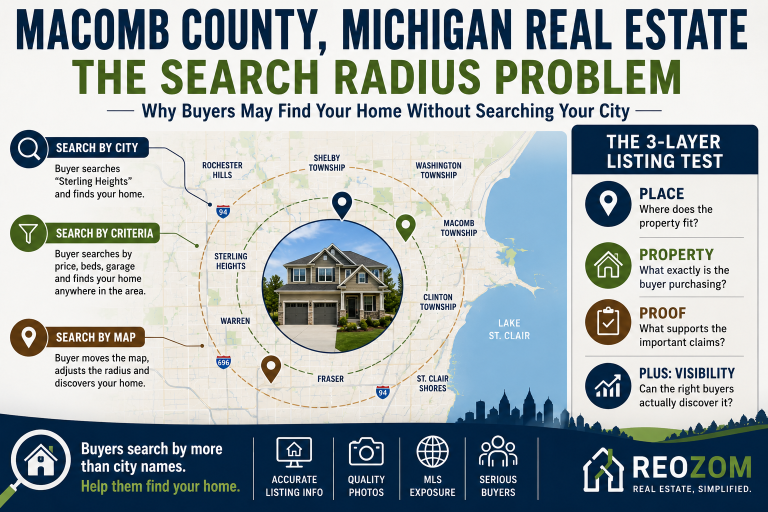
There’s another reason homeowners shouldn’t think only in county lines.
Real estate markets don’t always behave according to government boundaries.
Imagine a property near the edge of two market areas.
Potential buyers may be searching based on:
- school district
- commuting distance
- lake or waterfront
- city name
- township
- ZIP code
- acreage
- vacation-home market
- regional employment centers
—not simply county.
That’s why the best MLS question is ultimately:
Which listing environment gives professionals serving this property’s actual buyer market appropriate access to the listing?
County is a useful starting point.
Buyer geography is the deeper question.
FOUR MICHIGAN SELLERS, FOUR DIFFERENT MLS QUESTIONS
Let’s make this practical.
SELLER #1: DETROIT SUBURB
The seller owns a home in Oakland County.
Primary concern:
Will the listing enter an MLS environment widely used in Southeast Michigan, and how does its data circulate?
SELLER #2: GRAND RAPIDS
The seller owns a home in Kent County.
Primary concern:
How does the provider handle the West Michigan/MichRIC listing environment?
SELLER #3: TRAVERSE CITY
The seller owns a home in Grand Traverse County.
Primary concern:
Will the listing be handled through the appropriate northern Michigan MLS pathway, such as NGLRMLS where applicable?
SELLER #4: LANSING AREA
The seller owns a home in Ingham County.
Primary concern:
Which MLS will actually originate the listing, and what data-sharing relationship connects that listing to the local professional market?
Notice something?
Not one of these questions is simply:
“Do you list on MLS?”
That’s too broad.
7 QUESTIONS TO ASK ANY MICHIGAN FLAT FEE MLS PROVIDER
Before paying for a Flat Fee MLS service, ask:
1. WHICH MLS WILL MY PROPERTY ACTUALLY BE ENTERED INTO?
Get the specific name.
2. WHY IS THAT MLS APPROPRIATE FOR MY PROPERTY’S LOCATION?
The answer should be clearer than:
“We cover Michigan.”
3. ARE THERE OTHER MLS SYSTEMS SERVING OR SHARING DATA IN THIS MARKET?
This is especially useful in overlapping markets.
4. DOES MY PACKAGE INCLUDE THE APPROPRIATE MLS FOR MY PROPERTY?
Don’t assume every geographic option or additional entry is automatically included.
5. HOW MANY PHOTOS AND LISTING CHANGES ARE INCLUDED?
MLS access is only one part of the service.
6. HOW ARE PRICE, STATUS AND PROPERTY CHANGES HANDLED?
A listing is a living data record—not a one-time advertisement.
7. WHERE SHOULD I EXPECT MY LISTING DATA TO APPEAR OUTSIDE THE MLS?
Ask for expectations rather than vague promises of “every website.”
These questions help sellers compare the actual service instead of comparing advertising slogans.
HOW REOZOM HANDLES THE QUESTION
Reozom is a licensed Michigan real estate brokerage, not simply a website referring sellers to unrelated listing brokers.
For Michigan sellers using the current Flat Fee MLS service, the appropriate listing pathway depends on the property’s location and applicable MLS coverage.
Reozom maintains a current MLS Directory showing its Michigan coverage and the MLS systems used for different regions.
The current directory identifies, among others:
- Realcomp
- Greater Lansing MLS relationships
- northern Michigan MLS coverage
- NGLRMLS coverage
and the counties associated with those listing pathways.
Because MLS relationships and service terms can change over time, sellers should always review the current MLS Directory and current service terms rather than relying on an older article.
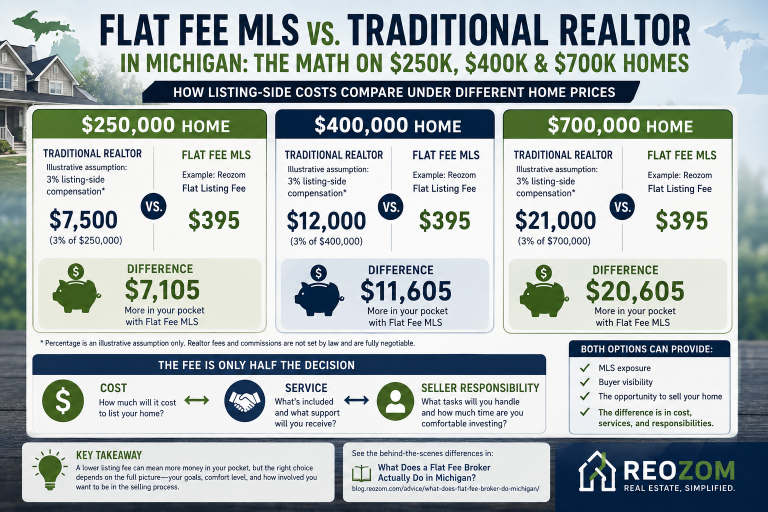
You can also review Reozom’s current Michigan Flat Fee MLS service for pricing, features and listing options. Explore Reozom Michigan Flat Fee MLS
THE BIGGER LESSON: “MLS EXPOSURE” IS NOT A BINARY CHECKBOX
Sellers often compare listing services this way:
| Question | Provider A | Provider B |
|---|
| MLS included? | ✔ | ✔ |
But that comparison is incomplete.
A better table looks like this:
| Question | Provider A | Provider B |
|---|
| Which MLS? | ? | ? |
| Correct local-market pathway? | ? | ? |
| Relevant data sharing? | ? | ? |
| Number of photos? | ? | ? |
| Listing changes? | ? | ? |
| Showing tools? | ? | ? |
| Distribution expectations? | ? | ? |
| Support after activation? | ? | ? |
| Offer workflow? | ? | ? |
| Additional fees? | ? | ? |
Now you’re comparing an actual real estate service.
Not a checkbox.
MICHIGAN FLAT FEE MLS: WHERE THIS ALL FITS
A Flat Fee MLS model doesn’t eliminate the MLS system.
It changes the brokerage service and pricing structure around obtaining MLS exposure.
Instead of assuming that:
FLAT FEE MLS = DIY WEBSITE LISTING
a more accurate mental model is:
HOMEOWNER
↓
LICENSED BROKERAGE
↓
APPROPRIATE MLS LISTING PATHWAY
↓
MLS / DATA-SHARING ECOSYSTEM
↓
PROFESSIONAL + APPLICABLE CONSUMER VISIBILITY
The seller may then retain more responsibility for pricing decisions, photography, showings, communications and other parts of the transaction depending on the service agreement.
That’s why we describe Flat Fee MLS as a different brokerage service model, rather than “selling without a broker.”
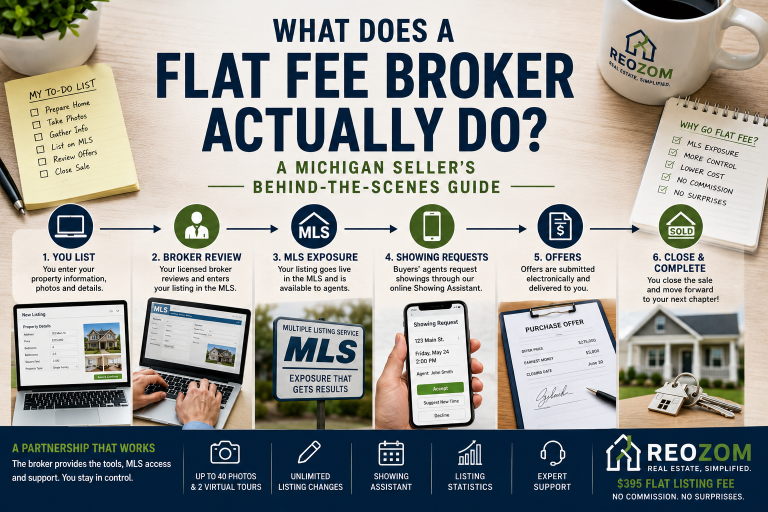
For a full explanation of what the broker is actually doing behind the scenes, read What Does a Flat Fee Broker Actually Do in Michigan? Read the behind-the-scenes guide
THE MICHIGAN MLS MAP: THE SIMPLE VERSION
If you remember nothing else from this guide, remember this:
MICHIGAN DOES NOT HAVE ONE SIMPLE, EXCLUSIVE MLS FOR EVERY COUNTY.
Different regional MLS organizations operate throughout the state.
COUNTY COVERAGE CAN OVERLAP.
A county name alone doesn’t always tell the complete story.
DATA CAN MOVE BETWEEN MLS SYSTEMS.
Realcomp and other Michigan organizations participate in data-sharing relationships that can expand professional access to listing information.
LISTING ENTRY STILL MATTERS.
Ask which MLS will originate and maintain your listing.
CONSUMER WEBSITES ARE ANOTHER LAYER.
MLS entry and consumer website display are related but different.
ASK FOR YOUR EXACT PROPERTY PATHWAY.
That’s better than asking only:
“Do you cover Michigan?”
FREQUENTLY ASKED QUESTIONS ABOUT MICHIGAN MLS COVERAGE
IS THERE ONE STATEWIDE MLS IN MICHIGAN?
Not in the simple sense most consumers imagine.
Michigan has multiple MLS organizations and regional listing environments, along with substantial data-sharing relationships between organizations.
CAN MORE THAN ONE MLS COVER THE SAME MICHIGAN COUNTY?
Yes, geographic footprints and data access can overlap.
That’s why a county should not automatically be treated as belonging exclusively to one MLS.
WHAT MLS IS USED IN METRO DETROIT?
Realcomp and MiRealSource are important MLS organizations in Southeast Michigan. Realcomp identifies itself as Michigan’s largest MLS, while MiRealSource identifies itself as the state’s largest broker-owned MLS.
The actual listing pathway depends on the brokerage and property.
WHAT MLS IS USED AROUND GRAND RAPIDS?
MichRIC is a major MLS environment serving West Michigan. The Grand Rapids Association of REALTORS® describes its MLS database as spanning 22 counties.
WHAT MLS IS USED IN TRAVERSE CITY AND NORTHERN MICHIGAN?
Northern Great Lakes REALTORS® MLS is a major regional system serving participating northern Michigan REALTOR® associations, including Aspire North REALTORS®, Central Michigan Association of REALTORS® and Northeastern Michigan Board of REALTORS®.
DOES BEING ON ONE MLS MEAN REAL ESTATE PROFESSIONALS USING OTHER SYSTEMS CAN’T SEE MY PROPERTY?
Not necessarily.
Michigan MLS organizations maintain various data-sharing relationships. Realcomp, for example, publicly lists numerous Michigan data-sharing partners.
Ask your listing provider what applies to your specific listing.
DOES MLS ENTRY GUARANTEE MY LISTING WILL LOOK IDENTICAL ON EVERY REAL ESTATE WEBSITE?
No.
Consumer websites, broker sites and MLS systems are distinct platforms. Data availability, refresh timing, display rules and individual platform practices can affect presentation.
HOW DO I KNOW WHICH MLS REOZOM WILL USE FOR MY PROPERTY?
Use Reozom’s current MLS Directory, which lists the Michigan counties and listing systems used within the service. View the Reozom MLS Directory
Because coverage, MLS relationships and service terms can change, verify the current information when you’re ready to list.
FINAL THOUGHT: DON’T BUY “THE MLS.” UNDERSTAND THE PATHWAY.
A homeowner doesn’t really need to become an MLS expert.
You don’t need to memorize regional organizations.
You don’t need to understand every data-sharing agreement.
But before choosing a listing service, you should be able to answer one sentence:
My property will be entered into __________ MLS, through __________ brokerage, for my __________ Michigan market, with the following listing and distribution pathway: __________.
If a provider can explain that clearly, you understand what you’re buying.
If the entire explanation is:
“We put you on the Michigan MLS.”
ask another question.
Because in Michigan, where the listing starts, how the data moves, and which market it reaches are all part of understanding MLS exposure.
For sellers who want MLS exposure while remaining more involved in the sale, you can review Reozom’s current Michigan Flat Fee MLS listing service and verify the MLS coverage available for your property. View Michigan Flat Fee MLS options