
You own the house.
You choose the asking price.
You take the photographs.
You write the description.
You decide when buyers can see it.
So a perfectly reasonable question follows:
Why can’t I just log into the MLS and list the house myself?
Search online and you’ll find seemingly contradictory answers.
“Yes, you can sell without a Realtor.”
“No, homeowners can’t list directly on the MLS.”
“Use Flat Fee MLS.”
All three statements can sound incompatible.
They’re not.
The confusion disappears once we separate selling your own home from putting your property into an MLS.
So let’s answer the question differently.
You can take a much more active role in selling your own Michigan home.
That does not mean an ordinary homeowner simply gets the same MLS access that participating real estate professionals have.
There is a middle path:
You can remain highly involved in selling your own property while using a licensed brokerage to place the listing into the applicable MLS through a Flat Fee MLS arrangement.
That’s the part many homeowners don’t realize.
You don’t necessarily have to choose between:
“Do everything through a traditional full-service agent”
and
“Have no MLS exposure at all.”
There’s another model between those two.
Let’s see how it works.

Before asking whether you can list on it yourself, it helps to understand what you’re trying to access.
MLS stands for:
An MLS is not simply a national consumer property website.
It is an organized real-estate marketplace/database through which participating real estate professionals share structured property information.
NAR describes MLSs as marketplaces that provide participants with access to accurate listing information and facilitate cooperation among real estate professionals.
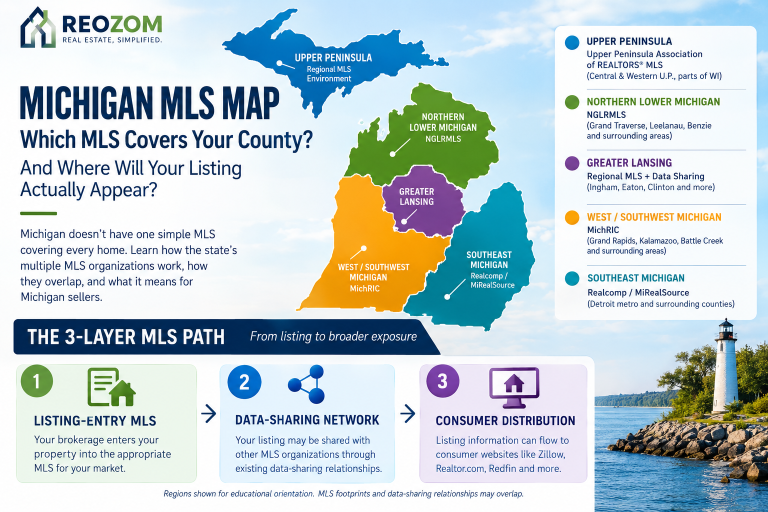
Importantly, there isn’t simply one giant national MLS.
Different markets can be served by different MLS organizations.
That distinction becomes important when a Michigan homeowner sees an advertisement saying:
“We’ll list your house on the MLS.”
A better question is:
“Which MLS is appropriate for my property?”
Think about some familiar websites.
Want to sell furniture?
Create an account.
Want to sell something on an online marketplace?
Create an account.
Want to advertise something on social media?
Create an account.
That consumer-access model makes it natural to assume MLS works the same way.
But MLS participation is structured around participating real estate professionals and brokerage relationships rather than functioning as an ordinary public classifieds website.
Michigan also regulates real estate brokerage activity through Article 25 of the state’s Occupational Code. The Michigan Department of Licensing and Regulatory Affairs oversees real estate brokers and salespersons in the state.
So when a homeowner wants MLS exposure without using a conventional full-service listing arrangement, the solution isn’t normally:
Instead, the structure is closer to:
And that’s where Flat Fee MLS enters the picture.
Imagine you’re standing in front of three doors.
All three can potentially lead toward selling your home.
But they take very different routes.
You decide to market the property yourself without putting it into an MLS through a brokerage.
You might use:
You retain substantial control.
But you don’t have the same MLS listing exposure that comes from having the property entered into the applicable MLS.
This is one form of what people commonly associate with For Sale By Owner, or FSBO.
If you’re considering this route, Reozom has additional For Sale By Owner resources.
But there’s another option.
Here, the homeowner enters into a listing relationship with a brokerage under which a real estate professional may handle a substantial portion of the process.
Depending on the brokerage and agreement, that could include assistance with:
pricing,
property preparation,
photography,
listing creation,
MLS entry,
showings,
buyer communication,
offers,
negotiation,
and transaction management.
The exact services and compensation depend on the agreement.
Broker compensation is not set by law and is negotiable. Current MLS policy expressly requires that fact to be disclosed to consumers.
This model can make sense for sellers who want substantial professional involvement.
But it isn’t the only way to obtain MLS exposure.
This is the door that answers our original question.
The seller remains heavily involved.
But a licensed brokerage provides the route into the applicable MLS.
The basic concept looks like this:
Prepare property information and make seller decisions.
↓
Establishes the listing relationship and handles the MLS-side listing process according to the applicable arrangement.
↓
The property becomes available through the applicable MLS environment.
↓
Listing information may then flow through applicable feeds and real-estate data networks.
↓
The property can be discovered through the broader real-estate search ecosystem.
This is why Flat Fee MLS is not the same thing as bypassing a broker.
A brokerage is still involved.
What’s different is the service model and division of responsibilities.
This is where terminology becomes messy.
When homeowners search:
“list house on MLS without Realtor Michigan”
they may actually mean one of several things.
“Can I sell without paying for a traditional full-service listing model?”
Possibly.
Flat Fee MLS is one alternative.
“Can I make my own pricing and showing decisions?”
Depending on the service arrangement, yes—the seller may retain substantial control.
“Can I directly upload my property into an MLS with no brokerage involvement whatsoever?”
That’s a different question.
MLS access operates through participating professionals and brokerage relationships rather than functioning like an ordinary public posting website.
So the more accurate search question may be:
“How can I get my Michigan home on the MLS without using a traditional full-service listing model?”
Now we have a much more useful answer.
This deserves clarification because Flat Fee MLS sometimes gets described as:
“Pay someone to push a button.”
That’s an oversimplification.
The brokerage exists within a regulated real estate environment.
Michigan licenses and regulates real estate brokers and salespersons, and an associate broker, for example, is licensed to provide brokerage services as an employee or independent contractor of a real estate broker.
The exact responsibilities under a Flat Fee MLS service depend on the brokerage and listing agreement.
That’s why we wrote an entire guide on this question:
What Does a Flat Fee Broker Actually Do in Michigan?
The important point here is:
Instead:
Now we reach the other half of the arrangement.
A homeowner using Flat Fee MLS may take responsibility for significantly more of the selling process than someone using a broader full-service model.
Depending on the service, that may include:
You may need to make your own asking-price decisions.
You decide what to repair, clean, improve or leave as-is.
You need to provide accurate information about the home.
You may provide or arrange your listing photography.
You may draft or approve property remarks.
You may manage availability and showing decisions.
You may interact more directly with buyers or their representatives.
You remain the person making the ultimate seller decisions.
You decide which terms you’re willing to accept, reject or counter.
You need to understand your obligations and know when appropriate legal, tax, title, lending or other professional guidance is necessary.
That’s why Flat Fee MLS isn’t simply a cheaper version of the identical service.
It can represent a different allocation of work.
This comes up constantly.
A homeowner may think:
“If buyers search online anyway, why do I need MLS exposure?”
This confuses two different layers of the property-search ecosystem.
Consumer-facing real estate websites are where many people see properties.
An MLS is part of the infrastructure through which structured listing information can be shared among participating real estate professionals and, through applicable feeds and relationships, distributed more broadly.
So think of it this way:
Where a buyer may encounter a property.
One important source/infrastructure layer from which listing data can be distributed.
They aren’t simply interchangeable versions of the same thing.
No.
This is another important misconception.
MLS exposure can help make property information available within the professional real-estate marketplace and related distribution ecosystem.
It cannot guarantee:
the right asking price
good photographs
accurate property information
buyer demand
showings
offers
or
a successful closing
Think of MLS exposure as:
not:
A poorly positioned property doesn’t automatically become attractive simply because more people can find it.
Here’s a useful way to think about it.
Imagine a restaurant has its menu available on every major food platform.
Excellent distribution.
But:
The photographs are poor.
The descriptions are confusing.
The prices don’t match customer expectations.
The restaurant rarely answers the phone.
Does distribution solve those problems?
No.
Real estate isn’t a restaurant, of course.
But the principle is useful:
Exposure creates opportunity to be discovered. Presentation and market fit influence what happens after discovery.
That’s why sellers need both:
and
This varies by property, brokerage and MLS, but a seller should expect to organize substantial information about the home.
Potential fields can include:
This is not the place for guessing.
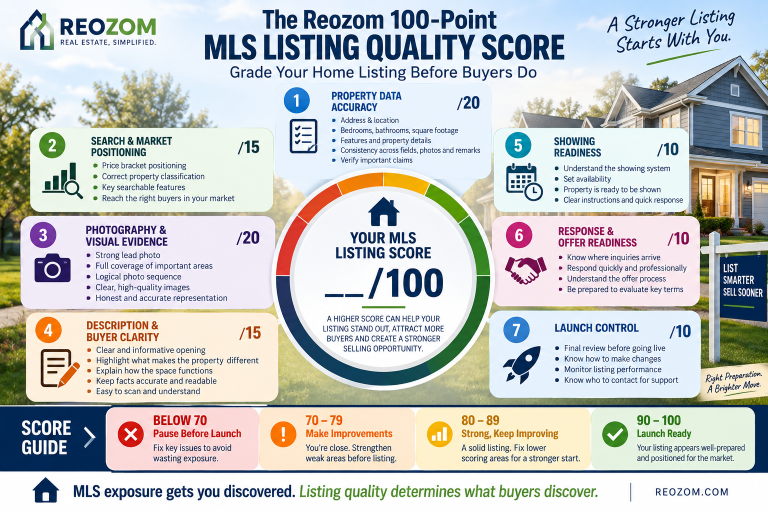
If you’re unsure about a property fact, verify it before representing it as fact.
A listing isn’t merely an advertisement.
It is structured information being presented to the marketplace.
A seller ultimately makes the decision about what price they are willing to offer their property for, subject to their contractual arrangements and applicable law.
But pricing deserves more thought than:
“My neighbor sold for $450,000, so mine must be worth $475,000.”
Properties differ.
Markets change.
Condition matters.
Timing matters.
Location within the same community matters.
Comparable sales need interpretation.
Michigan also regulates appraisal activity. LARA notes that licensed real estate brokers and salespersons can perform certain market analyses within the scope allowed by Michigan law, while formal appraisal activity is separately regulated.
If you’re taking greater control over pricing, make sure you understand the difference between:
an asking price
and
market evidence supporting that price.
Depending on the service, sellers may be able to provide their own photographs.
But don’t interpret:
“I can.”
as:
“It doesn’t matter how good they are.”
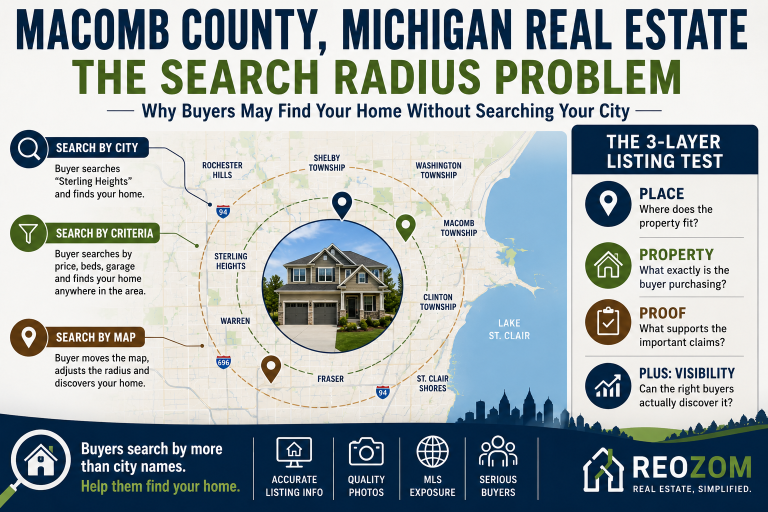
Think about how buyers search.
A buyer may see:
photo → price → location → basic features
before reading a single sentence of your carefully written description.
Your photographs are often the property’s first presentation.
Flat Fee MLS gives sellers more control.
That means sellers need to use that control well.
This is where service differences become very practical.
Before choosing any Flat Fee MLS provider, ask:
How are showing requests handled?
Do they come through an online system?
Email?
Text?
Telephone?
Can you set showing preferences?
Can you approve or decline times?
How are buyer agents instructed to request access?
These details may seem minor when you’re comparing prices.
They become much more important when your phone starts receiving showing activity.
Reozom’s current platform includes an online Showing Assistant designed to let sellers establish showing preferences and manage requests.
You can review the platform’s current functionality on Reozom’s Features page.
This is the moment when “selling my own home” stops feeling theoretical.
Someone has put real money and real terms on paper.
Now you’re evaluating much more than price.
Potential considerations can include:
Financing
Earnest money
Inspection
Appraisal
Closing date
Possession
Seller concessions
Contingencies
Buyer-broker compensation requests
and other terms.
The seller makes the ultimate decision about what they are willing to accept.
But understanding the document and the consequences of different terms matters.
Know what your Flat Fee MLS service provides at this stage—and know when you need additional professional guidance.
This area changed significantly in recent years, so older internet advice can be misleading.
Under current MLS policy, offers of compensation to buyer brokers cannot be made through the MLS.
Buyer representatives working with buyers are also generally required under current MLS policy to have written buyer agreements before touring homes, subject to applicable law. Those agreements must address compensation, and current policy requires disclosure that broker compensation is negotiable.
For sellers, another important rule is that any payment or offer of payment that the listing participant or seller will make to a buyer representative requires appropriate written seller authorization under current MLS policy.
So don’t rely on an old blog telling you:
“Just put X% in the MLS.”
That’s outdated.
Compensation should be treated as a separate negotiated issue under current rules and applicable agreements.
Not necessarily.
And this is exactly why sellers need to compare services carefully.
“Flat Fee MLS” describes a category.
It doesn’t tell you everything included in a particular package.
One provider may offer primarily MLS entry.
Another may also provide:
So when comparing services, don’t ask only:
Ask:
Our Complete Guide to Choosing a Flat Fee Broker in Michigan goes much deeper into that comparison.
Here’s a different way to determine which model may fit you.
You want substantial professional involvement throughout the transaction.
A traditional full-service arrangement may deserve consideration.
You want control over major decisions but significant professional support with execution.
Compare brokerage service packages carefully.
You’re comfortable with technology, property information, showings and seller decisions.
Flat Fee MLS may be worth exploring.
You may be thinking about a non-MLS FSBO route.
But recognize what you’re giving up when you remove MLS exposure from the equation.
There is no universally correct level.
The question is:
How much control do you want—and how much responsibility are you prepared to accept with it?
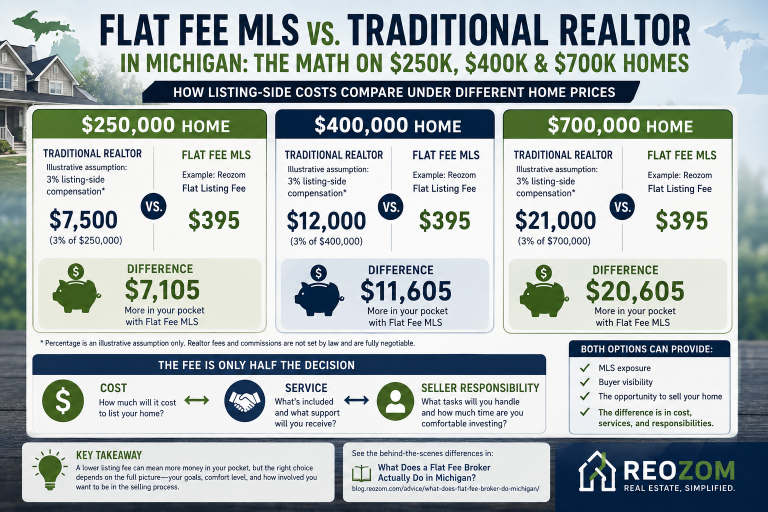
We’ve already tested this in the previous article.
Using an illustrative 3% listing-side percentage versus a $395 flat listing example, we showed:
| Sale Price | Illustrative 3% | $395 Example | Listing-Side Difference |
|---|---|---|---|
| $250,000 | $7,500 | $395 | $7,105 |
| $400,000 | $12,000 | $395 | $11,605 |
| $700,000 | $21,000 | $395 | $20,605 |
Those figures are not standard commissions or guaranteed savings.
Broker compensation is negotiable.
The table simply demonstrates how fixed and percentage-based pricing behave differently as home values change.
You can see the full analysis in:
Flat Fee MLS vs. Traditional Realtor in Michigan: The Math on a $250K, $400K & $700K Home
Reducing a listing-side expense does not eliminate other transaction costs.
Depending on the transaction, a Michigan seller may still encounter:
We’ve broken these down separately in:
How Much Does It Really Cost to Sell a House in Michigan in 2026?
That’s important because:
It changes one part of the selling model.
Now we can finally answer that without turning the entire article into an advertisement.
Reozom is a licensed real estate brokerage offering a Flat Fee MLS model for Michigan sellers.
Instead of requiring the seller to choose between:
full-service percentage-based listing
and
no MLS access,
Reozom’s model is designed for homeowners who want to take a more active role while still obtaining MLS listing exposure through a brokerage.
The current Michigan service provides a flat-fee listing structure together with tools intended to support the seller’s workflow.
You can review current pricing, features and terms on the Reozom Michigan Flat Fee MLS page.
The important word is:
Always review the current service rather than relying on an older blog article for package details.
If you’ve decided that Flat Fee MLS sounds appealing, don’t purchase the first inexpensive package you find.
Ask these ten questions.
Ask for specificity.
Michigan regulates real estate brokers and salespersons, and current license information can be checked through LARA’s real-time licensing resources.
Don’t assume every service offers the same duration.
Visual presentation matters.
Ask about price, photographs, remarks and other information.
A low initial fee can look different after add-on charges.
Know the workflow before buyers start requesting access.
This should not be a mystery.
Understand the service beyond MLS entry.
Perhaps the most important question of all.
An ordinary homeowner generally does not interact with an MLS in the same way a participating real estate professional does. Homeowners seeking MLS exposure without a conventional full-service listing arrangement commonly use a licensed brokerage offering a Flat Fee MLS model.
A homeowner can take a highly active role in selling their own property. However, selling independently and obtaining MLS exposure are separate questions. A Flat Fee MLS arrangement can involve a licensed brokerage while leaving significantly more responsibility with the seller.
Not exactly. Traditional FSBO can involve marketing without an MLS listing. Flat Fee MLS combines a seller-directed approach with MLS entry through a brokerage.
Selling property you own is different from engaging in licensed brokerage activity for others. Michigan regulates real estate brokers and salespersons under Article 25 of its Occupational Code.
Consumer property websites and an MLS are different parts of the real-estate information ecosystem. Using a consumer-facing platform does not make it equivalent to having a property entered into the applicable MLS through a participating brokerage.
Distribution varies according to the applicable MLS, brokerage, website and data-feed arrangements. Sellers should ask a provider specifically where and how its MLS listings are distributed rather than assuming every property appears everywhere.
Flat-fee models can give sellers substantial control over pricing decisions, depending on the listing agreement. Sellers should still use credible market information rather than treating an asking price as an arbitrary number.
There is no universal seller-paid buyer-agent amount required for every transaction. Broker compensation is negotiable, offers of buyer-broker compensation cannot be made through the MLS under current NAR policy, and applicable agreements determine the specific arrangement.
The listing-side expense can be considerably lower under some flat-fee models, but services and seller responsibilities may differ. Compare the complete service and likely transaction outcome—not just the advertised fee.
Flat-fee brokerage is a brokerage service model. Michigan regulates the real estate professionals and brokerages performing brokerage activities. Sellers should verify the brokerage providing the service and review the applicable listing agreement.
Let’s return to the original Google search:
“Can I list my house on the MLS without a Realtor in Michigan?”
Now we can give a much better answer.
Yes.
Potentially, depending on the service you choose.
You can retain substantial control under seller-directed models.
Some Flat Fee MLS services are designed around exactly that kind of seller involvement.
That’s where the answer changes.
Yes.
And that’s the idea behind Flat Fee MLS.
So perhaps the better question isn’t:
“How do I get rid of the Realtor?”
It’s:
“How much brokerage service do I actually want?”
For some Michigan sellers, the answer will be:
For others:
And for sellers comfortable taking responsibility for more of the process, Flat Fee MLS creates a middle path worth understanding.
Because selling your own home and getting professional-market exposure do not necessarily have to be mutually exclusive.
What Does a Flat Fee Broker Actually Do in Michigan? — Understand what happens between the seller, brokerage, MLS, showings, offers and closing.
Flat Fee MLS vs. Traditional Realtor in Michigan — Compare the listing-side math on $250K, $400K and $700K hypothetical home sales.
How Much Does It Really Cost to Sell a House in Michigan? — Understand the other costs that can affect seller net proceeds.
Complete Guide to Choosing a Flat Fee Broker in Michigan — Compare Flat Fee MLS providers beyond headline price.
Michigan Flat Fee MLS — Reozom — Review Reozom’s current Michigan listing service.






Lorem ipsum dolor sit amet, consectetur adipiscing elit. Ut elit tellus, luctus nec ullamcorper mattis, pulvinar dapibus leo.
© Copyright 2025 Reozom.com All rights reserved.
FSBO Listings in Florida and Michigan. Saving Home buyers and Sellers millions of dollars.