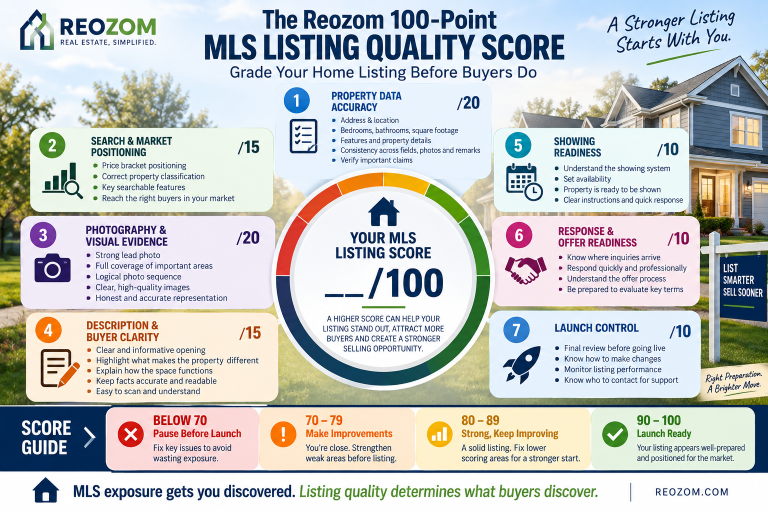
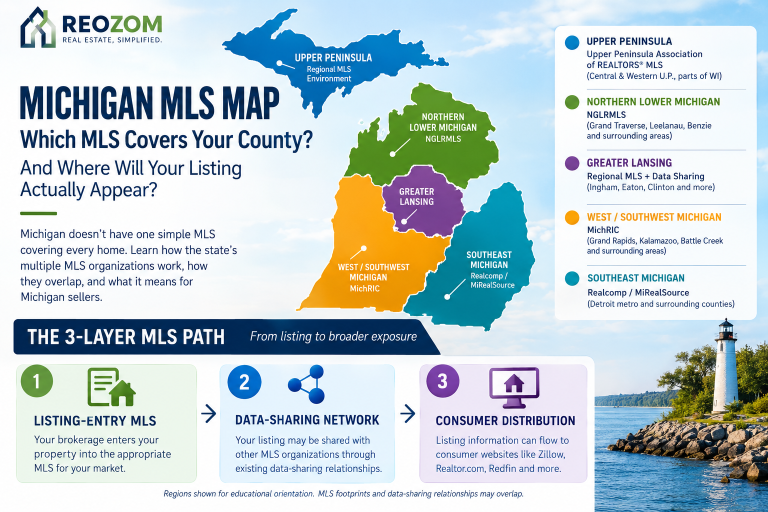
8:07 AM — The Seller Searches “Flat Fee Broker Michigan”
Let’s start with the terminology.
A flat fee describes how a service is priced.
It does not, by itself, tell you exactly what services are included.
That distinction matters.
One company may primarily provide MLS-entry services.
Another may provide:
- MLS entry
- listing changes
- photographs
- showing technology
- forms
- electronic signatures
- offer-management tools
- customer support
- transaction assistance
So two services described as Flat Fee MLS can be quite different.
This is why the first question shouldn’t be:
What’s the fee?
It should be:
What happens after I pay it?
Reozom’s Complete Guide to Choosing a Flat Fee Broker in Michigan explores those differences in much greater detail.
But today we’re following the transaction itself.
8:24 AM — Why Is There a Broker Involved at All?
This is where many homeowners misunderstand Flat Fee MLS.
An MLS is not simply another consumer classifieds website where anyone creates an account and uploads a house.
MLS participation generally operates through real estate professionals and organizations subject to the applicable MLS’s rules.
That’s why a Flat Fee MLS arrangement still involves a licensed real estate brokerage.
In Michigan, real estate brokers and broker companies operate under state licensing requirements administered by the Michigan Department of Licensing and Regulatory Affairs (LARA). Michigan describes a broker-company license as the license used by qualifying business entities engaged in brokerage activity, with the company represented by a principal associate broker.
Reozom, for example, identifies itself as a licensed Michigan real estate brokerage rather than simply a referral website.
This distinction is important.
Flat fee does not mean “no broker.”
It means the seller is choosing a different service and compensation structure from a conventional percentage-based listing arrangement.
8:42 AM — Sarah Chooses Her Service
Now our hypothetical seller has reached the first major decision.
What exactly does she want the brokerage to handle?
A traditional full-service arrangement may place more of the selling workflow in the hands of the listing professional.
A flat-fee model can shift more responsibility toward the seller.
But there is no universal definition of precisely what every flat-fee package includes.
That is why sellers need to inspect the actual service.
For example, Reozom currently describes its Michigan service as a $395 flat listing fee, with no additional Reozom commission or fee at closing. Its published features include up to 40 photographs, two virtual tours, unlimited listing changes, electronic disclosures, showing tools, listing statistics and customer support.
Those are Reozom’s current published features.
Another flat-fee broker may structure its service differently.
The seller’s first checklist
Before paying any Flat Fee MLS provider, determine:
What MLS exposure is included?
How long does the listing remain active?
How many photographs are included?
Can I change the price?
Can I replace photographs?
Are changes free or separately charged?
How do buyers request showings?
How do buyer agents contact me?
How are offers delivered?
What happens after I accept an offer?
What support is included?
Suddenly, “$X versus $Y” isn’t a very useful comparison.
You’re comparing workflows, not simply prices.
9:15 AM — The Seller Starts Building the Listing
Now Sarah begins entering information about her house.
This looks like ordinary data entry.
It isn’t.
She’s constructing the digital identity of the property.
She may need information such as:
- Property address
- Property type
- Bedrooms
- Bathrooms
- Square footage
- Lot information
- Garage
- Basement
- Heating/cooling
- Property features
- Asking price
- Photographs
- Public remarks
- Showing information
- Other MLS-specific fields
Different MLSs can require different information and forms.
And this is where the seller’s responsibility becomes significant.
A flat-fee arrangement doesn’t give a homeowner permission to become casual about accuracy.
Michigan’s real-estate rules prohibit licensees from misrepresenting material facts, which is one reason accurate property information and appropriate disclosure matter within a brokerage transaction.
For the homeowner, the practical lesson is simpler:
Don’t write what you hope is true. Enter what you can reasonably support as true.
10:03 AM — The Broker’s Work Becomes Less Visible
This is the part consumers often don’t see.
The seller may experience the process as:
I entered my information → My house appeared online.
But there is a layer between those two events.
The listing must move into the appropriate real-estate listing infrastructure.
Reozom explains its own process this way: seller-entered information is used to enter the property into the appropriate local Multiple Listing Service, after which the listing can flow from the MLS to consumer-facing real-estate websites.
That middle step is important.
The Flat Fee Broker isn’t merely selling you a webpage on its own website.
MLS entry is the bridge.
10:41 AM — The Property Enters the MLS
Now Sarah’s property becomes part of the applicable MLS environment.
This is one of the primary reasons sellers investigate Flat Fee MLS in the first place.
The MLS helps real estate professionals share structured listing information and provides a broad market view of homes available for sale. NAR describes accurate and reliable property data as one of the core values of an MLS.
But there’s an important misconception to correct.
MLS does not mean “the entire internet.”
The MLS is one part of the property-discovery ecosystem.
Consumer websites may receive listing information through MLS feeds and other data relationships.
Reozom, for example, explains that its listings are entered into the seller’s local MLS and then transferred onward to sites such as Realtor.com through that listing-data ecosystem.
So Sarah’s property journey may look approximately like:
SELLER
↓
LICENSED BROKER
↓
LOCAL MLS
↓
LISTING DATA DISTRIBUTION
↓
BUYER AGENTS + CONSUMER SEARCH SITES
↓
POTENTIAL BUYERS
That’s what the seller is really buying access to when MLS exposure is part of the service.
11:30 AM — The Listing Is Live. Is the Broker’s Job Finished?
No.
And neither is Sarah’s.
This is another misconception about flat-fee selling.
Some homeowners mentally treat MLS entry as the finish line:
“Great. We’re listed.”
It is actually the starting line.
Now real people begin interacting with the property.
They may:
- Save the listing
- Share it
- Ask questions
- Request a showing
- Have their agent request information
- Revisit the property later
- Compare it with competing homes
- Submit an offer
This is where the service structure you chose earlier begins to matter.
How are those interactions handled?
12:16 PM — The First Showing Request Arrives
Imagine a buyer wants to see Sarah’s house.
Now several practical questions arise.
Who receives the request?
How does Sarah know about it?
Can she accept it?
Can she suggest another time?
Can she establish showing preferences?
Does the buyer need to provide anything before visiting?
Different brokerages and platforms handle these questions differently.
Reozom’s current platform includes an online Showing Assistant that lets sellers establish showing preferences and receive requests. Its published system can notify sellers electronically and allow scheduling interaction between the parties.
That’s a good example of why sellers shouldn’t compare flat-fee services only by the cost of MLS entry.
Once the property is live, workflow matters.
2:05 PM — Sarah Notices a Mistake
Sarah opens her listing.
One photograph isn’t flattering.
She also realizes one property detail should be corrected.
What happens now?
With some services, listing modifications may be limited or cost extra.
With others, changes are included.
Reozom currently advertises unlimited changes, including photographs, without an additional change fee.
This sounds like a small feature before you list.
After you list, it can become much more important.
Imagine needing to:
- Correct a property detail
- Replace photographs
- Change the asking price
- Update remarks
- Change showing information
- Reflect a transaction-status change
The seller should understand before purchasing the service how those updates work.
DAY 3 — The Seller Wants to Change the Price
Sarah has reviewed the market response and decides she wants to change her asking price.
This illustrates the difference between control and execution.
The seller may make the pricing decision.
But the MLS listing itself still exists within the broker/MLS infrastructure.
The process for submitting and implementing the change depends on the brokerage and applicable MLS procedures.
That’s why a strong Flat Fee MLS service needs more than a one-time upload button.
The listing is a living record during the sale.
DAY 5 — An Offer Arrives
This is where the transaction suddenly feels very real.
A buyer wants the house.
What does the flat fee broker do now?
Again, the exact answer depends on the service agreement.
But one principle is especially important:
Offers cannot simply disappear into a system.
Under the 2026 REALTOR® Code of Ethics, listing brokers who are REALTORS® must submit offers and counteroffers objectively and as quickly as possible, and generally continue presenting offers until closing unless the seller has waived that obligation in writing.
Reozom’s current Michigan platform also provides an online offer workflow through which registered buyers or their agents can submit an offer, with the seller receiving electronic notification and having the ability to respond through the platform.
Now Sarah has decisions to make.
Price is only one of them.
An offer may also involve:
- Financing
- Earnest money
- Inspection
- Appraisal
- Closing date
- Possession
- Contingencies
- Concessions
- Personal property
- Other transaction terms
This is where a seller should understand exactly what support their chosen brokerage provides—and when legal, tax, title, lending or other professional advice may be appropriate.
DAY 5, 4:40 PM — “What About the Buyer’s Agent Commission?”
This deserves special attention because many online articles about Flat Fee MLS are now outdated.
Under current NAR MLS policy:
Offers of compensation to buyer brokers cannot be made through the MLS.
That does not mean compensation to a buyer’s representative is prohibited.
It means an offer of compensation cannot be communicated through the MLS itself. Such arrangements may be communicated or negotiated off-MLS, subject to applicable rules and agreements.
Another critical point:
Broker compensation is not set by law. It is negotiable. Current MLS policy requires this principle to be disclosed conspicuously in applicable agreements.
And if a listing broker or seller is going to make a payment or offer of payment to a buyer representative, current NAR policy requires appropriate written seller authorization specifying the amount or rate before the payment or agreement to pay.
So Sarah should not begin with:
“What percentage am I required to pay?”
A better question is:
“What are my options, what have I agreed to, and what makes sense for my transaction?”
That’s an important difference.
DAY 6 — Compensation and Seller Concessions Are Not the Same Thing
Another source of confusion is the word concession.
A seller concession can help cover certain buyer transaction costs.
That is different from an offer to compensate a buyer’s broker.
Current NAR guidance explains that concessions may potentially cover items such as transaction costs, repairs or other buyer expenses, depending on the transaction and financing limitations. Some MLSs may allow concessions to be indicated, although local MLS rules vary.
The important distinction is:
Buyer-broker compensation
and
seller concessions
are not automatically interchangeable concepts.
A knowledgeable seller should understand the difference before negotiating an offer.
DAY 8 — Sarah Accepts an Offer
Now the property moves into another phase.
This is where homeowners sometimes think:
“The marketing is over, so the work must be over.”
Not quite.
An accepted purchase agreement can start a chain of deadlines and responsibilities.
Depending on the transaction, that might involve:
inspection
↓
financing
↓
appraisal
↓
title work
↓
contingency management
↓
closing preparation
↓
closing
The brokerage service selected at the beginning determines how much assistance is included through these stages.
This is precisely why comparing Flat Fee MLS services only by their upfront price can be misleading.
THE BIG REVEAL: WHAT DID THE FLAT FEE BROKER ACTUALLY DO?
Now let’s rewind Sarah’s transaction.
At first she thought she was paying someone to:
“Put my house on MLS.”
But look at the complete system.
BEFORE LISTING
The brokerage provides the structure through which the seller enters the listing arrangement and prepares the information required for MLS entry.
MLS ENTRY
The property is entered into the applicable MLS according to the brokerage’s process and relevant MLS requirements.
DISTRIBUTION
MLS data can then become available to real estate professionals and flow to consumer property-search sites through applicable data feeds.
LISTING MAINTENANCE
Changes to price, photographs, property information and status must move through the listing system.
SHOWINGS
The service may provide technology or procedures for managing showing requests.
OFFERS
Offers need to reach the seller, and transaction communication must be handled appropriately.
TRANSACTION
After acceptance, there are still contractual, administrative and closing-related steps.
Suddenly:
“Put my house on MLS”
doesn’t describe the whole relationship very well.
SO WHAT DOES THE SELLER DO?
This is equally important.
Flat-fee selling can transfer more day-to-day responsibility to the homeowner.
Depending on the service selected, a seller may be responsible for more of the following:
- Determining the asking price
- Preparing the home
- Providing accurate property information
- Supplying photographs
- Writing or approving the property description
- Establishing showing availability
- Responding promptly to inquiries
- Evaluating market response
- Making pricing decisions
- Reviewing offers
- Negotiating decisions
- Keeping records organized
- Meeting transaction deadlines
- Coordinating with appropriate professionals
This isn’t necessarily a disadvantage.
For some sellers, control is exactly what they want.
But control and responsibility arrive together.
THE FLAT FEE BROKER / SELLER RESPONSIBILITY MAP
Here’s the simplest way to understand the model.
| Stage | Broker/Platform Role May Include | Seller Role May Include |
|---|
| Preparation | Listing workflow, forms, support | Property information, pricing decisions |
| MLS | MLS entry and compliance workflow | Accurate information |
| Marketing | MLS exposure/distribution tools | Photos, presentation, property readiness |
| Showings | Scheduling infrastructure | Availability and access decisions |
| Updates | Process MLS changes | Decide what should change |
| Offers | Receive/transmit or facilitate workflow | Evaluate and make decisions |
| Contract | Transaction tools/support depending on service | Understand and perform obligations |
| Closing | Brokerage-related transaction responsibilities | Coordinate seller obligations and professionals |
The exact division varies by brokerage and service package.
That sentence is important.
There is no universal Flat Fee MLS package.
THE $99 QUESTION
Suppose Sarah sees one service for $99.
Another costs $395.
Another costs $599.
Which is cheapest?
That’s easy.
Which provides the best value?
We can’t answer yet.
We need to know:
Does the $99 service charge for listing changes?
How many photographs are included?
How long is the listing active?
Which MLS receives it?
What happens when a buyer asks a question?
What happens when an offer arrives?
Is showing technology included?
Are forms included?
Is transaction support included?
Are there closing fees?
What responsibilities remain entirely with the seller?
Only then can Sarah compare them intelligently.
That’s why we’ve created a separate Complete Guide to Choosing a Flat Fee Broker in Michigan.
The cheapest entry price and the lowest total transaction cost are not necessarily the same thing.
WHAT REOZOM’S MODEL ACTUALLY INCLUDES
Now that we understand the general model, we can look at Reozom specifically.
Reozom currently describes its Michigan offering as a $395 flat listing fee and states that there is no additional Reozom commission or fee at closing.
Its published features currently include:
- Up to 40 photographs
- Two virtual tours
- Unlimited listing changes
- Electronic disclosures
- Showing-preference tools
- Online showing scheduling
- Listing statistics
- Online technical support
- Customer support
- Michigan online offer functionality
Reozom also identifies itself as a licensed Michigan brokerage rather than a referral service.
Homeowners can review the current service directly on Reozom’s Michigan Flat Fee MLS page.
This section is deliberately near the end of the article.
Why?
Because a seller should first understand what a flat fee broker does.
Then they can intelligently evaluate what Reozom provides.
That’s much more useful than starting the article with a sales pitch.
SEVEN QUESTIONS TO ASK ANY FLAT FEE BROKER IN MICHIGAN
Before Sarah closes her laptop, let’s give her one final checklist.
1. Are you actually a licensed brokerage?
Verify who is providing the brokerage service.
Michigan maintains real-time professional licensing information through the state’s Bureau of Professional Licensing.
2. Which MLS will contain my property?
Don’t settle for “we put you on MLS.”
Ask which MLS applies to the property.
3. What happens after my listing goes live?
Understand showings, questions, changes and offers.
4. What costs extra?
Ask about:
photographs,
changes,
extensions,
cancellation,
forms,
transaction assistance,
and closing-related brokerage charges.
5. What happens when I receive an offer?
Know the workflow before you’re staring at an offer with a deadline.
6. What am I responsible for?
A good service comparison should make seller responsibility clear.
7. What happens between accepted offer and closing?
This is where the differences between “MLS entry” and a broader brokerage service become especially important.
Frequently Asked Questions
What is a flat fee broker in Michigan?
A flat fee broker provides real estate brokerage services for a predetermined fee structure rather than relying solely on a traditional percentage-based listing commission. Services vary substantially by brokerage, so sellers should review the actual listing agreement and included services.
Is Flat Fee MLS the same as FSBO?
Not exactly. A seller may take on many FSBO-like responsibilities while using a licensed brokerage to obtain MLS exposure. The precise relationship depends on the listing agreement and service model.
For sellers considering a more hands-on approach, Reozom also provides Michigan FSBO information.
Can a homeowner put a property directly on an MLS?
MLS participation and listing submission operate under the applicable MLS’s membership and participation rules. This is why Flat Fee MLS services generally involve a participating licensed brokerage rather than functioning like an ordinary consumer classified-ad website.
Does Flat Fee MLS mean the broker does nothing after listing the property?
Not necessarily. Services vary widely. A package may include changes, showing technology, forms, offer handling and transaction support, while a more basic package may provide fewer services. Sellers need to compare the actual agreement.
Is buyer-agent compensation required in Michigan?
Broker compensation is negotiable and is not set by law. Under current NAR MLS policy, offers of buyer-broker compensation cannot be communicated through the MLS, although compensation arrangements may still be made off-MLS subject to applicable agreements, rules and law.
What’s the difference between Flat Fee MLS and a traditional listing agent?
The most important difference isn’t simply the fee. It is the division of services and responsibilities. A traditional full-service arrangement may place more responsibilities with the listing professional, while a flat-fee arrangement may leave more activities with the homeowner. Exact services vary.
How much does Reozom charge in Michigan?
At the time this article was prepared, Reozom advertises a $395 flat listing fee for its Michigan service and states there is no additional Reozom commission or fee at closing. Sellers should always check the current Michigan Flat Fee MLS service page for current pricing and terms.
THE ANSWER SARAH WAS ACTUALLY LOOKING FOR
Remember Sarah?
At 8:07 AM she searched:
“flat fee broker Michigan.”
She thought she was comparing prices.
But she was actually comparing something much larger:
Who provides the MLS access?
How does the listing get there?
How is it maintained?
How are showings handled?
How do offers reach me?
What happens after I accept one?
What does the brokerage handle?
What do I handle?
That’s the real Flat Fee MLS decision.
The fee matters.
But the workflow behind the fee matters too.
So before choosing a Flat Fee Broker in Michigan, don’t ask only:
“How much does it cost to list my house?”
Ask:
“What exactly happens from the moment I list until the moment I close?”
When you understand that answer, you’re no longer comparing advertisements.
You’re comparing real estate services.
Recommended Related Reading
Complete Guide to Choosing a Flat Fee Broker in Michigan (2026) — Use this next if you’re comparing different flat-fee service models.
Michigan Flat Fee MLS Listing Service — Review Reozom’s current Michigan service, features and pricing.
Sale by Owner in Michigan — Understand the responsibilities involved in taking a more active role in your home sale.
Reozom Features — See the platform tools available for listings, changes, showings and transaction management.