Most real estate searches begin with a location.
A buyer chooses a city.
A neighborhood.
A school district.
A commute radius.
Then they look for homes inside that boundary.
But some places challenge that conventional search pattern.
Monroe County is one of them.
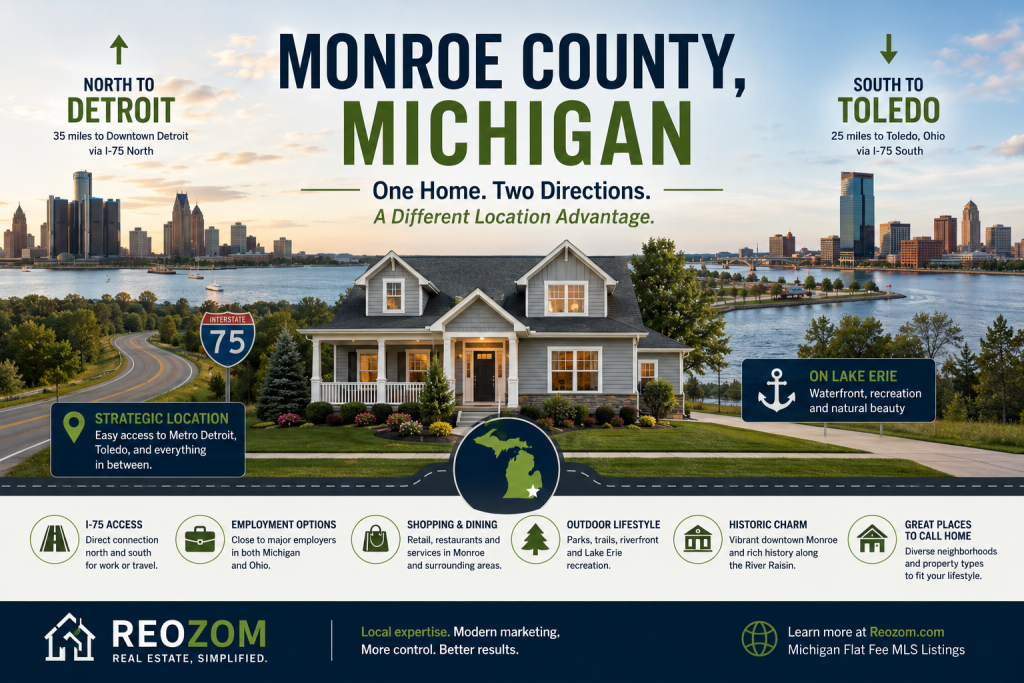
Located in Southeast Michigan along the western shore of Lake Erie, Monroe occupies an unusual geographic position. The National Park Service describes its River Raisin National Battlefield Park as approximately 35 miles south of Detroit, with I-75 providing direct access through the area.
Travel south instead, and the Ohio border and Toledo region become part of the broader geographic picture.
That creates an interesting question for real estate:
What happens when a home’s location can make sense in more than one direction?
For sellers, understanding that question can change how a property is presented online.
The Traditional Real Estate Search Is a Circle
Imagine someone accepting a new job.
They open a map.
They place their workplace in the center.
Then they mentally draw a circle around it:
How far am I willing to travel?
Homes inside the circle become possibilities.
Homes outside it disappear from consideration.
For decades, that simple geographic logic has influenced housing searches.
But remote work, hybrid schedules, two-income households and changing lifestyle priorities can make the circle considerably less perfect.
Sometimes it becomes an oval.
Sometimes two circles overlap.
And sometimes buyers aren’t optimizing around a single destination at all.
That’s where Monroe County becomes interesting.
Think of Monroe as an Overlap Market
Instead of viewing Monroe County only as the southern edge of Metro Detroit’s broader orbit, consider another possibility.
Some buyers may evaluate it as an overlap market.
Their lives may pull them north and south.
One household member might work toward Detroit.
Another might have professional connections toward Toledo.
Family could live in different directions.
Travel patterns might cross state lines.
A hybrid worker may only need to make a longer commute a few times per week.
None of this means Monroe County is automatically the right location for these buyers.
It means its geography can create a different decision framework.
And that is something sellers can communicate.
Location Isn't Just Distance Anymore
Real estate descriptions often reduce location to minutes:
“X minutes from downtown.”
“Y minutes from the airport.”
That information can be helpful.
But buyers increasingly have access to sophisticated maps and navigation tools.
They don’t necessarily need a listing description to calculate distance for them.
What they need is context.
A better property description might help buyers understand:
- access to major transportation routes
- nearby communities
- regional employment centers
- shopping and services
- recreational destinations
- waterfront access
- local attractions
The goal isn’t to tell buyers where they should work or travel.
It’s to help them understand where the property sits within the larger region.
I-75 Changes the Geography of the Search
Transportation corridors can quietly influence real estate discovery.
Monroe’s relationship with I-75 is particularly important because the interstate creates a north-south connection through Southeast Michigan.
The River Raisin National Battlefield Park, for example, provides visitor directions directly from Interstate 75.
For a homebuyer, highway access isn’t necessarily exciting enough to become the hero photograph.
But it can influence whether a property even enters the consideration set.
This is especially true when buyers are searching from outside Monroe County.
A House Can Compete in More Than One Search
Here’s where the idea becomes particularly relevant for sellers.
Imagine a buyer searching specifically for:
Monroe MI homes
That person is already looking locally.
Now imagine someone searching more broadly for:
homes south of Detroit
Or:
Michigan homes near Toledo
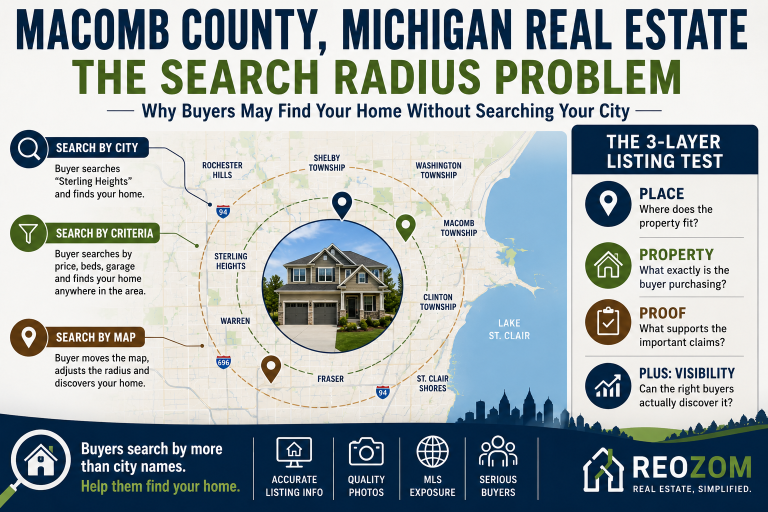
Or simply using a real estate website’s map search and gradually expanding the boundaries.
The same Monroe County property can potentially enter each discovery path.
This illustrates an important principle of digital real estate marketing:
Your buyer doesn’t necessarily begin their search by typing the name of your county.
Sometimes they discover the location because the property satisfies another requirement.
That Makes Digital Visibility Particularly Important
A yard sign is hyperlocal.
Someone generally has to pass the property to see it.
Digital real estate discovery works differently.
A buyer can begin thirty, fifty or hundreds of miles away.
They can search by:
- price
- bedrooms
- acreage
- property type
- map boundaries
- waterfront characteristics
- other filters
and discover a community they weren’t initially researching.
That’s one reason MLS exposure can matter.
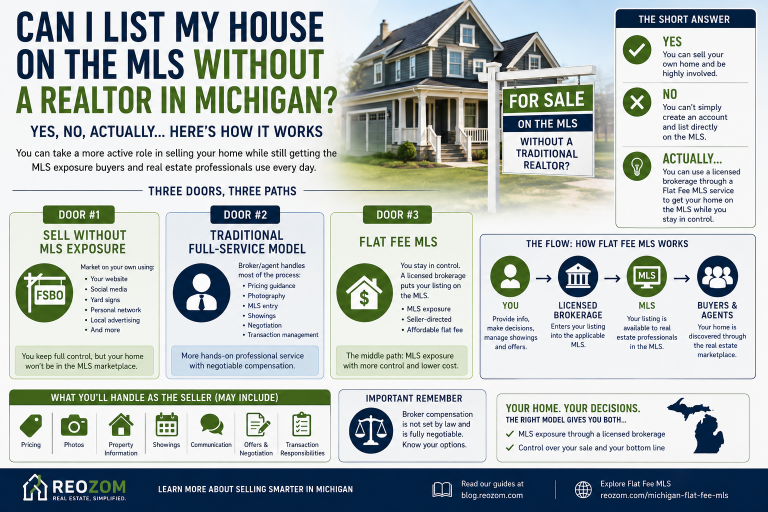
Homeowners who want broad property visibility while retaining greater control over their selling process can explore Reozom’s Michigan Flat Fee MLS listing options.
But visibility is only the beginning.
Don't Market Monroe as a Highway Exit
There is an important distinction here.
Transportation access can be valuable.
But Monroe County isn’t simply a midpoint between two larger cities.
Reducing the area to commuting convenience would miss much of its identity.
The City of Monroe highlights a historic downtown along the River Raisin and notes that the city contains Michigan’s only port on Lake Erie.
The area also contains something nationally significant.
A National Story Exists Inside the Local Story
The River Raisin National Battlefield Park preserves and interprets the January 1813 Battles of the River Raisin and their aftermath.
The National Park Service describes those events as including the greatest U.S. defeat of the War of 1812 and discusses the consequences for Native nations that followed.
Today, the park includes trails and visitor facilities and connects into the surrounding area’s recreational landscape.
For real estate marketing, the lesson isn’t to turn a property listing into a history lesson.
It’s something broader:
Communities have identities beyond commute times.
Lake Erie Adds a Third Dimension
Now the Monroe County equation becomes even more interesting.
North.
South.
And east—toward Lake Erie.
Monroe sits along Lake Erie’s western shoreline.
That means the county’s geographic identity isn’t only about access between metropolitan areas.
It also includes a Great Lakes environment.
For certain buyers, recreation, fishing, boating, wildlife, parks or simply proximity to the water can become part of the lifestyle decision.
Again, sellers shouldn’t make assumptions about what every buyer values.
The better strategy is to provide enough accurate context for different buyers to recognize what matters to them.
The Best Listing Description Answers “Where Does This Home Fit?”
Consider two hypothetical descriptions.
Description A
Beautiful Monroe County home conveniently located near I-75.
Useful—but generic.
Description B
Located in Southeast Michigan with convenient access to I-75, this property provides connections north toward Metro Detroit and south toward the Ohio border while remaining close to Monroe-area shopping, recreation and community amenities.
The second description gives buyers a mental map.
It doesn’t promise commute times.
It doesn’t claim everyone should work in Detroit or Toledo.
It simply explains where the property fits geographically.
That can be much more valuable.
The Two-Metro Idea Doesn't Apply Equally Everywhere
This is important.
Monroe County contains multiple communities and property types.
A home in the City of Monroe presents a different lifestyle from a rural property elsewhere in the county.
A property closer to the state line creates different transportation considerations from one farther north.
Water-oriented properties introduce another set of priorities.
Agricultural and larger-parcel properties create another.
USDA’s 2022 Census of Agriculture recorded 1,122 farms and 206,377 acres of land in farms in Monroe County, showing just how substantial agriculture remains within the county landscape.
So even within this one county, there is no single Monroe County buyer.
That Should Change the Seller's Marketing Question
Instead of asking:
“How do I advertise my house?”
Try asking:
“Which kinds of buyers could reasonably discover value in this particular property?”
Then work backward.
For a suburban home, the story may involve everyday convenience.
For acreage, it may be land.
For a waterfront-oriented property, it may be proximity to Lake Erie.
For another home, regional accessibility may matter.
Different properties require different narratives.
MLS Exposure + Context Is Stronger Than Exposure Alone
This is a principle worth repeating across Michigan real estate.
Putting a home into an MLS creates visibility.
A well-prepared listing creates understanding.
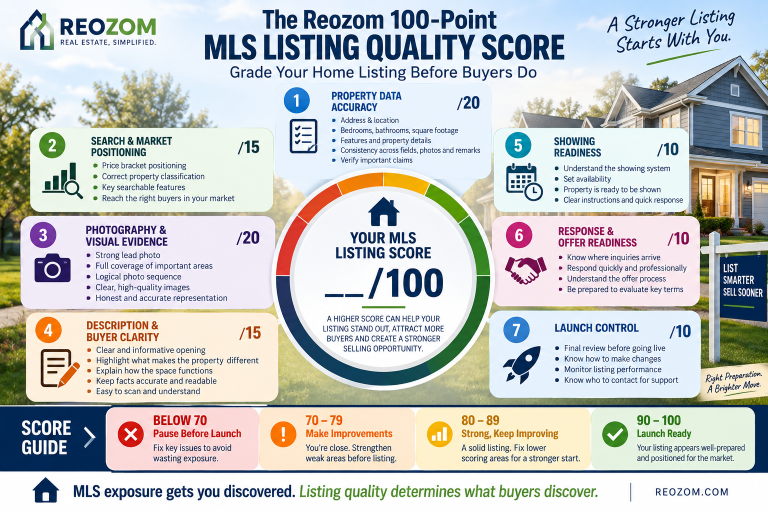
Sellers still need:
Accurate property information
Useful photography
Appropriate pricing
Clear geographic context
Responsive communication
Digital visibility
MLS exposure can’t replace those things.
It can help them reach more people.
What Should Monroe County Sellers Include?
Before publishing a listing, consider whether the information helps an unfamiliar buyer understand both the home and its location.
Property information
Bedrooms, bathrooms, square footage, condition, updates and major features.
Location context
Major road access, nearby communities and important local destinations.
Property characteristics
Lot, garage, outbuildings, waterfront characteristics or acreage where applicable.
Photography
Images that accurately represent the property rather than simply filling the available photo slots.
Community context
Useful nearby amenities and attractions where relevant.
Accurate claims
Avoid promising commute times, permitted land uses, school assignments or other information that buyers should independently verify.
What Does a Flat Fee Broker Have to Do With This?
Quite a lot—if the homeowner is comparing alternative listing models.
A flat fee service isn’t automatically identical from one brokerage to another.
One provider may primarily offer MLS entry.
Another may provide additional tools or assistance.
Before choosing a service, homeowners should understand:
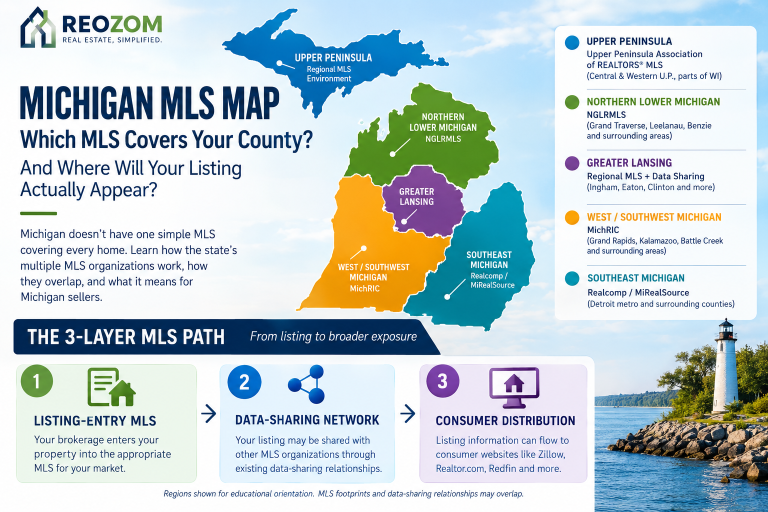
- which MLS will contain the listing
- how photographs are handled
- whether listing changes are included
- how buyer inquiries are delivered
- what happens when an offer arrives
- which services cost extra
- what responsibilities remain with the seller
We’ve created a separate comprehensive resource specifically for this decision:
Complete Guide to Choosing a Flat Fee Broker in Michigan
This should be the strongest internal link in the Monroe article because it connects your informational local content directly to the keyword cluster you’re trying to strengthen.
Monroe County Shows Why Michigan Needs Local Stories
We’ve now examined Michigan counties through very different lenses.
Montcalm County showed us how acreage can change the property story.
Oakland County demonstrated why one county can contain multiple micro-markets.
Muskegon County illustrated how community reinvention can influence perceptions of place.
Monroe gives us something different.
Geographic optionality.
It demonstrates that location doesn’t always mean choosing one center.
Sometimes value comes from being connected to several different directions at once.
The Homebuyer Map Is Becoming More Flexible
Real estate will always be local.
But the way buyers define “local” continues to evolve.
Hybrid schedules can change commute tolerance.
Online property discovery expands search boundaries.
Two-income households can have competing geographic priorities.
Family connections can pull buyers in multiple directions.
Lifestyle preferences add another layer.
Monroe County sits in an especially interesting position within that changing map.
For sellers, the lesson is simple:
Don’t assume buyers already understand why your location matters.
Show them.
Accurately.
Clearly.
And give the property enough digital visibility to be discovered by buyers whose search may have started somewhere completely different.
Frequently Asked Questions
Where is Monroe County, Michigan?
Monroe County is in Southeast Michigan along the western Lake Erie region and the Ohio border. The City of Monroe is approximately 35 miles south of Detroit.
Why can Monroe County appeal to buyers considering multiple regions?
Its Southeast Michigan location and I-75 access can make regional connectivity part of the housing decision for some buyers. Individual travel requirements should always be evaluated by the buyer.
Does Monroe County have rural properties as well as city and suburban housing?
Yes. Monroe County includes a significant agricultural landscape; USDA counted 1,122 farms covering 206,377 acres in 2022.
Why does online visibility matter when selling a Monroe County home?
Online property searches allow buyers to discover homes using maps, prices, property characteristics and broader geographic boundaries rather than searching only by a specific city or county name.
Can Monroe County homeowners use Flat Fee MLS?
Flat Fee MLS is one possible listing approach. Homeowners should compare MLS coverage, services, pricing, support and their own responsibilities before choosing a provider.
How should sellers choose a flat fee broker in Michigan?
Compare more than the advertised price. Evaluate MLS exposure, included services, listing-change policies, technology, support, additional charges and the responsibilities assigned to the seller.