FIRST: THIS IS NOT “3% VS. $395”
That would make a great advertisement.
It wouldn’t make a particularly good analysis.
Why?
Because a traditional listing arrangement and a Flat Fee MLS arrangement may involve very different divisions of work.
Suppose Seller A pays a percentage-based listing fee.
Their service might include substantial assistance with:
pricing,
property preparation,
photography,
listing creation,
showing coordination,
communication,
negotiation,
transaction management,
and other activities depending on the agreement.
Seller B chooses Flat Fee MLS.
They may pay substantially less on the listing side but take responsibility for more of those activities.
So if we write:
Traditional = $12,000
versus
Flat Fee = $395
we’ve compared two numbers.
We haven’t necessarily compared two equivalent services.
That’s the first rule of our experiment:
Compare both COST and RESPONSIBILITY.
If you’re not yet familiar with the division of work, read What Does a Flat Fee Broker Actually Do in Michigan? before continuing.
THE FOUR VARIABLES IN OUR MICHIGAN SELLER MATH TEST
Instead of pretending every transaction is identical, we’re going to separate four things.
VARIABLE #1 — SALE PRICE
We’ll test:
$250,000
$400,000
$700,000
VARIABLE #2 — LISTING-SIDE COST
We’ll compare a hypothetical percentage-based listing arrangement with a hypothetical flat listing fee.
VARIABLE #3 — OTHER TRANSACTION COSTS
These can include transfer taxes, title/closing expenses, concessions, negotiated buyer-broker compensation and other transaction-specific expenses.
VARIABLE #4 — SELLER RESPONSIBILITY
This is the variable most online calculators leave out.
And it may be one of the most important.
WHY WE ARE NOT USING “THE STANDARD REALTOR COMMISSION”
Because there isn’t one.
Broker compensation is negotiable.
Current NAR policy requires disclosure that broker fees and commissions are not set by law and are fully negotiable.
So throughout this article, whenever we use a percentage, it is an:
ILLUSTRATIVE ASSUMPTION
It is not:
a required Michigan rate
a standard commission
or
a prediction of what a particular brokerage will charge.
That distinction matters.
ROUND ONE: THE $250,000 MICHIGAN HOME
Let’s begin with a hypothetical $250,000 sale.
For our experiment only, imagine:
OPTION A — PERCENTAGE-BASED LISTING
Hypothetical listing-side compensation:
3%
Math:
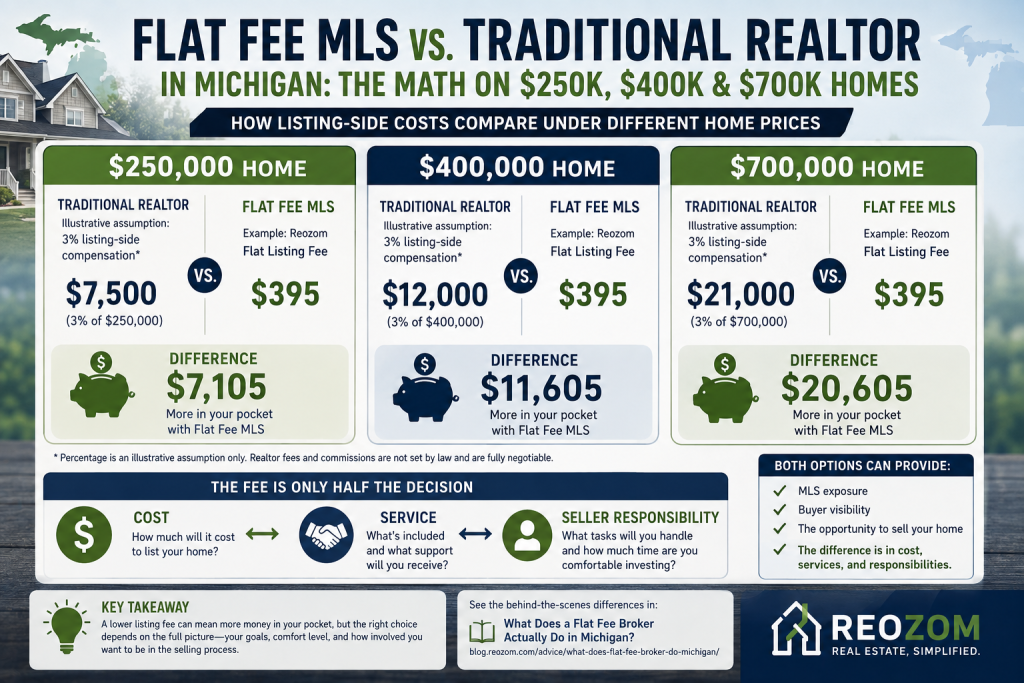
$250,000 × 3% = $7,500
OPTION B — FLAT FEE LISTING
For illustration, we’ll use Reozom’s currently published Michigan flat listing price:
$395
Reozom currently describes its Michigan service as a fixed-fee MLS listing option rather than a percentage-based listing-side commission.
Now compare only this one cost:
| $250K Sale | Hypothetical Percentage Model | Flat Listing Example |
|---|
| Sale price | $250,000 | $250,000 |
| Listing-side assumption | 3% | $395 |
| Listing-side cost | $7,500 | $395 |
| Difference | | $7,105 |
That’s substantial.
But don’t call it $7,105 saved yet.
We haven’t finished the experiment.
THE QUESTION BEHIND THE $7,105
What does Seller A receive for the $7,500?
What does Seller B receive for $395?
And what must Seller B do themselves?
That’s the real comparison.
Suppose Seller B needs to manage more of the:
pricing decisions
property preparation
photographs
showing coordination
buyer communication
offer evaluation
negotiation decisions
and other parts of the transaction.
Seller B may be perfectly comfortable doing that.
Seller A may strongly prefer not to.
So our first result isn’t:
Flat fee wins.
It’s:
Flat fee creates a large listing-side cost difference under these assumptions—but the seller must decide whether the difference in services and responsibilities makes sense for them.
That’s much more useful.
ROUND TWO: THE $400,000 MICHIGAN HOME
Now increase the sale price.
Keep our hypothetical percentage assumption unchanged.
PERCENTAGE MODEL
$400,000 × 3% = $12,000
FLAT LISTING EXAMPLE
$395
Difference:
$11,605
| $400K Sale | Hypothetical Percentage Model | Flat Listing Example |
|---|
| Sale price | $400,000 | $400,000 |
| Listing-side assumption | 3% | $395 |
| Listing-side cost | $12,000 | $395 |
| Difference | | $11,605 |
Something important just happened.
The home price increased by $150,000.
The percentage-based cost increased:
$7,500 → $12,000
Our assumed fixed fee didn’t.
That’s one of the fundamental mathematical differences between:
PERCENTAGE
and
FIXED-FEE
pricing.
THE QUESTION A $400K SELLER SHOULD ASK
Don’t simply ask:
Can I save $11,605?
Ask:
What additional responsibilities am I accepting in exchange for potentially retaining that $11,605?
Now put a hypothetical value on your own time.
Suppose managing additional parts of the transaction takes:
10 hours
or
20 hours
or
40 hours.
There is no universal number—we’re simply thinking through the trade-off.
At a hypothetical 20 hours:
$11,605 ÷ 20 = $580.25
That doesn’t mean the seller “earns $580/hour.”
It means the cost difference is large enough that the seller should seriously evaluate the responsibilities rather than dismissing either model without analysis.
ROUND THREE: THE $700,000 MICHIGAN HOME
Now let’s change only the sale price again.
PERCENTAGE MODEL
$700,000 × 3% = $21,000
FLAT LISTING EXAMPLE
$395
Difference:
$20,605
| $700K Sale | Hypothetical Percentage Model | Flat Listing Example |
|---|
| Sale price | $700,000 | $700,000 |
| Listing-side assumption | 3% | $395 |
| Listing-side cost | $21,000 | $395 |
| Difference | | $20,605 |
Now the mathematics becomes impossible to ignore.
But something else becomes more important too.
RISK.
A $700,000 transaction may represent a much larger financial event for the seller.
So the seller shouldn’t think only:
I can potentially reduce my listing-side expense by $20,605.
They should also ask:
Am I comfortable managing the responsibilities my chosen service leaves with me on a $700,000 transaction?
Those are two sides of the same decision.
NOW PUT ALL THREE HOMES ON ONE PAGE
Here’s our experiment:
| Sale Price | Hypothetical 3% Listing Cost | $395 Flat Listing Example | Difference |
|---|
| $250,000 | $7,500 | $395 | $7,105 |
| $400,000 | $12,000 | $395 | $11,605 |
| $700,000 | $21,000 | $395 | $20,605 |
This table demonstrates something simple but powerful:
A percentage-based expense grows with the sale price. A true fixed fee does not.
But again:
Difference ≠ guaranteed savings.
The final financial result depends on the entire transaction.
And that’s where this article becomes more interesting.
THE SALE-PRICE BREAK-EVEN TEST
Suppose Seller A uses a hypothetical percentage-based listing arrangement costing $12,000 on a $400,000 sale.
Seller B pays our $395 flat-fee example.
The listing-side difference is:
$11,605
Now imagine Seller A ultimately sells for:
$400,000
How much lower could Seller B’s sale price theoretically be before the listing-side cost difference is completely erased?
Ignoring every other difference:
$11,605
In other words, under this deliberately simplified experiment:
Seller A:
$400,000 − $12,000 = $388,000
Seller B could theoretically have:
$388,395 − $395 = $388,000
and arrive at the same amount before other transaction expenses.
This is not a prediction.
It’s a break-even concept.
And it reveals the question sellers really need to ask:
Will the different service model affect my sale outcome enough to offset the difference in cost?
Nobody can responsibly answer that for every property.
But every seller should understand the question.
NOW REVERSE THE EXPERIMENT
Suppose both properties sell for exactly:
$400,000
Then under our listing-side assumptions:
Seller A:
$400,000 − $12,000 = $388,000
Seller B:
$400,000 − $395 = $399,605
before all other transaction costs.
Difference:
$11,605
Now the fixed-fee model produces a clear listing-side mathematical advantage.
So the comparison turns on two things:
COST DIFFERENCE
and
OUTCOME DIFFERENCE
This is why “Which one costs less?” isn’t enough.
WHAT ABOUT THE BUYER’S AGENT?
Now we need to remove another common source of bad comparison math.
Some articles still write:
Traditional Realtor = 6%
Flat Fee MLS = flat fee + 3% buyer agent
as though those are mandatory rates.
They’re not.
Current rules prohibit offers of compensation to buyer brokers on the MLS, and broker compensation remains negotiable.
Depending on the transaction and agreements, a seller may agree to contribute toward buyer-broker compensation.
For our comparison, therefore, we should treat buyer-side compensation as a separate variable.
Why?
Because if the same hypothetical buyer-side amount applies to both Option A and Option B, it doesn’t explain the difference between the two listing models.
Example:
Seller A buyer-side amount:
$8,000
Seller B buyer-side amount:
$8,000
That cost matters to both sellers.
But it doesn’t change the:
$11,605 listing-side difference
in our $400,000 experiment.
That’s cleaner math.
SAME WITH MICHIGAN TRANSFER TAX
Our previous guide showed that Michigan real estate transfer taxes can represent a meaningful seller expense in a taxable transaction.
For the examples we used:
$250,000 → approximately $2,150
$400,000 → approximately $3,440
$700,000 → approximately $6,020
subject to the statutory calculation and applicable exemptions.
Those costs matter.
But if the same property sells for the same price under either listing model, the transfer-tax calculation isn’t what differentiates:
Flat Fee MLS
from
traditional percentage-based listing services.
That’s why we shouldn’t clutter our comparison by pretending every selling cost changes.
Our detailed Michigan home-selling cost guide explains those additional expenses separately.
THE VARIABLES THAT ACTUALLY CHANGE BETWEEN THE TWO MODELS
Now we’re getting somewhere.
Think of the transaction as two buckets.
BUCKET A — COSTS THAT MAY EXIST EITHER WAY
Depending on the transaction:
Mortgage payoff
Michigan transfer tax
Title/closing expenses
Seller concessions
Buyer-broker compensation if negotiated
Repairs
Moving
Other transaction expenses
BUCKET B — COSTS AND RESPONSIBILITIES THAT MAY CHANGE WITH YOUR LISTING MODEL
Listing-side brokerage cost
Pricing assistance
Photography
Listing preparation
Showing coordination
Communication
Negotiation assistance
Transaction support
Seller workload
Those are the variables we should focus on when comparing selling models.
THE RESPONSIBILITY TEST
Let’s stop talking about dollars for a moment.
Give yourself one point for every statement that sounds like you.
PRICING
I am comfortable researching the market and making my own pricing decisions.
PROPERTY INFORMATION
I can accurately organize the details needed for my listing.
PHOTOGRAPHY
I can arrange effective property photography.
SHOWINGS
I’m comfortable coordinating access and showing requests.
COMMUNICATION
I can respond promptly to buyer and agent inquiries.
OFFERS
I’m comfortable reviewing offers and understanding when I need professional guidance.
NEGOTIATION
I’m comfortable making negotiation decisions.
DEADLINES
I can stay organized through a transaction with important dates and responsibilities.
TECHNOLOGY
I’m comfortable managing parts of my home sale online.
TIME
I actually have time to do these things.
Now count your answers.
This isn’t a scientific score.
But it reveals something a commission calculator cannot:
How well does the selling model fit the seller?
SELLER A: “I WANT SOMEONE TO HANDLE IT”
Imagine David.
He works long hours.
He is relocating.
He doesn’t want to manage showing requests.
He doesn’t want to research comparable properties.
He doesn’t want to coordinate listing preparation.
He doesn’t want to manage buyer communication.
For David, paying more for a broader full-service arrangement may be perfectly rational.
His objective isn’t:
MINIMIZE LISTING COST
It’s:
MINIMIZE MY INVOLVEMENT
Those are different goals.
SELLER B: “I WANT CONTROL”
Now imagine Lisa.
She has sold property before.
She understands her neighborhood.
She’s comfortable using online systems.
She wants direct visibility into showing activity.
She’s comfortable communicating.
And she’s willing to do more herself in exchange for reducing her listing-side expense.
A Flat Fee MLS model may deserve serious consideration.
Reozom describes its Michigan service as designed for sellers who want MLS visibility and greater control while using a fixed-fee listing model.
Lisa’s objective is:
CONTROL COST WHILE REMAINING INVOLVED
Again, different goal.
SELLER C: “I WANT THE CHEAPEST OPTION”
This seller concerns me more.
Not because cost doesn’t matter.
It matters enormously.
But if the entire decision is:
Which website has the smallest number on the pricing page?
they may be comparing incomplete information.
One Flat Fee MLS service may include:
more photographs,
listing changes,
showing technology,
longer listing duration,
forms,
support,
or other tools.
Another may charge separately.
Even competing Michigan flat-fee providers currently advertise substantially different package structures and closing-related fees, which reinforces why headline price alone is an incomplete comparison.
That’s why we’ve already created a separate Complete Guide to Choosing a Flat Fee Broker in Michigan.
THE “SAME HOUSE” EXPERIMENT
Now let’s conduct the fairest comparison possible.
One hypothetical Michigan property.
Same house.
Same condition.
Same photographs.
Same listing information.
Same asking price.
Same MLS exposure.
Same eventual sale price.
Same buyer-side arrangement.
Same concessions.
Same transfer tax.
Same closing expenses.
The only variable we change is the listing-side brokerage model.
At $400,000:
OPTION A
Hypothetical 3% listing-side compensation:
$12,000
OPTION B
Illustrative Reozom flat listing fee:
$395
Listing-side difference:
$11,605
Under this artificial same-everything experiment, the lower listing-side cost clearly leaves more money with Seller B.
But real transactions aren’t laboratories.
The houses may be the same.
The execution may not be.
And that leads to the most important section of this article.
THE $11,605 QUESTION
Imagine someone offers you:
$11,605
but says:
“In exchange, you’ll need to take more responsibility for managing your home sale.”
Would you do it?
Some Michigan sellers would immediately say:
YES.
Others:
ABSOLUTELY NOT.
And both can be rational decisions.
Because the value of professional service isn’t identical for every homeowner.
The real decision is:
Is the additional service I receive worth the additional cost to me?
That’s much more useful than arguing that one model is universally better.
WHAT DOES REOZOM ACTUALLY INCLUDE?
Now that we understand the comparison, we can look specifically at Reozom.
Reozom currently positions its Michigan service as a Flat Fee MLS model intended to provide MLS exposure while allowing sellers to retain more control over pricing, showings and communication.
The current service page describes:
MLS submission through a licensed broker
structured listing activation
listing distribution
and a seller-directed transaction workflow.
You can review the current service and pricing directly on the Michigan Flat Fee MLS listing page.
And because services and pricing can change, sellers should always review the current offering rather than relying solely on an article.
THE DECISION MATRIX
Forget price for 60 seconds.
Which column sounds more like you?
| Seller Priority | Flat Fee MLS May Fit Better | Full-Service Agent May Fit Better |
|---|
| Reduce listing-side expense | ✓ | |
| Stay highly involved | ✓ | |
| Direct control | ✓ | |
| Comfortable with technology | ✓ | |
| Comfortable coordinating parts of sale | ✓ | |
| Want more tasks handled for you | | ✓ |
| Limited time for transaction | | ✓ |
| Prefer professional involvement throughout | | ✓ |
| Comfortable paying more for broader service | | ✓ |
This isn’t a verdict.
It’s a fit test.
THE QUESTION ISN’T “WHICH IS BETTER?”
That’s the wrong question.
A hammer is better than a screwdriver for a nail.
A screwdriver is better than a hammer for a screw.
The tool needs to match the job.
Likewise:
A seller who wants substantial hands-on professional involvement may value a traditional full-service relationship.
A capable seller who wants MLS exposure while retaining control may value a Flat Fee MLS model.
The important thing is to understand what you’re choosing.
Frequently Asked Questions
Is Flat Fee MLS cheaper than a traditional Realtor in Michigan?
It can have a substantially lower listing-side cost because a fixed listing fee doesn’t increase with the home’s sale price. However, sellers should compare services, responsibilities, other transaction expenses and the final financial outcome—not simply the advertised listing fee.
How much does a traditional Realtor charge in Michigan?
There is no legally fixed or standard commission that every Michigan seller must pay. Brokerage compensation is negotiable. Any percentage used in this article is purely illustrative.
How much does Flat Fee MLS cost in Michigan?
Pricing varies by provider and package. Reozom currently publishes its Michigan service as a fixed-fee listing model; sellers should check the current Michigan Flat Fee MLS page for current pricing and terms.
Does Flat Fee MLS provide the same service as a traditional agent?
Not necessarily. Both can provide MLS exposure, but the division of responsibilities can differ substantially. A Flat Fee MLS seller may take responsibility for more aspects of pricing, preparation, communication, showings or negotiation depending on the chosen service.
Does the seller still pay a buyer’s agent with Flat Fee MLS?
There is no universal buyer-broker amount every seller must pay. Compensation is negotiable, and offers of buyer-broker compensation cannot be made on the MLS under current NAR rules. Any seller contribution depends on the applicable transaction and agreements.
Is Flat Fee MLS better for expensive Michigan homes?
The mathematical difference between a percentage-based listing expense and a fixed fee grows as the sale price rises, assuming the same percentage and fixed fee. But higher price alone does not determine which service model is appropriate. The seller should also evaluate responsibilities, property complexity, experience, risk and desired support.
What other costs should Michigan sellers consider?
Potential expenses can include Michigan transfer taxes, title/closing costs, negotiated buyer-broker compensation, concessions, preparation, repairs and moving expenses. See our complete guide to the cost of selling a house in Michigan.
How do I know whether Flat Fee MLS is right for me?
Evaluate your experience, available time, comfort with pricing and communication, ability to manage showings and offers, desired level of professional assistance, and the financial difference between service models.
THREE HOMES. THREE DIFFERENCES. ONE DECISION.
Let’s return to our three Michigan sellers.
$250,000 HOME
Illustrative listing-side difference:
$7,105
$400,000 HOME
Illustrative listing-side difference:
$11,605
$700,000 HOME
Illustrative listing-side difference:
$20,605
Those numbers are interesting.
But they’re not the answer.
Because we still need to know:
What services are included?
What responsibilities remain with the seller?
How comfortable is the seller managing them?
How does the property perform in the market?
What is the final net result?
That’s why the smartest Michigan seller doesn’t simply ask:
“Which option charges less?”
They ask:
“What am I paying for—and what am I willing to do myself?”
Once you can answer those two questions, the comparison between Flat Fee MLS and a traditional Realtor becomes much clearer.
Recommended Related Reading
What Does a Flat Fee Broker Actually Do in Michigan? — Understand the workflow before comparing the cost.
How Much Does It Really Cost to Sell a House in Michigan? — See the other costs that can affect seller net proceeds.
Complete Guide to Choosing a Flat Fee Broker in Michigan — Compare Flat Fee MLS services beyond headline pricing.
Michigan Flat Fee MLS — Review Reozom’s current Michigan listing service.