On paper, many real estate decisions appear straightforward.
If two approaches offer similar exposure and outcomes, logic suggests sellers would choose the more efficient option.
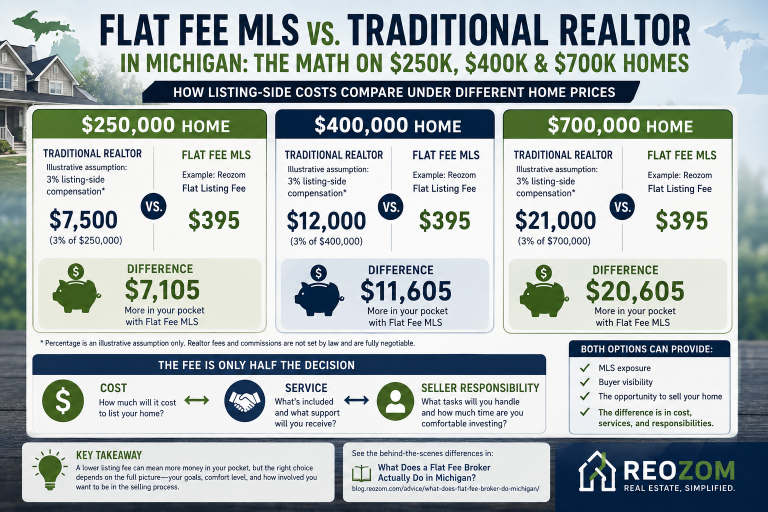
Yet in practice, many Michigan homeowners continue to choose higher-cost paths—even when alternatives are available.
This isn’t a failure of logic.
It’s a reflection of how human decision-making actually works.
Real Estate Decisions Are Emotional Before They Are Financial
Selling a home is not like buying a product.
It involves:
- A significant financial asset
- Emotional attachment
- Uncertainty about outcomes
Because of this, sellers often prioritize:
- Confidence
- perceived safety
- reduced stress
over pure cost optimization.
The “Safety Premium” Effect
In behavioral economics, there is a concept known as the safety premium.
People are willing to pay more when they believe it reduces risk.
In real estate, this often translates to:
- Choosing familiar models
- Paying higher costs for perceived assurance
- Avoiding decisions that feel “different”
Case Insight:
A seller in Ann Arbor may:
- Know that alternative approaches exist
- Understand potential savings
But still choose a traditional path because:
👉 “It feels safer”
Familiarity Bias in Michigan Real Estate
Familiarity plays a major role in decision-making.
For decades, the real estate process has followed a consistent structure.
This creates:
- Expectations about how selling should work
- Comfort with known processes
- Resistance to change
Example:
A homeowner preparing to sell may:
- Ask friends for recommendations
- Follow what others have done
- Avoid exploring unfamiliar options
Even if those options are more efficient.
The Fear of Missing Out on Buyers
One of the strongest psychological drivers is:
“What if I miss the right buyer?”
This fear leads sellers to believe that:
- More traditional approaches = wider exposure
- Higher cost = better reach
Even though:
👉 Exposure is largely driven by MLS distribution
Trust and Intermediaries
Trust is central to real estate decisions.
Sellers often:
- Associate trust with human intermediaries
- Feel more comfortable delegating responsibility
This creates a perception that:
👉 More layers = more security
Even when:
👉 It may introduce inefficiencies
Decision Fatigue and Simplification
Selling a home involves many decisions:
- Pricing
- timing
- negotiation
- presentation
To reduce mental load, sellers often choose:
👉 The most straightforward option
Even if:
👉 It is not the most efficient
Case Example: Two Seller Mindsets
Seller A:
- Research-driven
- evaluates multiple approaches
- prioritizes efficiency
Seller B:
- prefers simplicity
- follows familiar path
- prioritizes peace of mind
Outcome:
Both may achieve similar sale results.
But:
👉 Their decision process—and cost—differs significantly
The Role of Social Proof
Sellers often rely on:
- Recommendations from friends
- Local market norms
- perceived “standard” practices
This creates a reinforcing cycle:
👉 “If everyone does it, it must be right”
Shifting Toward More Informed Decisions
The landscape is gradually changing.
Today’s sellers have:
- Access to more information
- Greater transparency
- More control over the process
This leads to:
- More comparison
- More awareness of cost structures
- More willingness to explore alternatives
The Intersection of Psychology and Technology
Technology is not just changing processes—it is changing behavior.
As sellers become more comfortable with:
- digital platforms
- real-time information
- direct communication
Their decision-making evolves.
A More Balanced Approach to Selling
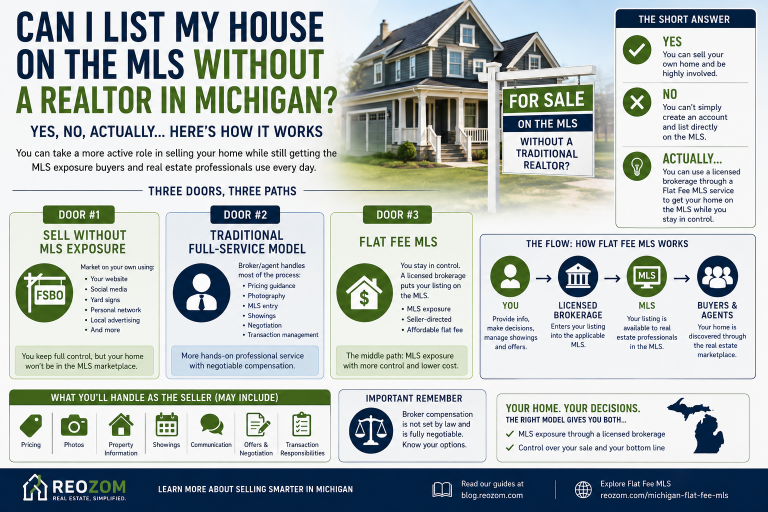
Modern approaches allow sellers to:
- Maintain control
- reduce unnecessary costs
- stay actively involved
without sacrificing:
- exposure
- efficiency
- outcomes
👉 Learn how this works in practice:
Michigan flat fee MLS listing service
Final Thought
Real estate decisions are not purely rational—and they don’t need to be.
But understanding the psychology behind them allows sellers to:
- make more informed choices
- reduce unnecessary costs
- align their approach with modern realities
To understand the broader vision and approach behind how modern real estate platforms are evolving, visit our About Us page.