A three-bedroom house on a quarter-acre lot can usually be introduced to buyers in familiar terms.
Bedrooms.
Bathrooms.
Square footage.
Kitchen.
Garage.
Updates.
But what happens when the property includes six acres?
Or a pole barn?
A wooded section?
A pond?
A long private drive?
Room for a garden, workshop, equipment, recreation—or simply more distance between neighbors?
Suddenly, the house is only part of what is being sold.
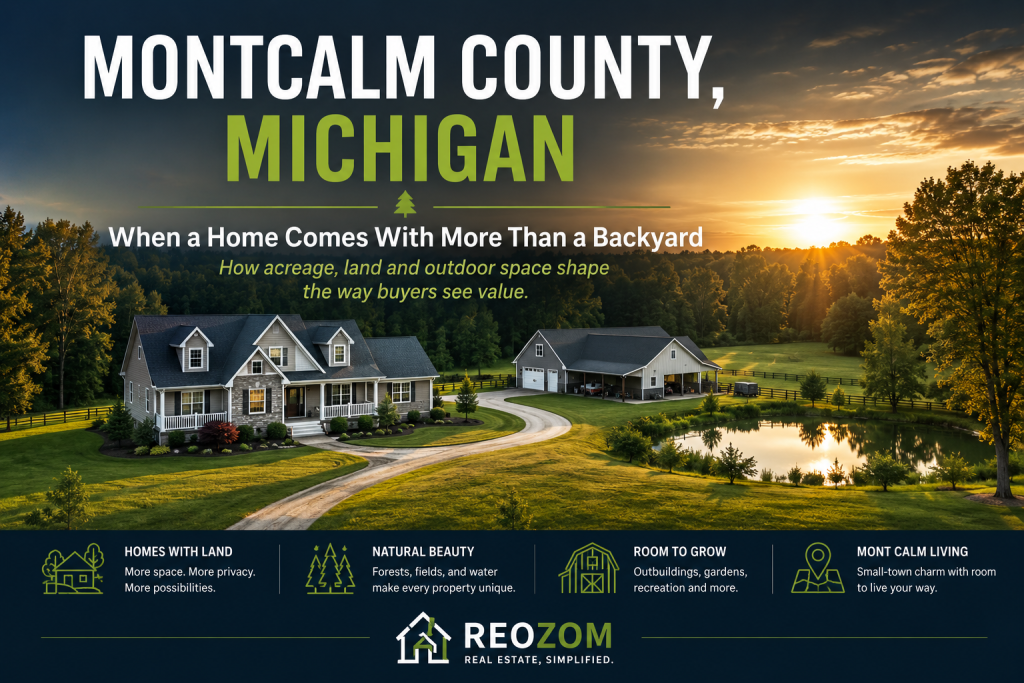
That distinction matters in Montcalm County, where residential life frequently intersects with the county’s agricultural and natural landscape.
For homeowners selling these kinds of properties, the challenge isn’t simply getting the home online.
It’s helping buyers understand what the entire property makes possible.
In Montcalm County, Land Is Part of the Local Story
Agriculture isn’t a minor feature of Montcalm County’s landscape.
According to the USDA’s 2022 Census of Agriculture, Montcalm County had 818 farms covering 232,558 acres. Of that land, approximately 191,506 acres were cropland, with additional acreage classified as woodland, pastureland and other agricultural uses.
That doesn’t mean every homebuyer is looking for a farm.
Far from it.
But it helps explain why property searches in this part of Michigan can involve features that aren’t adequately described by the traditional bedroom-bathroom-square-footage formula.
A buyer may be searching for a home and room for a workshop.
A house and woods.
A residence and recreational space.
A home and enough land to create something later.
And each buyer may interpret the same acreage differently.
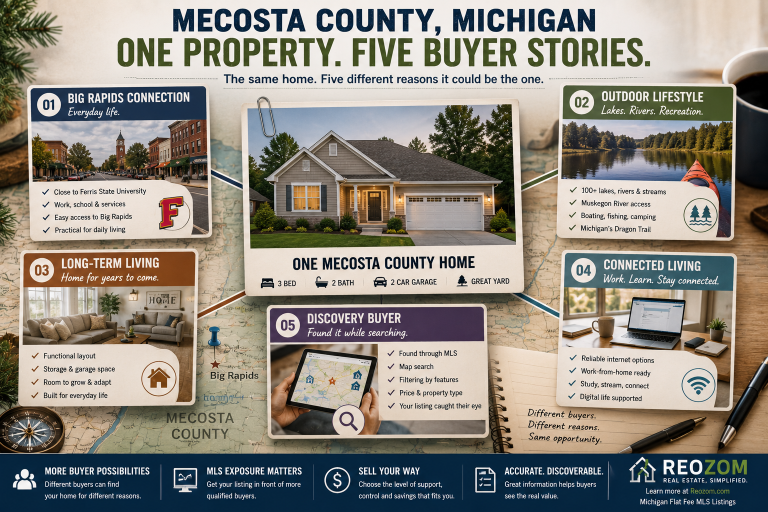
One Acreage Property. Five Different Buyers.
Consider a hypothetical Montcalm County home sitting on eight acres.
To one buyer, those eight acres mean:
Privacy
The buyer isn’t interested in farming or building anything.
They simply don’t want another house twenty feet from their kitchen window.
Recreation
Another buyer sees trails, outdoor activities and room to spend time outside.
Workshop Space
Someone else may be primarily interested in the garage, pole barn or ability to store equipment.
Gardening and Small-Scale Agriculture
Another household may imagine gardens or other permissible agricultural uses.
Future Flexibility
A fifth buyer simply values having options.
Same house.
Same eight acres.
Five completely different interpretations of its value.
That’s why marketing acreage property requires more than writing:
“Beautiful home on 8 acres.”
The acreage needs its own story.
The MLS Description Has a Different Job
When selling a conventional suburban property, buyers may already understand what they’re getting from the basic listing information.
A property with land can require more context.
Consider the difference between these two descriptions.
Description A
Three-bedroom home with pole barn on 7.8 acres.
Technically useful.
But compare it with:
Description B
Three-bedroom home positioned on approximately 7.8 acres with a detached pole barn, a mix of open and wooded areas, and space that may appeal to buyers seeking additional privacy, storage, recreation or outdoor flexibility.
The second description doesn’t promise uses that haven’t been verified.
It simply helps a prospective buyer understand the physical characteristics of the property.
That distinction is important.
Good real estate marketing doesn’t invent value.
It makes existing value easier to recognize.
Acreage Needs Better Photography, Too
If land is an important part of the property’s appeal, uploading twenty interior photographs and one photograph of the backyard misses part of the story.
Consider documenting:
- The home’s relationship to the land
- Front and rear acreage
- Wooded portions
- Open areas
- Outbuildings
- Driveways and access
- Water features, where applicable
- Significant landscaping
- Views from different parts of the property
- Seasonal features when useful
An aerial photograph may sometimes help buyers understand property scale and layout particularly well.
But photographs should accurately represent the property, and sellers should avoid implying boundaries that haven’t been professionally established.
The Map Can Be Almost as Important as the Kitchen
This is another way acreage properties differ.
A buyer examining a conventional subdivision home may focus heavily on the floor plan.
A rural-property buyer may spend almost as much time studying the map.
Why?
Because buyers can want to understand:
Where does the home sit on the parcel?
How is the property accessed?
Where are the wooded areas?
Where are the outbuildings?
What’s nearby?
What surrounds the property?
How does the land actually feel?
For sellers, this means location information and property context become part of the marketing package, not an afterthought.
Montcalm County's Outdoor Landscape Adds Another Dimension
Montcalm County also has substantial publicly managed recreational landscapes.
The Michigan Department of Natural Resources lists the Flat River State Game Area at 11,235 acres, partly within Montcalm County, along with the Stanton State Game Area at 4,725 acres, Langston at 3,252 acres, Vestaburg at 2,933 acres, and Edmore State Game Area partly within the county.
The Flat River watershed also provides opportunities for canoeing, kayaking, fishing, hiking, biking and birding.
Explore Michigan DNR state game and wildlife areas
This outdoor context can matter to certain buyers.
But sellers need to make an important distinction.
Nearby public recreation is not the same thing as private property rights.
A listing should accurately distinguish between what belongs to the property and what simply exists nearby.
Don't Turn Possibilities Into Promises
This may be the most important rule when marketing acreage.
A large parcel may look suitable for:
- horses
- another structure
- subdivision
- commercial activity
- short-term rental use
- farming
- hunting
- additional housing
That doesn’t mean all those uses are legally permitted.
Zoning, deed restrictions, easements, environmental considerations, access, utilities and other rules can affect what can actually be done.
Instead of writing:
“Perfect property to build a second home!”
A safer description might be:
“The property’s acreage may provide additional flexibility; buyers should independently verify zoning, permitted uses and development requirements with the appropriate authorities.”
That is less sensational.
It is also considerably more useful.
What Information Should an Acreage Seller Gather?
Before creating the listing, assemble a property information package.
For example:
Land
- Approximate acreage
- Survey, if available
- Parcel information
- Known easements
- Road/access information
Structures
- House
- Garage
- Pole barn
- Shed
- Workshop
- Other permanent structures
Utilities
- Water source
- Septic/sewer information
- Heating
- Electricity
- Internet availability where known
Land characteristics
- Open areas
- Woods
- Pond/water features
- Significant improvements
Documentation
- Relevant permits
- Surveys
- Well/septic documentation when available
- Improvements and maintenance records
This is valuable regardless of which listing model the homeowner ultimately chooses.
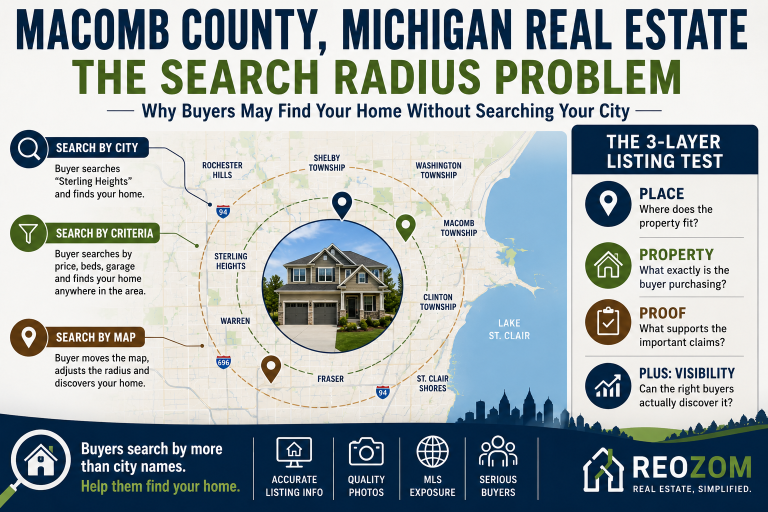
Digital Exposure Matters Even More When the Buyer Pool Is Wider
A buyer for an acreage property may not already live in Montcalm County.
Someone searching for:
“Michigan home with acreage”
may initially be comparing properties across several counties.
Another buyer may be considering Greenville while also researching communities closer to Grand Rapids.
Someone seeking recreational property may cast an even wider geographic net.
That makes online discoverability particularly important.
MLS exposure can help introduce a property to buyers who might never have discovered it through a yard sign or local advertising alone.
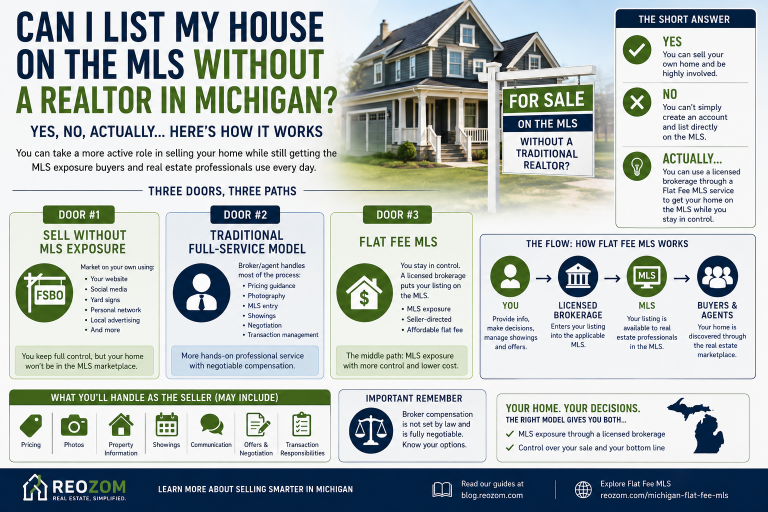
Homeowners interested in broad MLS visibility while retaining more control over their selling process can explore Reozom’s Michigan Flat Fee MLS listing options.
But MLS Exposure Isn't the Entire Strategy
This connects directly with an important principle we’ve discussed in our Michigan seller research:
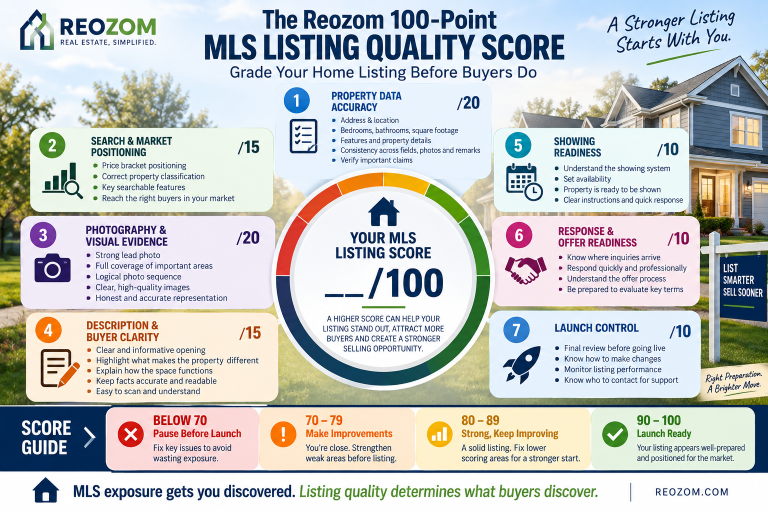
Exposure creates an opportunity to be discovered. It doesn’t automatically make a listing compelling.
For acreage property, that distinction becomes even more important.
A listing needs:
Accurate information + useful photographs + property context + appropriate pricing + visibility.
Leaving out one of those components can make an unusual property harder for buyers to understand.
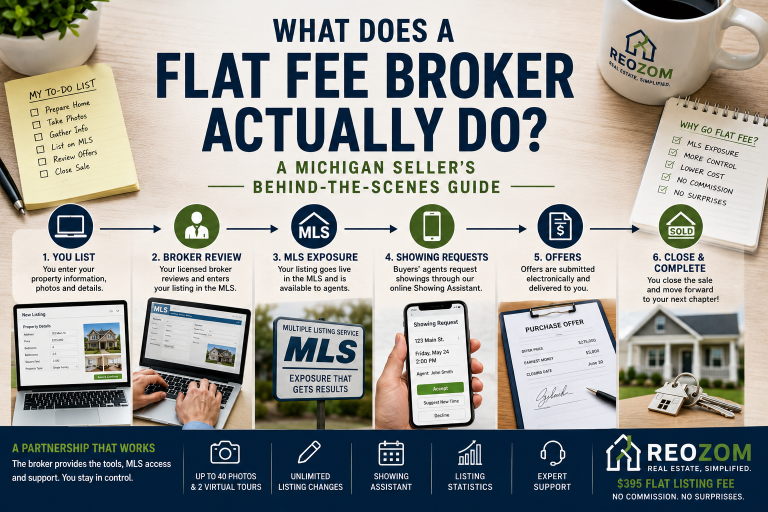
Flat Fee Doesn't Mean Every Service Is the Same
This is also where homeowners should look beyond the words “flat fee.”
One Michigan flat fee service may primarily provide MLS entry.
Another may provide additional assistance or tools.
Before choosing a provider, sellers should understand:
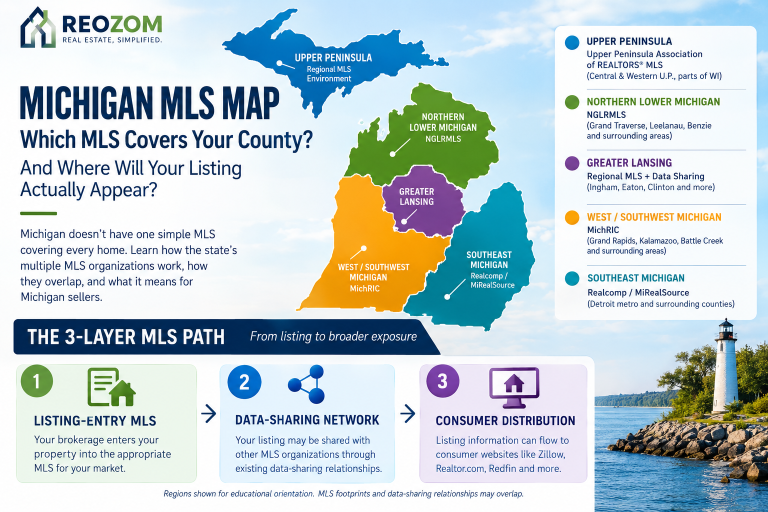
- Which MLS will contain the listing
- How listing changes are handled
- How many photographs can be included
- How inquiries are managed
- What support is available
- What services cost extra
- What responsibilities remain with the homeowner
We’ve created a detailed resource specifically around those questions:
Complete Guide to Choosing a Flat Fee Broker in Michigan
This is the internal link I consider most important in this entire article.
Your new Montcalm page now passes contextual relevance directly into the cornerstone page you’re trying to rank for Flat Fee Broker Michigan.
What If You Want More Control Over the Sale?
Some owners of unique properties know their land exceptionally well.
They know:
where the sun rises,
which areas stay dry,
where wildlife appears,
how the workshop is used,
what improvements have been made,
and what makes living there different.
For those homeowners, greater involvement in the selling process may be attractive.
Reozom also provides information for homeowners considering a For Sale By Owner approach.
The right approach depends on the seller’s experience, time, property and desired level of professional support.
Montcalm County Has More Than One Housing Story
Our previous Montcalm County analysis looked at something very different: how everyday convenience and community functionality contribute to housing appeal.
That article focuses primarily on daily life around the home.
This article focuses on the property itself—particularly when the parcel extends well beyond a conventional backyard.
Read:
Montcalm County Michigan: Why Everyday Convenience Shapes Long-Term Housing Value
Together, the two articles illustrate something important about local real estate:
A county doesn’t have to have only one housing story.
And neither does a property.
Seven Questions to Ask Every Michigan Flat Fee Broker
When a home includes meaningful acreage, the property’s story doesn’t stop at the exterior walls.
The woods matter.
The outbuilding may matter.
The open field may matter.
The privacy may matter.
The relationship between the house and the land may matter.
Different buyers will assign different value to each of those things.
A seller’s job isn’t to decide what every buyer should want.
It’s to provide enough accurate information for buyers to recognize what the property offers.
And in a county where agriculture, communities and substantial natural landscapes coexist, that’s an especially relevant lesson.
In Montcalm County, sometimes you’re not simply selling a home with a bigger backyard.
You’re selling a home where the land itself is part of the decision.
About Reozom
Reozom provides Michigan homeowners with flexible real estate listing options designed around transparency, technology, MLS exposure, and seller choice.
Our approach recognizes that homeowners have different levels of experience and different expectations from a brokerage.
We also believe better real estate decisions begin with better information.
That’s why Reozom continues developing educational resources covering Michigan home selling, local communities, buyer behavior, and alternative listing approaches.
You can learn more about Reozom and our background.
Frequently Asked Questions
Is Montcalm County known for agricultural land?
Agriculture represents a significant portion of Montcalm County’s landscape. The USDA’s 2022 Census of Agriculture recorded 818 farms and 232,558 acres of land in farms in the county.
What should sellers highlight when listing a Michigan home with acreage?
In addition to the home’s conventional features, sellers should accurately document acreage, outbuildings, access, wooded/open areas, water features and other characteristics relevant to the property.
Should sellers advertise possible uses of the land?
Be careful. A property’s appearance doesn’t establish what is legally permitted. Buyers should verify zoning, restrictions, easements and intended uses with the appropriate authorities.
Why can MLS exposure matter for Montcalm County acreage properties?
Buyers looking for acreage, recreational space or rural homes may search across a broader geographic area rather than limiting themselves to one community. Broad online exposure can therefore help a property reach buyers outside the immediate area.
Can a homeowner use Flat Fee MLS to sell an acreage property in Michigan?
Potentially, yes. The appropriate service depends on the property and seller. Sellers should compare MLS coverage, listing capabilities, photograph limits, support, pricing and their own responsibilities before selecting a provider.
Is Flat Fee MLS the same as FSBO?
No. FSBO generally refers to an owner taking primary responsibility for selling a property, while Flat Fee MLS refers to obtaining MLS listing exposure through a licensed brokerage for a predetermined fee. The exact services vary by provider.