Your Listing Has Passed the First Test. Now Come the Questions.
A buyer finds your Midland County home online.
The photographs look good.
The price fits.
The number of bedrooms works.
The location seems promising.
You’ve earned the click.
But instead of immediately scheduling a showing, the buyer opens another browser tab.
Then another.
And another.
They look at the parcel.
They examine the map.
They check nearby roads.
They look at the property’s history.
They investigate internet availability.
They compare similar homes.
They study the photographs again.
They zoom in on the basement.
They wonder about drainage.
They want to know the age of the roof.
They look for information about the mechanical systems.
They may even research something the seller never considered worth mentioning.
Welcome to the information-rich homebuyer.
For a Midland County seller, understanding this buyer may be just as important as understanding the market itself.
Midland Has an Unusually Technical Economic Identity
Its employment base includes a significant concentration of science, manufacturing, healthcare and professional organizations.
According to the Midland Business Alliance’s 2026 employer data, some of the county’s largest employers include:
| Employer | Reported 2026 employment |
|---|
| Dow | 4,800+ |
| MyMichigan Health | 4,607 |
| Midland Public Schools | 886 |
| DuPont | 736 |
| Corteva Agriscience | 550 |
| City of Midland | 475 |
The U.S. Census Bureau also reports that 36.6% of Midland County residents age 25 and older hold a bachelor’s degree or higher, while 95.5% have completed high school or higher.
Those statistics don’t mean every Midland homebuyer is an engineer, scientist, physician or researcher.
And sellers shouldn’t stereotype buyers based on local employers.
But they do tell us something useful about the community:
Information-intensive professional work is an important part of Midland County’s economic environment.
For real estate marketing, that makes a good question worth asking:
What happens when your prospective buyer approaches a house the same way they approach other important decisions—with research?
Today's Homebuyer Can Know a Lot Before Walking Through the Door
The traditional home-selling sequence once looked something like this:
See advertisement → contact agent → visit house → learn about property → decide whether interested.
Digital real estate has disrupted that order.
Now it can look more like:
Discover listing
↓
Study photographs
↓
Check map
↓
Research property
↓
Compare alternatives
↓
Investigate community
↓
Review available details
↓
Then decide whether the property deserves an in-person visit
That means the listing isn’t merely advertising the showing.
The listing itself has become part of the showing.
That’s an important distinction.
THE MIDLAND SELLER TEST
Could Your Listing Answer These 15 Questions?
Imagine you know nothing about your property.
Now open the listing and ask:
- What makes this home different?
- How old is the roof?
- Have major mechanical systems been updated?
- What does the backyard actually look like?
- Is there usable storage?
- What does the garage accommodate?
- What is the basement like?
- Are important renovations documented?
- How does the house sit on the lot?
- What is included with the property?
- Are there features photographs don’t adequately explain?
- Is the property description specific or generic?
- Can I understand the home’s layout?
- Are significant property characteristics clearly identified?
- What would I still have to investigate myself?
You don’t necessarily need to answer every possible buyer question in an MLS description.
That would be impractical.
But the exercise reveals something valuable:
Information gaps create uncertainty.
And uncertainty can make buyers keep searching.
“Updated” Is Not Very Informative
Consider this listing description:
Beautiful Midland home with many updates. Great location. Spacious rooms and wonderful backyard. Must see!
There is nothing technically wrong with it.
But what has the buyer learned?
Almost nothing.
Now compare:
Recent improvements include replacement of the roof in [year], updated kitchen cabinetry and countertops in [year], and [other accurately documented improvements]. The property includes an attached two-car garage, partially finished lower level and backyard patio.
The second version isn’t more effective because it’s longer.
It’s more effective because it contains information.
Specificity can build confidence.
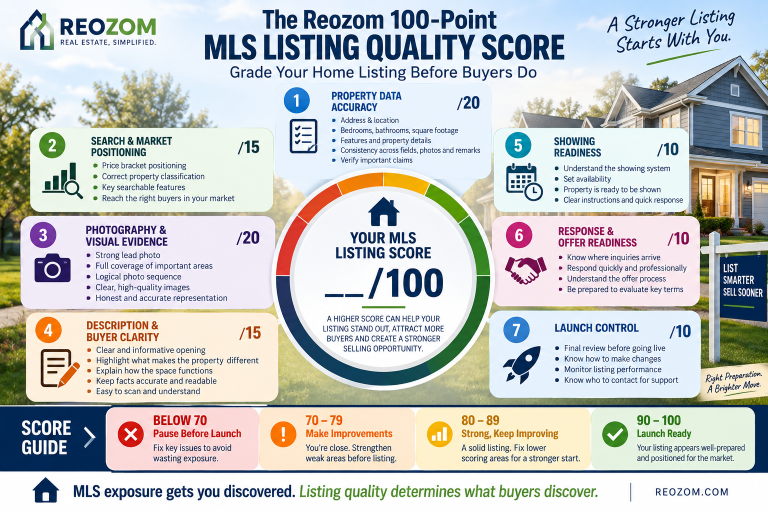
THE PROPERTY DATA STACK
Instead of thinking about a listing as one description and a collection of photographs, think about it as a property data stack.
Layer 1 — Basic Facts
Bedrooms
Bathrooms
Square footage
Property type
Lot information
Layer 2 — Physical Characteristics
Garage
Basement
Outdoor space
Storage
Floor plan
Major systems
Layer 3 — Improvements
Roof
HVAC
Windows
Kitchen
Bathrooms
Electrical
Other documented upgrades
Layer 4 — Visual Evidence
Exterior
Major rooms
Outdoor areas
Special features
Property layout
Layer 5 — Location Context
Road access
Nearby services
Recreation
Community characteristics
Layer 6 — Supporting Documentation
Disclosures
Surveys where available
Permits where relevant
Maintenance information
Other appropriate property records
The stronger these layers are, the easier it becomes for a buyer to understand what they’re evaluating.
Broadband Has Become Property Information
Twenty years ago, an internet connection probably wasn’t near the top of most residential property descriptions.
Today it can matter considerably more.
The Census Bureau estimates 89.5% of Midland County households had a broadband internet subscription during 2020–2024, while 94.3% had a computer.
Remote work, hybrid work, streaming, connected devices and online education have changed how households use their homes.
That doesn’t mean sellers should advertise internet speeds they haven’t verified.
Instead, it means internet availability belongs on the list of things sellers should understand about their property.
A buyer may ask.
Be prepared with accurate information and direct buyers to the applicable service providers for verification.
Midland's Flood History Makes Property-Specific Accuracy Especially Important
There is another reason Midland County illustrates the importance of research.
Flooding.
The 2020 dam failures and subsequent flooding significantly affected the region, and flood-risk planning remains an active local issue. In August 2026, a U.S. Army Corps of Engineers flood-risk study proposed potential structural and nonstructural measures involving areas around Sturgeon Creek and Snake Creek.
That history should not be used to characterize every Midland County property as flood-prone.
Quite the opposite.
It demonstrates why broad assumptions are dangerous.
A buyer researching a specific home may investigate:
- FEMA flood information
- property-specific flood history
- insurance considerations
- drainage
- elevation
- proximity to waterways
- applicable disclosures
The seller’s responsibility is not to reassure buyers with unsupported statements.
It’s to provide accurate required information and allow buyers to conduct appropriate due diligence.
Specific property facts beat broad geographic assumptions.
Five Listing Experiments Worth Running Before You Publish
This is where we’re going to make this article structurally very different from your other county blogs.
Before putting the home online, run five tests.
Experiment 1 — The 10-Second Test
Show someone your first five listing photographs for ten seconds.
Then close them.
Ask:
“What do you remember about the house?”
If the answer is simply:
“It looked nice.”
your photographs may not be communicating the property’s strongest differentiators.
Experiment 2 — The Stranger Test
Give the property description to someone who has never visited the home.
Ask them to describe the property back to you.
Did they understand what makes it different?
If not, the description may rely too heavily on generic adjectives.
Experiment 3 — The Question Test
Ask:
What are the five questions a serious buyer is most likely to ask after reading this listing?
Then determine whether appropriate answers could be incorporated into the listing or prepared for inquiries.
Experiment 4 — The Mobile Test
Open your listing on a phone.
Most buyers won’t experience it the way you did while creating it on a large computer monitor.
Look at:
- first photograph
- headline
- opening description
- photograph order
- readability
What information appears before someone has to keep scrolling?
Experiment 5 — The Comparison Test
Open three competing properties in the same general price range.
Don’t ask:
“Is mine better?”
Ask:
“Is it easier for a buyer to understand mine?”
That’s a much more useful marketing question.
MLS Exposure Amplifies Whatever You Put Into It
This point matters enormously.
MLS exposure can expand property visibility.
But greater visibility doesn’t automatically repair weak information.
Think of it like an amplifier.
Strong listing + broader exposure
Potentially more buyers encounter useful information.
Weak listing + broader exposure
Potentially more buyers encounter an incomplete presentation.
That’s why the sequence matters:
Prepare → Verify → Present → Distribute
rather than:
List first → fix later.
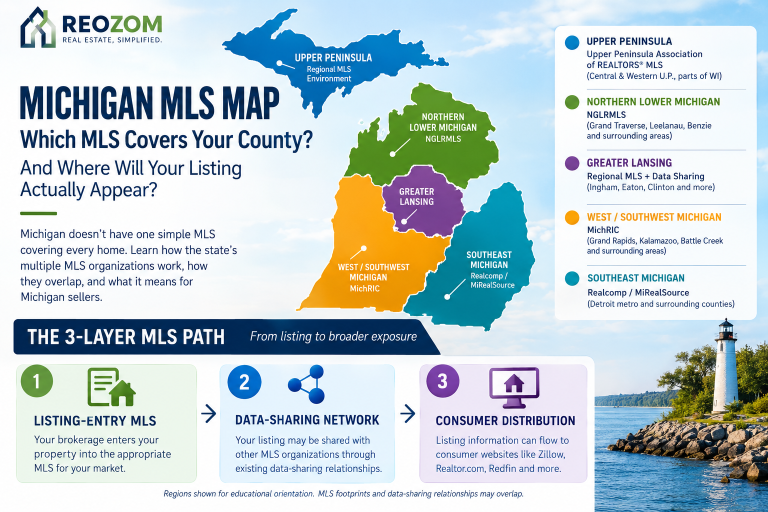
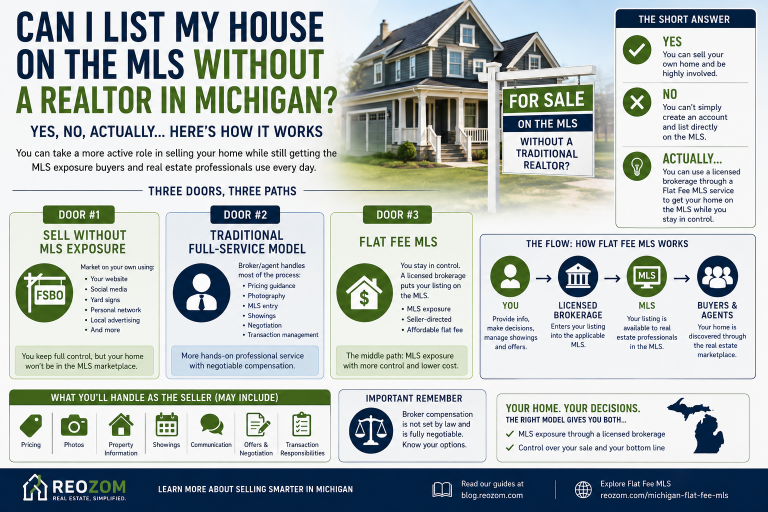
For Michigan homeowners exploring a listing model that provides MLS exposure while allowing greater involvement in the process, Reozom explains its Michigan Flat Fee MLS options.
Seller Control Works Best When It Comes With Seller Preparation
Control sounds attractive.
But greater control can also mean greater responsibility.
A homeowner considering a more self-directed sale should ask:
Do I have time to respond quickly?
Can I organize accurate property information?
Am I comfortable coordinating showings?
Do I know when I need professional assistance?
Can I keep documents organized?
Will I respond objectively to buyer feedback?
If the answers are yes, greater involvement may fit the seller well.
If not, additional support may be valuable.
Homeowners considering a more independent approach can also review Reozom’s For Sale By Owner resources.
THE MIDLAND LISTING BLUEPRINT
Here’s the entire article condensed into one seller workflow.
BEFORE LISTING
Research the property
↓
Gather improvements, systems, documentation and important facts.
BUILD THE STORY
Identify differentiators
↓
What should a buyer remember?
CREATE THE VISUAL RECORD
Photograph intentionally
↓
Don’t simply photograph every room. Explain the property visually.
REMOVE INFORMATION GAPS
Review as a stranger
↓
What questions remain?
CHECK ACCURACY
Verify claims
↓
Avoid assumptions about schools, internet, flooding, permitted uses or other facts that should be independently confirmed.
CREATE VISIBILITY
Publish through the appropriate listing channels
↓
This is where MLS exposure becomes valuable.
STAY RESPONSIVE
Manage inquiries and updates
↓
A digital listing isn’t static. The selling process continues after publication.
THE FINAL QUESTION
Is Your Listing Helping the Buyer Think?
That may sound like a strange question.
But consider how people make expensive decisions.
They gather information.
They compare.
They eliminate uncertainty.
They evaluate tradeoffs.
They revisit alternatives.
Buying a home is no different.
Midland County provides an especially interesting setting for thinking about this because the area’s economy includes major employers in chemicals, healthcare, education, agriculture-related science, government and manufacturing.
But the principle extends far beyond Midland:
The more information buyers can access independently, the more important accurate property presentation becomes.
The goal isn’t to overwhelm someone with data.
It’s to remove unnecessary uncertainty.
Because a great listing doesn’t merely make someone say:
“That’s a nice house.”
It helps them reach the next thought:
“I understand this property well enough to want to know more.”
And that’s when a digital impression can become a showing.
Frequently Asked Questions
What makes Midland County’s economy distinctive?
Midland County has a notable concentration of major employers in chemicals, healthcare, education, manufacturing and related professional sectors. The Midland Business Alliance lists Dow and MyMichigan Health as its two largest employers for 2026.
What information should a Midland home seller prepare before listing?
Start with accurate property characteristics, major improvements, mechanical-system information, photographs, lot details and available supporting documentation. Sellers should also be prepared for property-specific questions from prospective buyers.
Does MLS exposure replace good property marketing?
No. MLS exposure can expand visibility, but sellers still need accurate information, useful photography, appropriate pricing and responsive communication.
Can Midland homeowners use Flat Fee MLS?
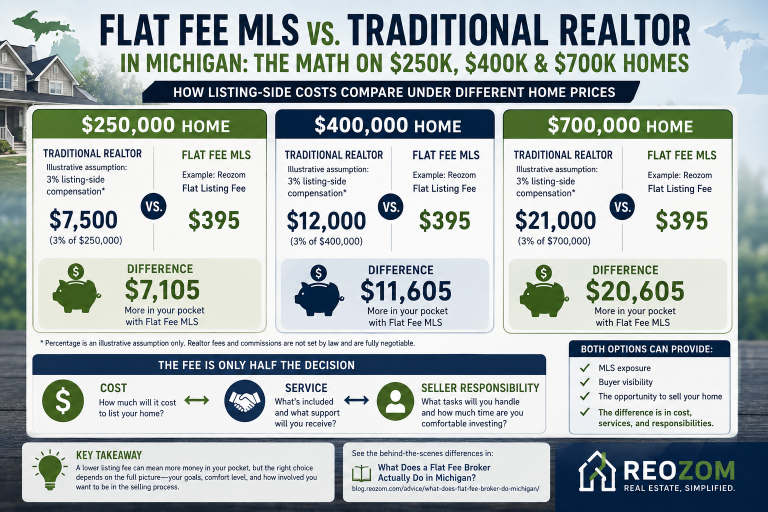
Flat Fee MLS is one possible listing approach. Sellers should compare the applicable MLS, included services, support, technology, pricing and seller responsibilities before choosing a provider.
How should I compare flat fee brokers in Michigan?
Compare more than the advertised fee. Evaluate MLS coverage, listing capabilities, included changes, offer handling, support, technology, additional charges and cancellation terms.
Why shouldn’t sellers make broad claims about flood risk?
Flood considerations can be highly property-specific. Buyers and sellers should rely on appropriate property information, disclosures, official mapping and professional guidance rather than assuming that conditions applying to one part of Midland County apply everywhere.