A 12-Month Seller’s Guide to Keeping a Property Relevant Beyond Its First Marketing Moment
Picture the same Mason County home twice.
Picture #1: July
The trees are full.
The lawn is green.
Lake Michigan is part of the weekend conversation.
Outdoor spaces photograph beautifully.
The patio looks inviting.
The listing feels alive.
Picture #2: February
Same address.
Same square footage.
Same kitchen.
Same mortgage possibilities.
But now?
The buyer may notice completely different things.
How does the driveway function?
Where do coats and boots go?
How much natural light enters the house?
Is there practical storage?
How does the home feel when outdoor living isn’t doing part of the marketing?
The property hasn’t changed.
But the way a buyer experiences it might.
Welcome to the second-look buyer.
JANUARY
The House Has to Stand on Its Own
Summer scenery isn’t doing the work anymore.
That can actually be useful.
Winter strips a property down to fundamentals.
A buyer may pay more attention to:
Layout
Storage
Natural light
Heating
Garage functionality
Entry areas
Everyday comfort
For sellers, January provides a useful thought experiment:
If we removed every lifestyle adjective from the listing, would the actual house still sound compelling?
If not, the description may depend too heavily on location imagery and not enough on the property.
January seller assignment
Read your listing description.
Circle every adjective:
beautiful
amazing
charming
stunning
incredible
Now ask:
Can I replace some of them with facts?
FEBRUARY
The “What Would I Want to Know?” Month
February isn’t about adding more marketing.
It’s about removing uncertainty.
Create a property-information file.
Include whatever is applicable and available:
- Major improvement dates
- Roof information
- Heating/cooling systems
- Appliances included
- Garage information
- Storage
- Utility information
- Surveys
- Permits
- Maintenance records
- Relevant disclosures
The objective isn’t to overwhelm a buyer.
It’s to be prepared when serious questions arrive.
MARCH
Build the Property Before You Build the Promotion
This is where many sellers reverse the sequence.
They think:
MLS first.
Photography next.
Fix description later.
A stronger sequence is:
VERIFY
↓
PREPARE
↓
PHOTOGRAPH
↓
DESCRIBE
↓
DISTRIBUTE
Think of March as the listing infrastructure month.
The listing isn’t just an advertisement.
It’s a database of information about a very expensive product.
Treat it accordingly.
APRIL
What Changes When the Property Wakes Up?
Now the exterior starts telling a stronger story.
Landscaping becomes visible.
Outdoor spaces become easier to understand.
Trees change.
Natural light changes.
Certain exterior features become more obvious.
This is where the seller should ask:
Do my listing photographs still represent the property well?
If the listing has been active across seasons, old photography may no longer tell the strongest current story.
That doesn’t mean constantly replacing every photograph.
It means recognizing that digital listings shouldn’t always be treated as permanent documents created on Day One.
MAY
The Map Gets Bigger
Mason County isn’t only about a house.
Its geography is part of its identity.
Ludington State Park, for example, sits between Hamlin Lake and Lake Michigan. Michigan DNR says the park includes seven miles of Lake Michigan shoreline, 21 miles of marked trails, campgrounds, dunes and the Big Sable Point Lighthouse.
Explore Ludington State Park through Michigan DNR
But here’s the seller lesson:
Don’t turn nearby recreation into a substitute for describing the property.
A buyer still needs to understand:
the house,
the parcel,
the location,
and then the surrounding context.
In that order.
JUNE
The Lifestyle Trap
This is the month where marketing can become overly romantic.
Lake Michigan.
Sunsets.
Beaches.
Boating.
Summer.
Ludington.
All legitimate parts of the area’s broader identity.
But a listing can easily cross from useful context into generic tourism copy.
Compare:
Version A
Live the Lake Michigan dream in beautiful Mason County!
with:
Version B
Three-bedroom home with an attached garage, rear patio and [accurate property characteristics], located within the broader Ludington/Mason County area.
Version B may sound less exciting.
But it tells the buyer more about what they’re actually considering purchasing.
Sell the property first. Contextualize the lifestyle second.
JULY
The First-Look Buyer
July may give a Mason County property some of its strongest visual storytelling opportunities.
But imagine a buyer discovers your home today.
They look at it for 40 seconds.
Then leave.
Did you lose them?
Maybe.
Maybe not.
Digital property discovery isn’t always linear.
A buyer can:
see a listing,
save it,
compare something else,
change their price range,
return later,
show it to a spouse,
expand their geography,
or reconsider what features matter.
That creates the person this article is really about:
The second-look buyer.
The buyer who has already seen your property once.
AUGUST
Give the Second-Look Buyer Something Useful to Discover
Suppose a buyer returns two weeks later.
What has changed?
If the answer is nothing, that’s not necessarily a problem.
But sellers should periodically check whether the listing can be improved.
Not artificially refreshed.
Improved.
Check:
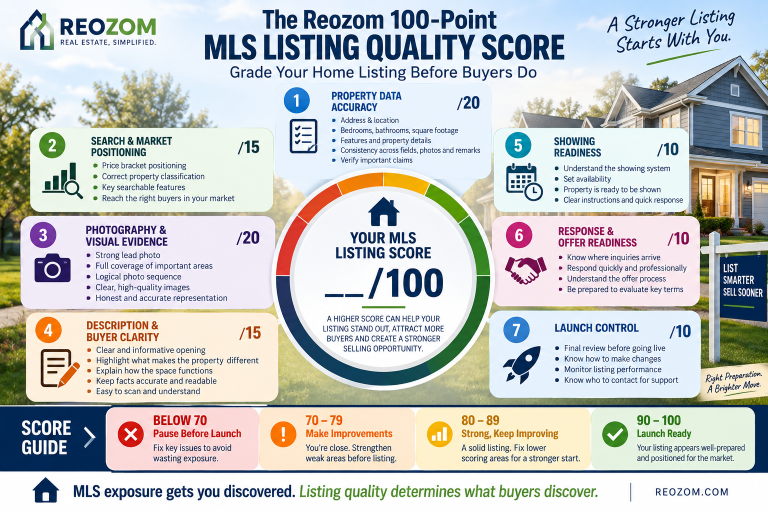
- Are photographs in the strongest order?
- Are factual errors present?
- Have important details been omitted?
- Is the description generic?
- Are property improvements accurately identified?
- Are inquiries revealing recurring unanswered questions?
- Is pricing still appropriate to the seller’s strategy?
The goal isn’t to manipulate freshness.
The goal is to maintain listing quality.
SEPTEMBER
The Listing Feedback Audit
By now, seller feedback may be more valuable than another paragraph of marketing copy.
Create three columns.
| Buyers Asked About | Listing Already Explains | Listing Could Explain Better |
|---|
| Garage | Yes | — |
| Storage | Somewhat | ✓ |
| Heating | No | ✓ |
| Outdoor space | Yes | — |
| Internet | No | Verify information |
| Improvement dates | Some | ✓ |
Now you’re using actual market interaction to improve information.
That’s much more useful than guessing what adjective to add.
OCTOBER
What Does the Property Look Like Without Summer?
This is another visual test.
If every photograph depends on summer scenery, the listing may not adequately communicate year-round functionality.
Consider whether buyers can understand:
- Exterior access
- Garage
- Entry
- Interior light
- Storage
- Major living spaces
- Lot relationship
- Outdoor structures
A Mason County property may benefit from seasonal beauty.
But seasonal beauty and property functionality aren’t the same thing.
NOVEMBER
The Serious-Information Test
Imagine someone is considering making an offer tomorrow.
Could you quickly provide the appropriate information they request?
Or would you spend hours searching through email, drawers and old documents?
That’s a seller-readiness problem.
November’s assignment is simple:
Organize.
Your listing strategy isn’t only about attracting attention.
It’s about being prepared when attention becomes serious.
DECEMBER
What Did the Listing Teach You?
At the end of our hypothetical twelve months, ask:
Which features received the most questions?
Which photographs attracted attention?
Which information did buyers repeatedly request?
Which assumptions were wrong?
What did buyers value that you hadn’t initially considered important?
That’s useful knowledge.
And it brings us to the central lesson.
THE MASON COUNTY LISTING CLOCK
A home doesn’t exist in one marketing moment.
Think of the listing as a clock with four repeating stages:
1. DISCOVER
A buyer encounters the property.
↓
2. UNDERSTAND
The listing helps them evaluate it.
↓
3. COMPARE
They evaluate alternatives.
↓
4. RETURN
Some buyers look again.
That final stage is easy to underestimate.
A buyer who doesn’t schedule a showing immediately isn’t necessarily permanently gone.
Their decision context can change.
What Mason County's Numbers Tell Us
Mason County had an estimated 29,040 residents in 2025 and 17,922 housing units. The Census Bureau reports an owner-occupied housing rate of 78.3% for 2020–2024 and a median owner-occupied home value of $219,600 during that period.
Another characteristic is particularly relevant to how we think about the county: 27.5% of residents were estimated to be age 65 or older, according to the current QuickFacts dataset.
Those statistics shouldn’t be used to predict the buyer for an individual home.
They simply reinforce why Mason County should be understood as a year-round residential community, not reduced to its tourism and recreation identity.
Where MLS Exposure Fits
Now we reach the SEO/commercial connection—but naturally.
The second-look buyer can’t reconsider a property they never discovered.
That makes visibility one component of the selling process.
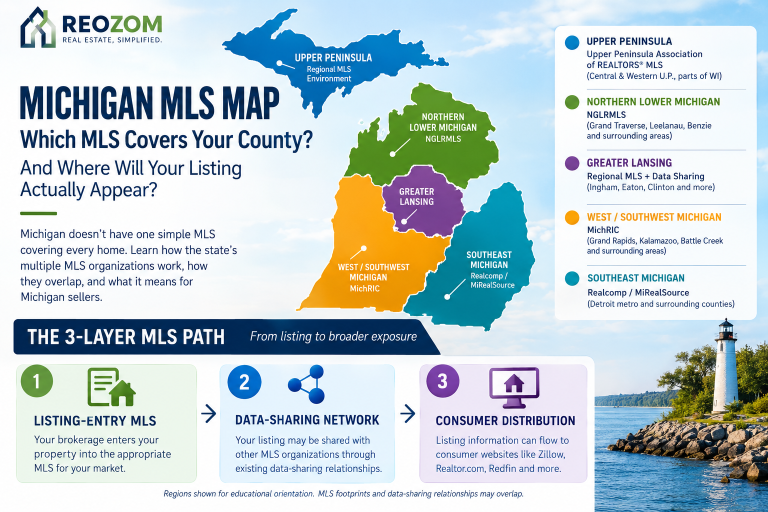
For homeowners who want MLS exposure while remaining more involved in their sale, Reozom’s Michigan Flat Fee MLS listing options explain one possible listing approach.
But MLS exposure isn’t a substitute for:
good photographs,
accurate information,
appropriate pricing,
seller responsiveness,
or a well-prepared property.
Exposure creates discovery.
The listing has to do the rest.
Flat Fee Doesn't Mean “List It and Forget It”
This is an important SEO section because it lets us strengthen the target phrase without forcing it into unrelated paragraphs.
A homeowner researching how to sell may encounter phrases such as:
Michigan Flat Fee MLS
Flat Fee MLS Michigan
Flat Fee Broker Michigan
But those terms shouldn’t be interpreted as meaning every service is identical.
Different providers can offer different combinations of:
- MLS entry
- photographs
- listing changes
- showing tools
- document support
- offer assistance
- transaction support
- additional services
That’s why sellers should compare the complete service structure, not only the advertised price.
Our Complete Guide to Choosing a Flat Fee Broker in Michigan walks Michigan homeowners through exactly what to compare.
This should be the strongest internal link on the page for your current SEO strategy.
The “Active Seller” Advantage
The Mason County calendar illustrates another important idea.
A seller doesn’t necessarily need to publish a listing and then become passive.
Depending on the service model, sellers may be able to stay actively involved by:
reviewing property information,
monitoring questions,
improving photographs,
requesting appropriate listing updates,
organizing documents,
and responding quickly.
Homeowners considering a more hands-on approach can also review Reozom’s For Sale By Owner resources.
Greater involvement can provide more control.
It can also create more responsibility.
The appropriate approach depends on the seller, property and level of support desired.
The Mason County 4-Season Listing Test
Before publishing, ask four questions.
WINTER
Would the house still make sense without beautiful outdoor photography?
SPRING
Have I accurately documented exterior and property features?
SUMMER
Am I describing the actual home—or mostly selling the surrounding lifestyle?
FALL
Could a serious buyer understand the property’s year-round functionality?
If the answer to all four is yes, you’ve probably created something much stronger than seasonal advertising.
You’ve created a property record that can help buyers understand the home at different points in their decision process.
A Listing Has More Than One Chance to Communicate
Mason County makes this idea particularly easy to see.
Lake Michigan changes.
Trees change.
Temperatures change.
Outdoor activity changes.
The property looks different.
But buyers change too.
Their budget may change.
Their preferred geography may change.
Their timeline may change.
The features they prioritize may change.
That’s why sellers shouldn’t think of online marketing as:
Publish → wait.
Think:
Prepare → publish → observe → maintain → respond.
Your first impression matters.
But don’t forget the person who comes back.
Because sometimes the buyer who eventually understands the property best isn’t the first-look buyer.
It’s the second-look buyer.
Frequently Asked Questions
Where is Mason County, Michigan?
Mason County is in western Michigan along Lake Michigan and includes Ludington and surrounding communities.
Is Mason County only a seasonal or vacation-home market?
No. Census estimates show approximately 29,040 residents, 12,801 households and a 78.3% owner-occupied housing rate. Recreation and tourism are important parts of the area’s identity, but Mason County also supports a substantial year-round residential population.
What makes Ludington State Park significant?
Michigan DNR says Ludington State Park sits between 5,000-acre Hamlin Lake and seven miles of Lake Michigan shoreline and includes dunes, campgrounds, 21 miles of marked trails, the Big Sable River and Big Sable Point Lighthouse.
Should sellers change their MLS listing every season?
Not simply for the sake of appearing new. Sellers should instead periodically review whether photographs, factual information, pricing and property descriptions remain accurate and useful, subject to their brokerage’s and MLS’s applicable policies.
Can Mason County homeowners use Flat Fee MLS?
Flat Fee MLS is one potential approach. Sellers should compare MLS coverage, included services, support, additional costs and their own responsibilities before selecting a provider.
How should I choose a flat fee broker in Michigan?
Look beyond the headline listing fee. Compare MLS coverage, photographs, listing changes, inquiry management, offer support, technology, cancellation terms, additional charges and the responsibilities retained by the homeowner.