Your Michigan flat fee MLS listing has attracted buyers through the door, but nobody has submitted a written offer. Before changing the price, find where buyers stopped. A full calendar with several declined appointment requests points to a different problem than a home that is easy to tour but keeps losing buyers to better-maintained alternatives.
Start with the last seven days of showing activity, then agree on a review date with your broker. Seven days is a practical reporting window for this worksheet. Choose a shorter or longer window based on your selling deadline and how many distinct buyers you have heard from.
Fix verified listing errors promptly. For other changes, adjust one thing at a time when your timeline allows. If you need to change the showing hours and the listing photos together, log both dates and treat the next week as a combined test.

Use one row per distinct buyer group for each review period. A buyer who reschedules twice or visits a second time should still count as one group. Log the second visit separately so you can see that group’s follow-up activity.
Calculate the showing completion rate by dividing completed tours by distinct groups who requested a tour. Count feedback themes against the number of responses. Two buyers mentioning a dark basement out of three responses is worth investigating. It leaves you with one completed tour where you still do not know what the buyer thought, if four groups toured.
Ask two short questions after a tour: “What specifically made the buyer pass?” and “What feature or alternative home did they compare ours with?” Ask your broker how follow-up is handled under your listing package, and keep your worksheet focused on the property and the appointment.
Hypothetical example. A Lansing seller lists at $329,000. In week one, eight distinct groups request a tour. Four visit, and the other four cannot make the available times. Of the three groups who provide feedback, two say the downstairs looks brighter in the photos. One mentions price. No written offers arrive.
The seller opens a Saturday showing window and holds the asking price for the second week. The broker checks the photos against the room in daylight. In this example the photos are accurate, so the seller keeps them and records the brightness comments for the next review. A misleading photo would warrant a correction as soon as it was identified.
Week two brings seven requests and six completed tours, including three Saturday tours. The worksheet shows completion rose from 4 of 8 (50%) to 6 of 7 (about 86%). Four groups give feedback. Two again mention the downstairs light, one prefers another home’s finished basement, and one says the layout does not work. No one submits an offer.
The seller has a reason to keep the Saturday window and a specific question to take to the broker: “How does our listing compare with similarly priced homes that offer brighter or more usable downstairs space?” The small sample cannot establish what caused the improvement or what a price change would do. It does identify which buyer concern kept coming up after the scheduling change.
Ask your broker for two short groups of comparable homes. Active listings show what buyers can tour today. Recent closed sales give you a record of what buyers paid for comparable homes. Ask the broker why each home belongs in the comparison, which differences matter most, and whether the asking price puts your home up against stronger alternatives. The National Association of REALTORS® home pricing guide explains how property characteristics and market conditions factor into pricing.
For each alternative, write down the location, price and status, above-grade living space, condition, and any feature your visitors keep bringing up. In the hypothetical Lansing example, ask whether the competing listing’s basement is finished, how buyers use the space and what the listing actually describes. Ask the broker to explain any comparable that looks like a good match online but differs materially in person.
When you discuss the asking price, keep the lender’s appraisal in its own column. The Consumer Financial Protection Bureau’s guide to different home valuations explains why valuations can vary by method and purpose. If the first buyer asks for repairs or a credit, use Reozom’s Michigan guide to comparing offers on a home that needs repairs to evaluate the proposal.
“From [date] to [date], we had [number] distinct requests, [number] tours and [number] written offers. [Number] groups could not make the available times, and [number] of [number] feedback responses mentioned [specific issue]. Can we review current alternatives and recent comparable sales, pick one change we can measure, and check the results again on [date]?”
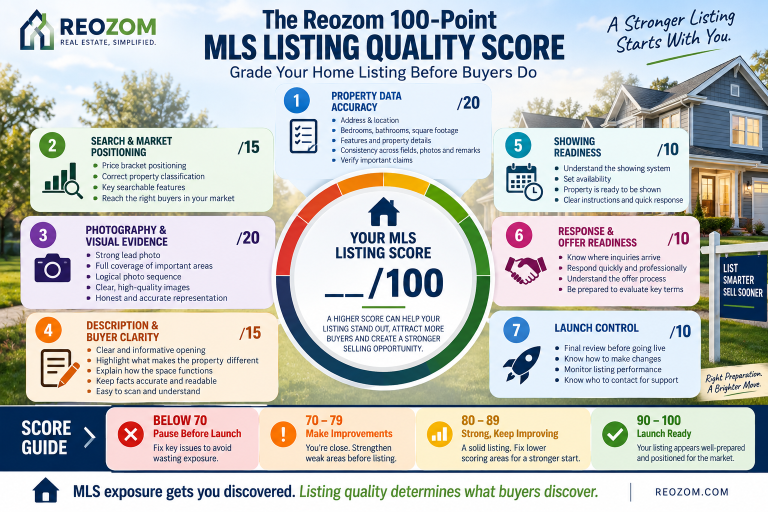
If the review turns up conflicting details or photos that set the wrong expectations, use the Michigan MLS listing quality checklist to review the listing field by field. If you are still choosing a package, ask how showing requests reach you, who submits changes and what pricing or feedback support is included. Review Reozom’s Michigan flat fee MLS listing service for package details.
There is no universal count. Start with your broker’s observations about similar homes in the same price range and review the feedback you have. Several groups raising the same checkable issue give you a specific next step even if your total is small.
Log the reason where you can. Repeated trouble with directions, a short notice window or a lockbox gives you a concrete issue to raise with the broker. If buyers give no reason, record the cancellation without assigning a cause.
Count a group that toured twice once in both the request and completed-tour totals for the same period. Track its second visit as follow-up. A returning buyer may be weighing a question about the property or comparing it with another option.
Check the concern against what a buyer actually sees. If a photo materially misrepresents the space, ask the broker to update it promptly. If it accurately shows the room and the comment reflects taste, log the feedback and look for a pattern.
Ask what prevented the appointment, especially whether another time would work. Save questions about condition, layout and value for groups that saw the home. Keep the answers in the corresponding columns of your worksheet.
Set a decision date with your broker at the start. If time is short, review access, recent comparable sales and current competition together and decide which change can be made soonest. Record the decision and what you will measure at the next check-in.