Real estate in Michigan has undergone visible changes over the past two decades—online listings, mobile apps, digital communication—but beneath the surface, the core structure of how homes are sold has remained largely unchanged.
For most homeowners, selling a property still involves:
- Multiple intermediaries
- Commission-based incentives
- Fragmented workflows across platforms
While these elements were once necessary, today they often create inefficiencies that directly impact cost, speed, and control.
The real question is not whether the system works—it clearly does.
The question is:
Is the system optimized for today’s technology and consumer expectations?
A System Designed Before Digital Transparency
To understand the current structure, we need to look at how it was originally built.
Decades ago:
- Property information was not easily accessible
- Buyers relied heavily on agents for discovery
- Communication was slow and localized
In that environment:
- Centralized control was necessary
- Intermediaries added real value
- Commission structures aligned with effort and access
However, the introduction of MLS systems and online listing platforms fundamentally changed this dynamic.
Today:
- Buyers browse listings independently
- Property data is widely distributed
- Communication happens instantly
Yet, the cost structure has not evolved at the same pace.
What Has Changed — And What Hasn’t
What has changed:
- Listings are instantly visible across platforms
- Buyers conduct their own research
- Digital tools have reduced manual effort
- Communication is real-time
What hasn’t changed:
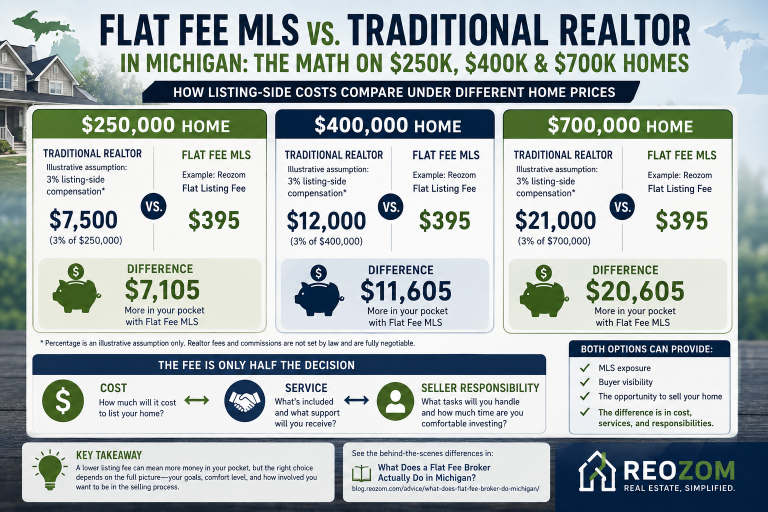
- Commission-based pricing remains standard
- Workflows still involve multiple layers
- Sellers often lack visibility into the process
- Decision-making is still influenced by legacy practices
This creates a disconnect between how real estate operates and how it is priced.
The Disconnect Between Exposure and Cost
One of the most persistent assumptions in real estate is:
“Higher cost leads to better exposure”
But when we examine how exposure actually works, a different picture emerges.
Example:
A home listed in Michigan is typically:
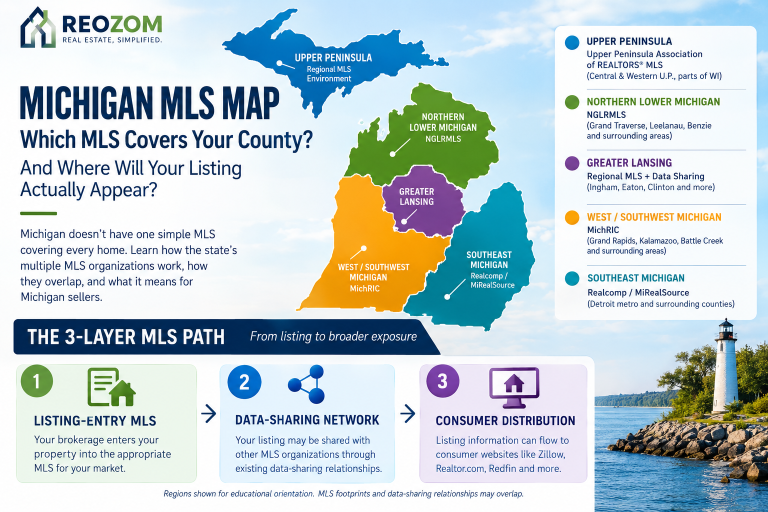
- Entered into an MLS system
- Syndicated to platforms like Zillow and Realtor.com
- Viewed by buyers searching those platforms
This distribution happens regardless of:
- The listing fee structure
- The specific intermediary involved
In other words:
👉 Exposure is standardized — but pricing is not
Case Study: Two Sellers, Same Market, Different Outcomes
Scenario:
Two homeowners in Ann Arbor list similar properties:
| Factor | Seller A | Seller B |
|---|
| Listing method | Traditional | Modern platform |
| Exposure | MLS + syndication | MLS + syndication |
| Buyer reach | Same | Same |
| Cost structure | % based | Fixed / optimized |
Outcome:
Both sellers:
- Received similar levels of buyer interest
- Were listed on the same platforms
- Reached the same audience
However:
👉 Seller A paid significantly more due to structure—not outcome
This example highlights a key point:
Cost differences are often structural—not performance-based
Why the System Persists
If inefficiencies exist, why hasn’t the system changed more rapidly?
The answer lies in behavior and incentives.
1. Familiarity Drives Decisions
For many homeowners:
- Selling a home is infrequent
- They rely on familiar processes
- They prioritize certainty over optimization
2. Risk Perception
Sellers often think:
- “If I change the approach, I might lose buyers”
- “Paying more reduces risk”
Even if the data does not support this belief.
3. Simplified Decision-Making
Traditional models:
- Package everything into one service
- Reduce decision complexity
This makes them easier to choose—even if not optimal.
The Emergence of More Efficient Models
As technology has advanced, new approaches have emerged that:
- Reduce dependency on intermediaries
- Increase transparency
- Enable direct interaction between participants
- Streamline workflows through automation
These models do not eliminate value—they reallocate it.
Case Insight: Speed vs Outcome
Data from transaction patterns shows:
- Faster response times → higher engagement
- Better communication → more offers
- Efficient workflows → quicker closings
These factors are often more impactful than:
- the structure of the listing model
Where Sellers Actually Gain Value
When sellers evaluate options, the key factors that influence outcomes are:
- Visibility (MLS distribution)
- Pricing strategy
- Responsiveness
- Buyer engagement
Not necessarily:
- the complexity of the system
A Shift Toward Efficiency and Control
Across Michigan markets, there is a gradual shift:
- Sellers are asking more questions
- Cost awareness is increasing
- Technology adoption is growing
This is particularly noticeable in:
- Detroit
- Grand Rapids
- Ann Arbor
Where digital-first approaches are gaining traction.
A More Direct Approach to Managing Listings
Modern listing platforms enable sellers to:
- Access MLS distribution
- Manage activity directly
- Track engagement in real time
- Control communication and scheduling
👉 Learn how this works:
Michigan flat fee MLS listing service
What This Means for the Future
The real estate industry is not static—it evolves based on:
- Technology
- consumer expectations
- market efficiency
The trend is clear:
👉 Toward more transparency
👉 Toward more control
👉 Toward more efficient systems
Final Thought
The question for sellers is no longer:
“Which option should I choose?”
It is:
“Which structure aligns with how real estate actually works today?”