One of the biggest misconceptions in real estate is that homeowners begin the selling process by choosing an agent.
In reality, most sellers start somewhere else entirely.
They start with questions.
Questions about:
- costs
- visibility
- timing
- market conditions
- selling options
By the time many homeowners speak with a real estate professional, they have already spent hours—or even weeks—researching their options online.
Understanding this decision process helps explain why home selling conversations are changing across Michigan.
The Traditional Seller Journey No Longer Exists
A decade ago, many homeowners followed a simple path:
- Decide to sell
- Contact an agent
- List the property
Today, the process is much less direct.
Most sellers now move through multiple research stages before making any listing decisions.
The result is what we call:
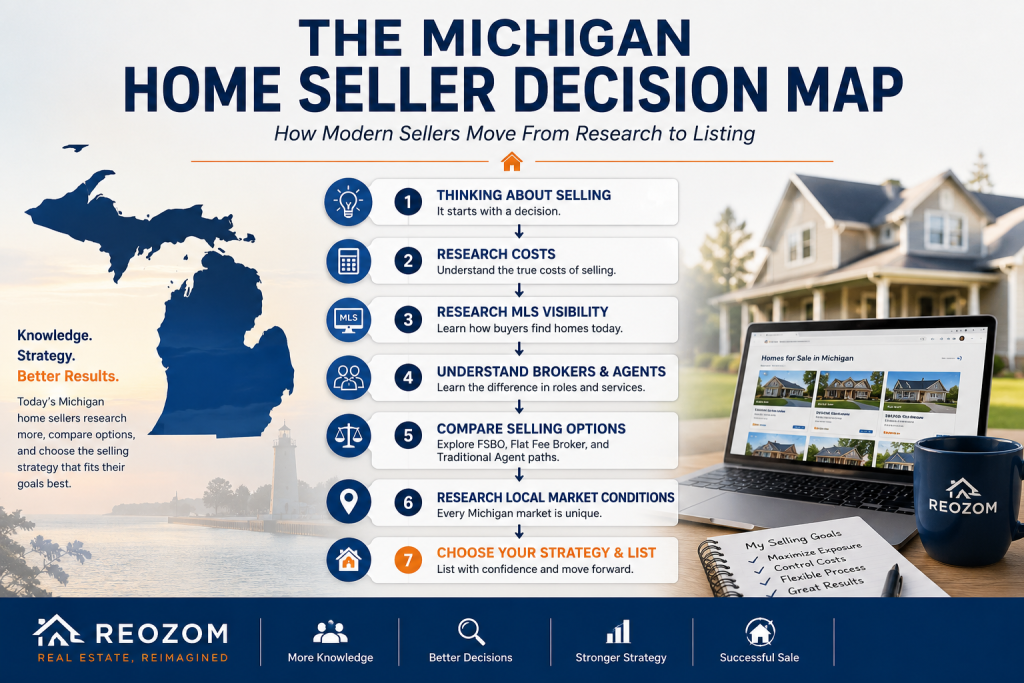
The Michigan Home Seller Decision Map.
Stage 1: Understanding the Cost of Selling
For many homeowners, the first search is not:
“Who should sell my house?”
Instead it is:
“How much does it cost to sell a house?”
This is often where awareness begins.
Sellers start learning about:
- closing costs
- commissions
- buyer agent compensation
- listing fees
- marketing expenses
The goal is simple:
Understand what the transaction may actually cost.
Stage 2: Understanding How Buyers Find Homes
Once sellers understand costs, a new question emerges:
How do buyers actually find homes today?
Most discover that the majority of buyers begin their search online.
This leads many homeowners to research:
- MLS visibility
- Zillow
- Realtor.com
- Redfin
- listing exposure
At this stage, sellers often realize that visibility matters more than many initially assumed.
Stage 3: Understanding the MLS
This is where many sellers discover that MLS access remains one of the most important parts of the selling process.
The MLS continues to power listing distribution across many major real estate platforms.
This naturally leads to questions such as:
- Can I get MLS exposure myself?
- Do I need a traditional agent?
- What is a listing broker?
- What is a flat fee broker?
Many homeowners first encounter alternative selling models during this research stage.
👉 Learn how a Michigan flat fee MLS listing service works:
https://www.reozom.com/michigan-flat-fee-mls
Stage 4: The Broker Confusion Phase
Almost every seller eventually encounters terminology that seems similar but actually means different things:
- agent
- broker
- Realtor®
- listing broker
- flat fee broker
This is often the most confusing part of the process. Many sellers discover they are not necessarily comparing individual people. They are comparing different service structures.
The question evolves from:
“Who should I hire?”
to:
“What type of selling approach fits my situation?”
Stage 5: Exploring Different Selling Paths
At this point, most sellers begin evaluating multiple approaches.
These often include:
Traditional Full-Service Listing
A more hands-off experience where many aspects of the transaction are managed by an agent.
Flat Fee Broker Models
Fixed-fee structures designed to provide MLS visibility while allowing varying levels of seller involvement.
For Sale By Owner (FSBO)
An approach where sellers maintain greater control over the process.
👉 Learn more about For Sale By Owner (FSBO):
https://www.reozom.com/fsbo-for-sale-by-owner
Stage 6: The Research-First Seller
One of the biggest changes in modern real estate is the rise of what we call:
The Research-First Seller.
These homeowners often spend considerable time researching:
- costs
- visibility
- pricing
- market conditions
- listing structures
before contacting anyone.
Industry organizations such as National Association of Realtors® continue highlighting how technology and online resources have transformed the home buying and selling process.
This trend is likely to continue.
Stage 7: Local Market Context Becomes Important
Stage 8: The Hidden Question Most Sellers Are Actually Asking
After researching brokers, MLS access, commissions, and selling options, many sellers arrive at a different question entirely.
Not:
“Which service is best?”
But:
“How do I get maximum visibility with the least unnecessary complexity?”
This is where selling strategy becomes highly personal.
Different homeowners prioritize different things:
- control
- convenience
- flexibility
- support
- efficiency
There is no universal answer.
Only the approach that best aligns with the seller’s goals.
Understanding Michigan Real Estate Requires Local Knowledge
Different Michigan markets continue evolving in different ways.
Understanding buyer behavior, visibility strategies, and local housing dynamics has become increasingly important for sellers evaluating their options.
👉 Learn more about Reozom’s experience across Michigan real estate markets:
https://www.reozom.com/about
The Michigan Home Seller Decision Map
Thinking About Selling
↓
Research Costs
↓
Research MLS Visibility
↓
Understand Brokers & Agents
↓
Compare Selling Approaches
↓
Research Local Market Conditions
↓
Choose Selling Strategy
↓
List Property
Final Thought
The modern home seller journey is no longer a straight line.
Most homeowners move through multiple stages of research before making a listing decision.
Understanding that process helps explain why conversations around:
- MLS visibility
- flat fee brokers
- listing flexibility
- FSBO options
- local market strategy
continue growing across Michigan.
The better sellers understand their options, the better positioned they are to choose an approach that aligns with their goals.
❓ FAQ SECTION
What is a flat fee broker?
A flat fee broker typically provides listing-related services for a fixed fee rather than a percentage-based commission structure.
What is a listing broker?
A listing broker represents the seller and facilitates the listing of a property on the market.
Why do sellers research MLS visibility first?
Because MLS visibility remains one of the primary ways buyers discover homes online.
Is FSBO the same as using a flat fee broker?
Not necessarily. Some FSBO sellers use flat fee MLS services to gain MLS exposure while remaining involved in the process.
Why are more Michigan sellers researching selling options online?
Technology has made it easier for homeowners to compare costs, visibility strategies, and selling approaches before contacting professionals.