THE SELLER’S MAP AND THE BUYER’S MAP ARE NOT ALWAYS THE SAME
A homeowner naturally thinks locally.
You know your municipality.
You know your subdivision.
You know the nearby roads.
You know which grocery store you use.
You know which direction you normally drive.
Your mental map might look something like:
MY HOUSE
↓
MY NEIGHBORHOOD
↓
MY CITY/TOWNSHIP
↓
MACOMB COUNTY
But a digital property search can work in almost the opposite direction.
A buyer might start:
BUDGET
↓
BEDROOMS
↓
PROPERTY TYPE
↓
FEATURES
↓
GENERAL AREA
↓
SPECIFIC HOME
That’s a fundamentally different discovery path.
And Macomb County gives us an excellent place to examine it.
WHY MACOMB MAKES THE SEARCH-RADIUS QUESTION INTERESTING
Macomb County isn’t a single housing environment.
The county includes communities with different densities, housing stocks, development patterns and relationships to Metro Detroit.
A buyer looking around Sterling Heights may also encounter properties in surrounding communities.
Someone looking farther north may compare different portions of Macomb Township, Shelby Township, Chesterfield Township or neighboring areas.
Someone prioritizing proximity to Lake St. Clair may create an entirely different geographic search.
And employment can add another layer.
Macomb County’s economic-development department identifies automotive and mobility, aerospace and defense, automation and robotics, distribution and logistics, and other sectors as important parts of the local economy. The county reported in 2026 that its automotive and mobility sector alone included 360 companies supporting more than 57,000 jobs.
Explore Macomb County’s business climate
That doesn’t mean we can predict where an individual buyer works.
We shouldn’t.
It means only that Macomb County participates in a large, interconnected regional economy.
And housing searches can reflect that interconnectedness.
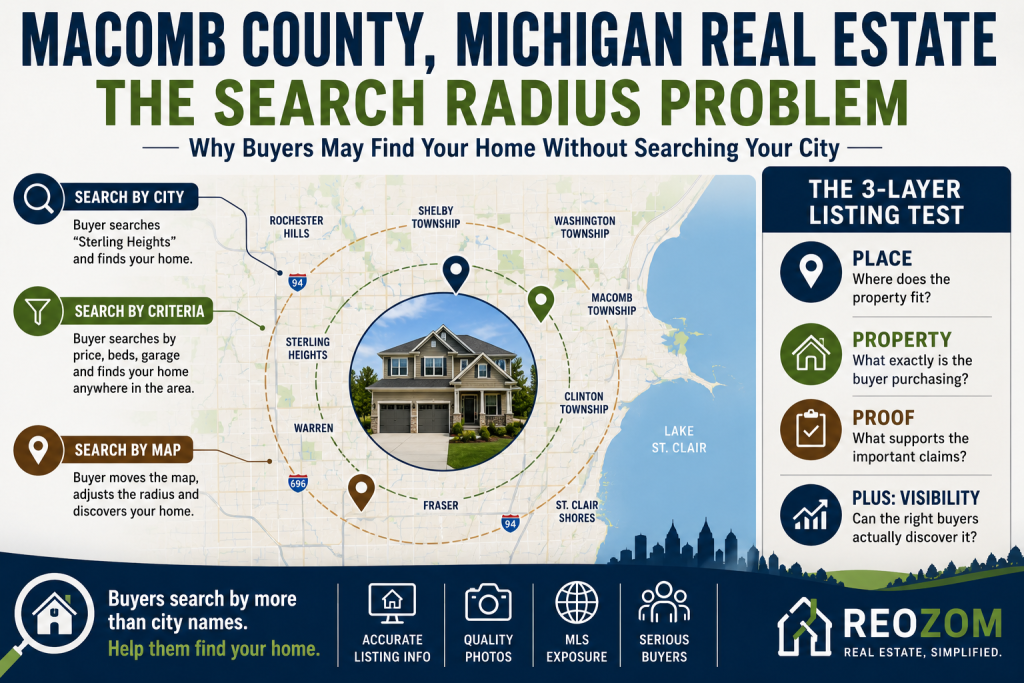
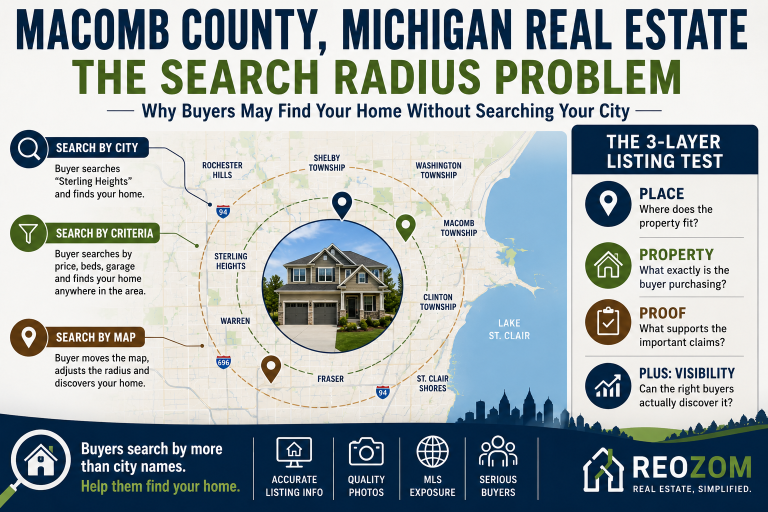
SEARCH #1: “I WANT TO LIVE IN THIS CITY”
This is the easiest buyer for a seller to understand.
Suppose the buyer searches specifically for:
Sterling Heights homes
They already know the municipality.
They’ve deliberately included it.
If your home meets the other search criteria, the geographic part is straightforward.
But that’s only one type of buyer.
SEARCH #2: “SHOW ME WHAT I CAN GET FOR THIS BUDGET”
Now remove the city.
Suppose the buyer’s first concern is price.
They establish:
Minimum bedrooms
Maximum price
Property type
General geographic area
Suddenly the search becomes more fluid.
They might discover that one community gives them one combination of:
square footage,
lot,
garage,
age,
location,
and price,
while another community gives them a different combination.
The buyer isn’t necessarily asking:
Which city do I love most?
They may be asking:
What does my budget buy me across this entire area?
That’s a different search.
SEARCH #3: “I NEED THIS FEATURE”
Now imagine the buyer doesn’t start with price or city.
They start with a feature.
Perhaps:
Attached garage
Basement
Certain bedroom count
Larger lot
Home office/flexible room
Single-story configuration
Specific property type
Depending on the search platform and available listing data, filters can substantially reshape the homes a buyer sees.
Now location is competing with property fit.
The buyer might be willing to move their imaginary boundary because a property checks more of their boxes.
SEARCH #4: THE MAP MOVER
This buyer may be particularly important to understand.
They open a map.
They zoom out.
They zoom in.
They drag it east.
Then west.
Then north.
They change the maximum price.
The available properties change.
They remove one filter.
More dots appear.
They move the map again.
This buyer isn’t necessarily loyal to a municipal boundary.
They’re exploring possibilities.
And suddenly a home they never knew existed becomes one of those possibilities.
THE 5-MILE EXPERIMENT
Here’s a simple exercise for Macomb County sellers.
This isn’t meant to represent the exact functionality of every property-search platform.
It’s a way of thinking about buyer discovery.
Imagine a circle around your property.
RADIUS A — Very Small
What does the buyer see?
Mostly your immediate area.
RADIUS B — Larger
What changes?
More housing styles?
Different price points?
Different municipalities?
RADIUS C — Broader Still
Now what competes with your property?
This exercise reveals something important:
Your competition isn’t necessarily limited to houses with the same city name in their address.
Depending on the buyer’s criteria, properties elsewhere may become alternatives.
That means sellers should understand the property not only locally, but comparatively.
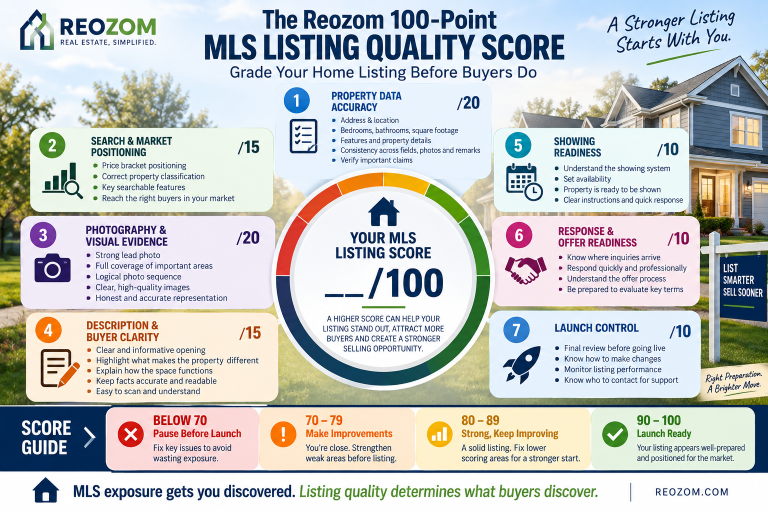
THE SEARCH-RADIUS SCORECARD
Let’s turn this into a seller exercise.
Give the property one point for each question you can answer clearly.
PROPERTY
What are the home’s strongest factual features?
PRICE
What other types of properties could a buyer encounter around the same asking price?
LOCATION
What does the property’s specific location provide?
FUNCTION
What buyer needs could the home’s layout/features potentially accommodate?
INFORMATION
Are important searchable property characteristics entered accurately?
PHOTOGRAPHY
Can buyers quickly recognize the features described?
DISCOVERY
Is the property receiving appropriate marketplace exposure for the seller’s chosen strategy?
A seller who cannot answer these questions may be thinking too narrowly about the listing.
SEARCH FILTERS CAN ONLY WORK WITH THE INFORMATION THEY RECEIVE
This is where the article shifts from buyer psychology to seller execution.
Imagine a house has a basement.
But the listing information is incomplete.
Or the garage is an important feature, but photographs barely show it.
Or an additional room provides useful flexibility, but the description never explains that the space exists.
A buyer can’t evaluate information that hasn’t been communicated clearly.
That leads to one of the most important ideas in this article:
Search visibility begins with listing accuracy.
It’s tempting to think online marketing means writing a more exciting description.
Sometimes the more important work is much less glamorous:
Enter the property information correctly.
YOUR LISTING HAS TWO AUDIENCES
Here’s another way to think about it.
A property listing communicates with:
AUDIENCE #1 — THE SEARCH SYSTEM
Structured information helps platforms organize and surface properties according to available search criteria.
Then comes:
AUDIENCE #2 — THE HUMAN
The buyer sees:
photographs,
description,
price,
property characteristics,
location,
and other available information.
The first helps with discovery.
The second helps with evaluation.
A strong listing needs to think about both.
DON’T KEYWORD-STUFF A PROPERTY DESCRIPTION
This is where SEO and real-estate listing strategy are very different.
For this article, phrases such as Macomb County Michigan real estate help search engines understand the topic of the webpage.
But that doesn’t mean a property seller should write:
Beautiful Sterling Heights Macomb County Michigan home for sale near Clinton Township Macomb Township Michigan real estate…
That’s not useful communication.
A property description should primarily help a human buyer understand the property.
Accurate structured listing information helps with property-search filtering.
The two jobs shouldn’t be confused.
MACOMB COUNTY’S OTHER MAP: WATER
There’s another reason a simple municipal map doesn’t explain Macomb County very well.
Water creates a completely different geography.
Macomb County reports approximately 32 miles of Lake St. Clair coastline, along with 32 miles of the Clinton River and more than 13,000 acres of tree-covered public space.
Lake St. Clair itself forms Macomb County’s eastern edge and creates a distinct recreational and geographic identity for that portion of the county.
Explore Lake St. Clair through Macomb County
That means one buyer’s mental map may be organized around:
roads
while another’s could be influenced by:
water access
recreation
marinas
or other location-specific priorities.
Again:
Not every buyer sees the same map.
THE “ZOOM OUT” SELLER TEST
Open your own mental map.
Now zoom out.
Instead of saying:
I have a home in [municipality].
Try completing these sentences:
My property is a ______ bedroom / ______ bathroom home.
Its most important functional features are ______.
Its strongest location characteristics are ______.
A buyer comparing homes around this price may notice ______.
The photographs clearly demonstrate ______.
The listing information accurately identifies ______.
Notice what happened?
We stopped marketing a city.
We started understanding a property within a competitive search environment.
That’s much more useful.
WHAT THIS MEANS FOR PHOTOGRAPHY
Photography should help a buyer make decisions quickly.
Suppose your strongest features include:
a large garage,
finished lower-level space,
updated kitchen,
substantial backyard,
or flexible additional room.
Don’t bury those characteristics.
A buyer who expanded their geographic search may be looking at many unfamiliar communities simultaneously.
Your photographs have an important job:
Help them understand why this dot on the map deserves a click.
WHAT THIS MEANS FOR THE FIRST PHOTO
Your first photograph isn’t merely decorative.
It is often part of the buyer’s first encounter with the property.
Ask:
Does it clearly represent the home?
Is the property visible?
Is the image current and accurate?
Does it create confusion?
Would I click it if I knew nothing about the municipality?
That last question is especially important for our Search Radius Buyer.
They may have no existing emotional connection to your city.
The property needs to communicate on its own.
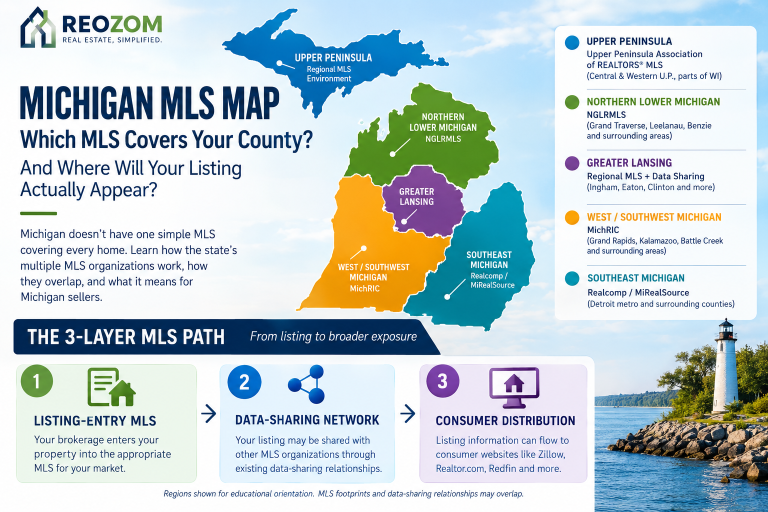
NOW MLS EXPOSURE BECOMES RELEVANT
We’ve established something important.
A buyer may not begin with your exact municipality.
They may discover properties through a combination of:
geography + price + property characteristics + search criteria.
That makes listing exposure part of the discovery process.
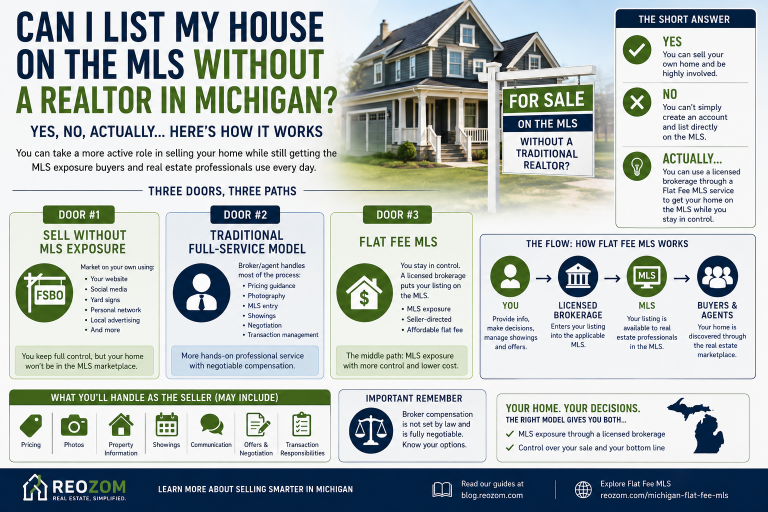
Michigan homeowners who want MLS exposure while taking a more active role in their sale can explore Reozom’s Michigan Flat Fee MLS listing options.
But exposure should not be confused with strategy.
A seller still needs:
accurate information,
appropriate pricing decisions,
good photographs,
a useful description,
responsiveness,
and an understanding of their responsibilities.
MLS exposure helps create an opportunity for discovery.
The property still has to compete after it is discovered.
THE FLAT FEE SEARCH HAS A RADIUS TOO
There’s an interesting parallel.
Buyers search for properties.
Sellers search for brokers.
And sellers can make the same mistake we’re discussing.
They may search only:
cheapest flat fee MLS
But that’s an extremely narrow search radius.
Expand the seller’s criteria.
Now ask:
Which MLS will my property enter?
How many photos are included?
Can the listing be changed?
How are inquiries handled?
What support is available?
What does the seller manage?
What costs extra?
How long does the listing remain active?
Suddenly the comparison changes.
That’s why homeowners researching a Flat Fee Broker in Michigan should compare the complete service rather than only the headline price.
Our Complete Guide to Choosing a Flat Fee Broker in Michigan provides a detailed framework for doing exactly that.
THREE SEARCHES. ONE MACOMB COUNTY HOME.
Let’s finish with an experiment.
Imagine one hypothetical Macomb County property.
3 bedrooms
2 bathrooms
attached garage
basement
fenced backyard
within the buyer’s hypothetical budget
Now introduce three buyers.
BUYER A
Searches specifically for the municipality.
They find the home because of location.
BUYER B
Searches a broader geographic area with three bedrooms, garage and a maximum price.
They find the same home because of criteria.
BUYER C
Starts elsewhere, moves the map, changes a filter and expands the geographic search.
They find the same home through exploration.
One property.
Three discovery paths.
And that’s the lesson.
Frequently Asked Questions
What is different about the Macomb County housing search?
Macomb County includes numerous communities within the broader Metro Detroit region, so buyers may compare properties across municipal boundaries depending on price, property characteristics, work/lifestyle needs and their preferred geographic area.
Why is Macomb County’s economy relevant to real estate?
Housing decisions and employment geography can interact, although individual buyers should never be stereotyped based on occupation. Macomb County identifies automotive/mobility, aerospace/defense, automation/robotics, logistics and other sectors as important parts of its business environment.
Does Macomb County have Lake St. Clair shoreline?
Yes. Macomb County reports approximately 32 miles of Lake St. Clair coastline.
Why does accurate MLS information matter?
Buyers may use price, location and property-characteristic filters when searching online. Accurate listing information helps buyers evaluate whether a property matches the criteria that matter to them.
Can Macomb County homeowners use Flat Fee MLS?
Flat Fee MLS is one possible listing approach. Sellers should compare MLS exposure, included services, support, fees and their own responsibilities. Reozom explains its Michigan Flat Fee MLS options.
How should I choose a flat fee broker in Michigan?
Don’t compare only the advertised price. Compare MLS coverage, listing term, photographs, changes, technology, inquiry handling, support, additional charges and seller responsibilities. Our Complete Guide to Choosing a Flat Fee Broker in Michigan goes deeper into those considerations.
Final Thought: Don’t Assume the Buyer Starts Where You Start
A seller starts with the house.
Then the address.
Then the municipality.
A buyer may start somewhere completely different.
A budget.
A bedroom count.
A garage.
A map.
A radius.
A feature.
And eventually—
your house.
That’s why strong digital property marketing isn’t simply about convincing people that Macomb County is a good place to live.
It’s about making sure the property is accurately represented when the right buyer’s search finally reaches it.
Because sometimes your future buyer isn’t searching for your city at all.
They’re searching for a home like yours.
Recommended Related Reading
Complete Guide to Choosing a Flat Fee Broker in Michigan — A detailed framework for comparing Michigan flat-fee brokerage options.
Michigan Flat Fee MLS — Explore Reozom’s Michigan listing options.
For Sale By Owner Resources — Resources for Michigan homeowners considering a more active role in their sale.
Michigan Home Seller Decision Map — Explore how different seller decisions fit together.